How do I lead when she doesn't follow?
6 min read
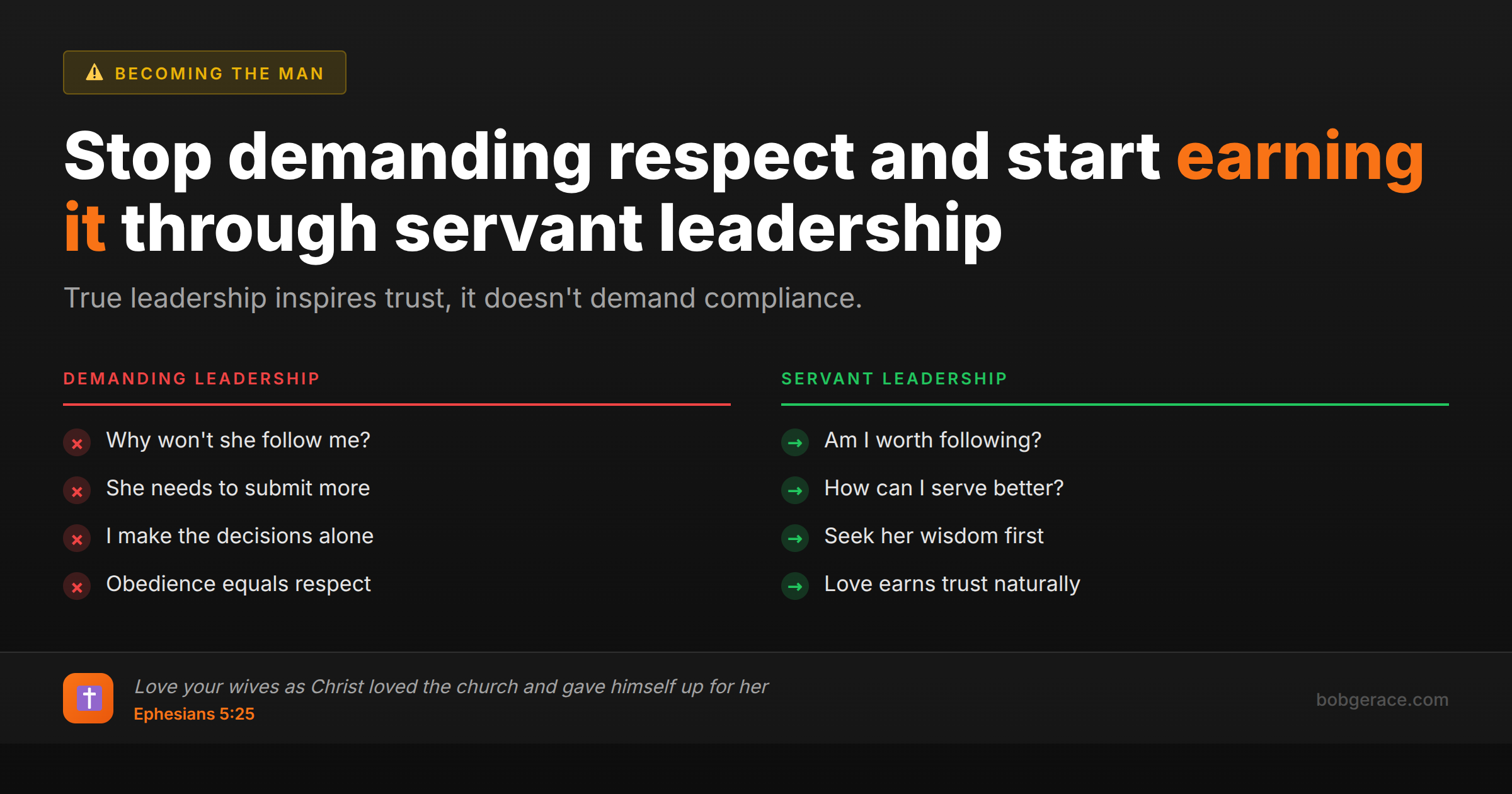
When your wife doesn't follow your lead, the first question isn't 'Why won't she follow?' but 'Am I worth following?' True leadership isn't about demanding compliance—it's about becoming the kind of man who naturally inspires trust and confidence. Most wives want to follow their husband's lead, but they need to see consistent, selfless leadership that serves their best interests, not just commands their obedience. The solution starts with examining your own leadership style. Are you leading with humility and wisdom, or are you trying to control? Are you making decisions that benefit your family, or just asserting dominance? When you focus on becoming a servant-leader who leads by example rather than demanding submission, you'll often find resistance melts away naturally.
The Full Picture
Here's what most men get wrong about leadership in marriage: they think it's about being the boss. They believe that because they're called to lead, their wife should automatically fall in line with whatever they decide. When she doesn't, they get frustrated, demanding, or withdraw entirely.
But leadership isn't about rank—it's about influence. And influence is earned, not demanded.
Think about the best leaders you've known in your life. Did they have to constantly remind people they were in charge? Did they get angry when others questioned their decisions? Probably not. The leaders worth following led through competence, character, and genuine care for those under their leadership.
Your wife's resistance might actually be telling you something important. Maybe she's seen you make impulsive decisions that hurt the family. Maybe your 'leadership' has felt more like control or selfishness. Maybe you've been inconsistent—leading strongly in some areas while completely checking out in others.
Consider this: her resistance might be protection, not rebellion. If you've led your family into financial trouble, relational conflict, or spiritual compromise, her hesitation to follow isn't defiance—it's wisdom.
The goal isn't to break down her resistance through force or manipulation. The goal is to become so trustworthy, so consistent, and so clearly focused on what's best for your family that following your lead feels safe and natural.
This requires patience. If you've damaged trust through poor leadership in the past, rebuilding that trust takes time. You can't demand it back—you have to earn it back through consistent, selfless action.
Real leadership serves those being led. When your wife sees that your decisions consistently benefit her and your family, when she sees you sacrificing your own preferences for the greater good, when she witnesses you seeking wisdom and counsel before making major decisions—that's when resistance turns into willing partnership.
What's Really Happening
From a psychological perspective, what many men interpret as defiance is often a trauma response or learned protection mechanism. When a woman doesn't 'follow' her husband's lead, she may be responding to past experiences where following authority figures led to harm, disappointment, or feeling unheard.
Research in attachment theory shows us that trust is the foundation of healthy relationship dynamics. If a woman has experienced inconsistent, self-serving, or harmful leadership—whether from her husband, father, or other authority figures—her nervous system may be wired to resist rather than trust.
The demand for compliance actually triggers deeper resistance. When men respond to their wife's hesitation with pressure, ultimatums, or anger, they're activating her fight-or-flight response. This creates a cycle where the more he demands leadership recognition, the more she pulls away.
Healthy leadership in marriage operates more like secure attachment. The leader creates safety through consistency, demonstrates care through sacrifice, and builds trust through transparency. Women are naturally inclined to partner with men who demonstrate these qualities—not because they're submissive, but because they recognize good leadership.
Consider also the cognitive load factor. Many women carry the mental load of running a household while also managing careers and relationships. If a husband's 'leadership' creates more work or stress for her without demonstrating clear benefit, resistance is a rational response.
The solution involves developing emotional intelligence, demonstrating consistent care, and creating space for her input in decision-making. True leadership involves the wisdom to know when to listen, when to act, and how to bring others along willingly rather than dragging them along reluctantly.
What Scripture Says
Scripture gives us a clear model for godly leadership, and it looks nothing like demanding compliance. Ephesians 5:25 commands husbands to "love your wives as Christ loved the church and gave himself up for her." Notice that leadership through love and sacrifice comes before any mention of submission.
1 Peter 3:7 instructs husbands to "live with your wives in an understanding way, showing honor to the woman as the weaker vessel, since they are heirs with you of the grace of life." Leadership requires understanding—really knowing your wife, her fears, her needs, her perspective.
Jesus himself modeled servant leadership. In Mark 10:43-44, He said, "Whoever wants to become great among you must be your servant, and whoever wants to be first must be slave of all." If the Son of God led through service, how much more should we?
Proverbs 27:14 warns that "whoever blesses his neighbor with a loud voice, rising early in the morning, will be counted as cursing." Even good intentions delivered poorly will be received as harmful. Your approach to leadership matters as much as your authority to lead.
The biblical model of headship is protective, not controlling. Ephesians 5:28-29 says men should love their wives "as their own bodies" because "no one ever hated his own flesh, but nourishes and cherishes it." Leadership that nourishes and cherishes doesn't have to demand following—it naturally attracts it.
Colossians 3:19 adds this crucial instruction: "Husbands, love your wives and do not be harsh with them." Harshness in leadership—whether through anger, demands, or manipulation—violates God's design for marriage. When your leadership consistently demonstrates love, protection, and wisdom, biblical submission becomes a joy rather than a burden for your wife.
What To Do Right Now
-
1
Stop demanding and start demonstrating. For the next 30 days, lead through action rather than words. Make decisions that clearly benefit your family, even when it costs you personally.
-
2
Ask for her perspective before making decisions. Leadership doesn't mean making unilateral choices. Seek her wisdom, especially in areas where she has expertise or strong feelings.
-
3
Own your past leadership failures. If you've made poor decisions or led selfishly in the past, acknowledge it specifically. Apologize and commit to change without making excuses.
-
4
Lead in the small things consistently. Take initiative in household management, planning, and daily decisions. Show that your leadership makes her life easier, not harder.
-
5
Develop your character and competence. Read, pray, seek counsel from wise men. Become the kind of person worth following by growing in wisdom, emotional maturity, and spiritual depth.
-
6
Be patient with the process. Trust is rebuilt through consistent action over time. Don't expect immediate change—focus on being faithful in leadership regardless of her response.
Related Questions
- What does masculine leadership look like?
- How do I lead without controlling?
- What's the difference between leading and dominating?
- What if my leadership was the problem?
- How do I reclaim authority I gave away?
- How do I lead when I've lost credibility?
- She won't talk about our problems
- She shuts down when I try to connect
- She doesn't respect me — what do I do?
- What if she doesn't want me to lead?
Also find Bob on
Subscribe for weekly videos on Christian marriage.
Your Marriage Isn't Generic
A coach who knows your story can see what you can't—where your leadership lands with her, what's working, what's backfiring. You don't have to keep guessing.
Talk to Bob →