She responds to me like I'm a stranger
6 min read
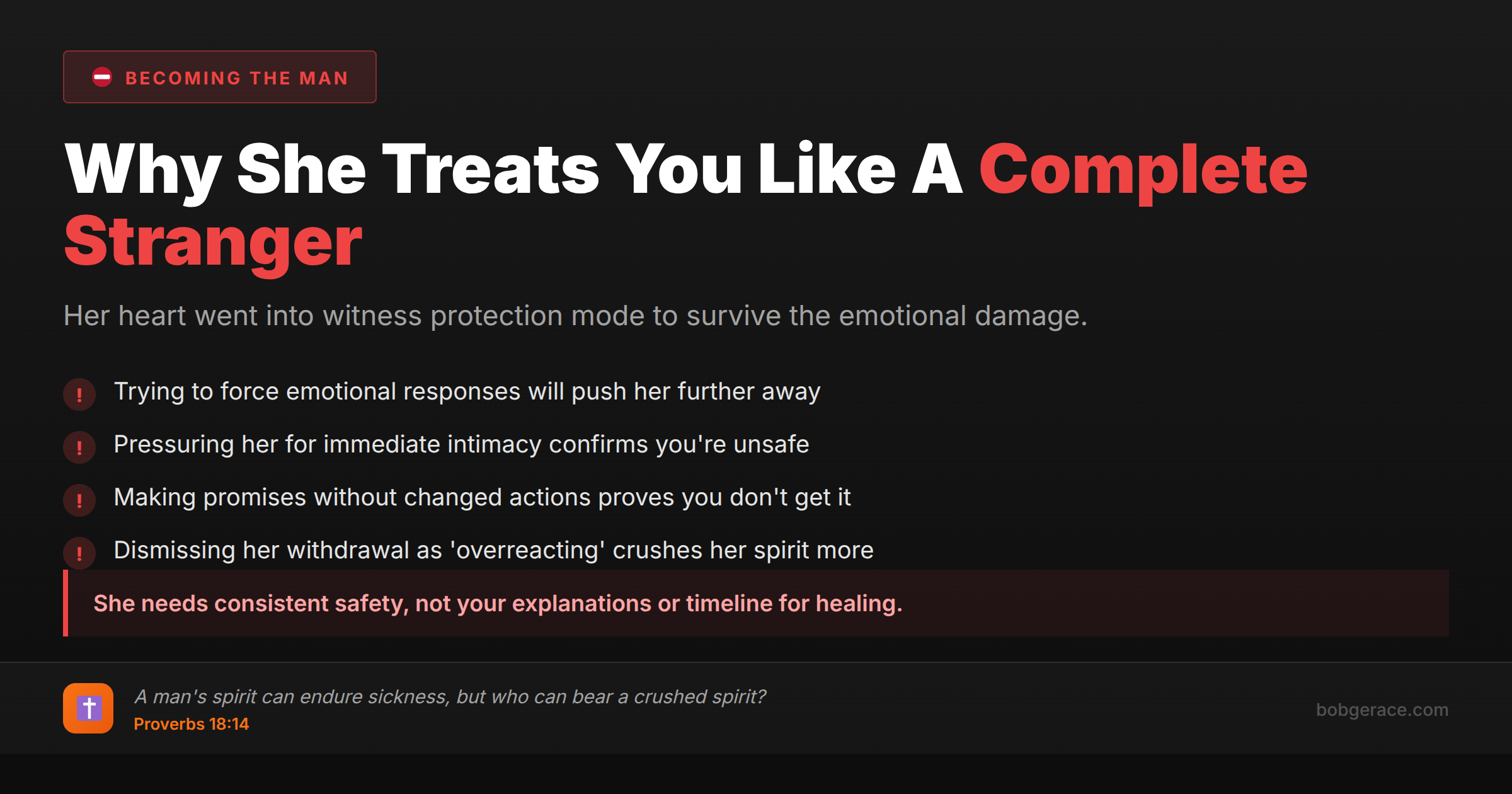
When your wife responds to you like a stranger, she's protecting herself from further emotional pain. This isn't about you becoming unrecognizable - it's about her heart building walls to survive what feels like a hostile or unsafe emotional environment. She's treating you with the same polite distance she'd give any acquaintance because intimacy feels too risky right now. This stranger-like response typically develops after repeated experiences of feeling unheard, dismissed, or emotionally unsafe. Her heart has essentially gone into witness protection mode. The woman who once shared her deepest thoughts and feelings now offers you the same surface-level pleasantries she'd give the mailman. It's devastating, but it's also her way of self-preservation.
The Full Picture
The stranger treatment is one of the most painful experiences a husband can face. The woman who once lit up when you walked in the room now responds with the emotional warmth of a bank teller. She's polite, functional, but completely detached. It feels like you're living with a roommate who happens to share your last name.
This didn't happen overnight. Your wife didn't wake up one morning and decide to treat you like a stranger. This emotional wall was built brick by brick, often over months or years of accumulated hurt, disappointment, and feeling emotionally unsafe.
She's not being dramatic or manipulative. This is a genuine protective response. When someone feels repeatedly hurt or dismissed by their closest companion, their brain literally rewires to treat that person as emotionally dangerous. The intimate access she once gave you has been revoked for her own emotional survival.
The stranger treatment serves a purpose. It keeps her functional while protecting her heart. She can still manage the household, parent the children, and maintain the marriage structure, but without the vulnerability that led to her pain. It's like emotional anesthesia - it numbs the pain but also numbs the connection.
You're grieving the loss of intimacy. What you're experiencing is a form of grief. The emotional intimacy you once shared feels dead, and you're left wondering how to resurrect something that seems completely gone. The woman you married is physically present but emotionally absent, and that creates a unique kind of loneliness that's hard to explain to others.
What's Really Happening
From a clinical perspective, this stranger-like behavior represents what we call "emotional detachment" or "protective dissociation." Your wife's nervous system has categorized you as emotionally unsafe, triggering a protective response that prioritizes emotional survival over connection.
Neurologically, her brain has rewired itself. The neural pathways that once associated you with safety, love, and intimacy have been damaged by repeated negative experiences. Her brain now activates the same response systems it would use with an actual stranger - polite but guarded, functional but not vulnerable.
This is often accompanied by hypervigilance. She's constantly scanning for signs of dismissal, criticism, or emotional danger. What seems like normal conversation to you might feel like walking through a minefield to her. This heightened alertness exhausts her emotional resources and reinforces the need for protective distance.
The stranger treatment isn't conscious revenge. Many husbands interpret this behavior as intentional punishment, but it's typically an unconscious protective mechanism. She's not strategically withholding affection - she's genuinely unable to access those vulnerable feelings while her nervous system perceives threat.
Recovery requires consistent safety over time. Just as this response developed gradually, healing happens gradually too. Her nervous system needs repeated evidence that emotional vulnerability won't result in pain before it will lower these protective barriers.
What Scripture Says
Scripture gives us profound insight into the heart's need for safety and the devastating impact of wounds within marriage. Proverbs 18:14 reminds us that "A man's spirit can endure sickness, but who can bear a crushed spirit?" Your wife's spirit has been crushed, and she's protecting what remains.
Ephesians 5:29 teaches that husbands should nourish and cherish their wives as their own bodies. The word "nourish" (ektrepho) means to nurture to maturity, while "cherish" (thalpo) means to warm and comfort. When a wife treats her husband like a stranger, it often indicates she hasn't felt nourished or cherished in these biblical ways.
1 Peter 3:7 instructs husbands to live with their wives "according to knowledge," showing honor "as to the weaker vessel." The phrase "according to knowledge" means understanding her unique emotional needs and responding appropriately. The stranger treatment suggests this understanding has been missing.
Proverbs 27:5-6 tells us that "Open rebuke is better than love carefully concealed. Faithful are the wounds of a friend, but the kisses of an enemy are deceitful." Sometimes the most loving thing is honest confrontation about patterns that are destroying intimacy.
Isaiah 61:3 promises God will give "beauty for ashes, the oil of joy for mourning, the garment of praise for the spirit of heaviness." Your marriage isn't beyond redemption. God specializes in resurrection, including the resurrection of emotional intimacy that seems dead.
Hosea's entire story demonstrates God's persistent love for an emotionally distant spousee. Just as God pursued Israel despite her unfaithfulness, you're called to pursue your wife's heart with patient, consistent love, even when she responds like a stranger.
What To Do Right Now
-
1
Stop trying to force emotional responses and accept where she is right now
-
2
Examine your own patterns - what behaviors might have contributed to her emotional withdrawal
-
3
Create consistent safety through predictable, gentle responses to her attempts at communication
-
4
Demonstrate change through actions rather than promises or explanations
-
5
Give her space to process without pressuring her for immediate emotional availability
-
6
Seek professional help to understand and address the underlying dynamics that created this distance
Related Questions
- She's indifferent — not angry, just empty
- Nothing I do seems to matter to her
- She's physically present but emotionally gone
- She lights up for everyone but me
- She seems happier when I'm not around
- She stopped fighting — is that worse?
- What is 'emotional disengagement'?
- What is 'deactivation' and did I cause it?
- What happened to her attachment to me?
- Why does she seem numb/flat/dead inside?
Also find Bob on
Subscribe for weekly videos on Christian marriage.
Your Marriage Needs More Than a Framework
When she's this shut down, generic advice won't cut it. A coach who knows your specific story can help you rebuild safety without making it worse.
Talk to Bob →