What does effective accountability require?
6 min read
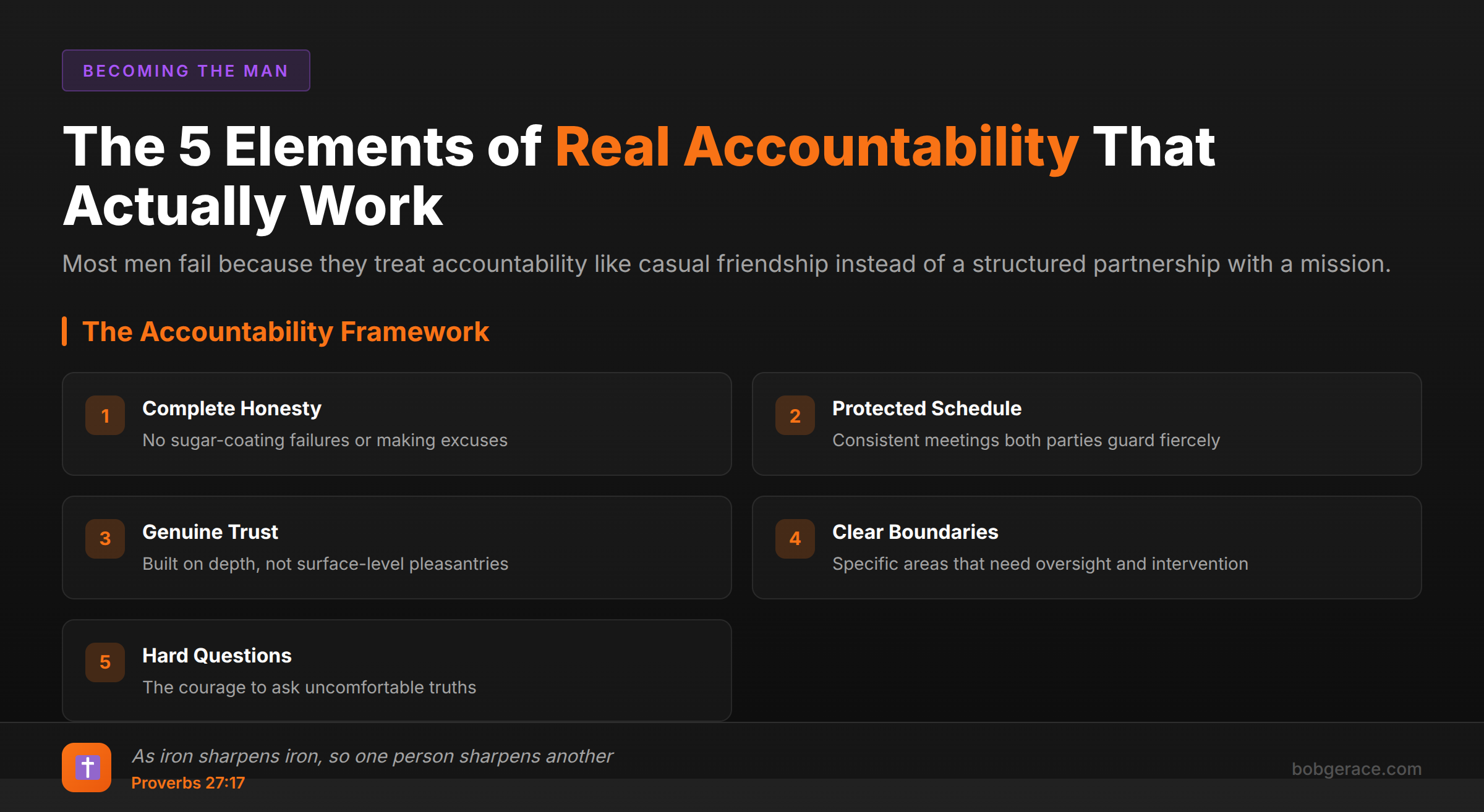
Effective accountability requires five non-negotiable elements: complete honesty without sugar-coating your failures, consistent meeting schedules that both parties protect fiercely, a relationship built on genuine trust rather than surface-level pleasantries, clear boundaries about what areas need oversight, and the courage to ask hard questions even when it's uncomfortable. Most men fail at accountability because they treat it like a casual friendship instead of a structured partnership with a mission. Real accountability isn't about finding someone to make you feel better about your mistakes - it's about finding a brother who loves you enough to call you higher and hold you to the standard you've committed to reach.
The Full Picture
Accountability isn't friendship - it's partnership with a purpose. Too many men confuse accountability with having a buddy to vent to. Real accountability is a structured relationship designed to help you become the man God called you to be, especially when you don't feel like it.
The foundation is brutal honesty. If you're not willing to tell your accountability partner about your actual struggles - the porn, the anger outbursts, the way you shut down your wife, the financial decisions you're hiding - then you're just playing games. Half-truths create half-results.
Consistency beats intensity every time. Meeting once a month for three hours is less effective than meeting weekly for thirty minutes. Your brain needs regular checkpoints, not dramatic interventions. The enemy works through isolation and time gaps.
Questions must have teeth. "How are you doing?" isn't accountability - it's small talk. Effective accountability requires specific questions: "How many times did you look at pornography this week? What triggered your anger toward your wife on Tuesday? What specific steps did you take to lead your family spiritually?"
Both men must be equally invested. One-way accountability creates an unhealthy dynamic. Both partners need areas where they're being challenged and supported. This isn't counseling - it's mutual sharpening.
There must be agreed-upon consequences. Without stakes, accountability becomes suggestion. Whether it's financial consequences, service commitments, or losing privileges, there must be real cost for breaking commitments.
What's Really Happening
From a clinical perspective, effective accountability works because it addresses three core psychological needs that drive lasting behavior change: external structure, social connection, and cognitive accountability.
Most men struggle with what we call 'internal regulation' - the ability to consistently make good choices when no one is watching. This isn't a moral failing; it's how our brains work. The prefrontal cortex, responsible for executive decision-making, gets fatigued throughout the day. When we're tired, stressed, or emotionally triggered, we default to old patterns.
Accountability provides external structure that compensates for this limitation. Knowing someone will ask specific questions about specific behaviors creates what psychologists call 'implementation intentions' - pre-planned responses to challenging situations.
The social connection element addresses our fundamental need for belonging. Men often struggle in isolation, but shame keeps them from seeking help. A structured accountability relationship provides safety within boundaries - you can be vulnerable without the relationship becoming codependent or overly emotional.
Cognitive accountability works through what we call 'prospective monitoring' - when you know you'll need to report on your behavior, your brain naturally becomes more aware of choices in real-time. This increased self-awareness is the first step toward sustainable change.
The key is that all three elements must be present. Structure without connection becomes legalistic. Connection without accountability becomes enabling. Accountability without structure becomes inconsistent and eventually ineffective.
What Scripture Says
Scripture is clear that we weren't designed to walk alone. Proverbs 27:17 tells us, "As iron sharpens iron, so one person sharpens another." This isn't gentle encouragement - iron sharpening iron involves friction, heat, and pressure. Real accountability requires the willingness to create and endure that friction for the sake of growth.
Ecclesiastes 4:12 reminds us that "though one may be overpowered, two can defend themselves. A cord of three strands is not quickly broken." Your accountability relationship isn't just about moral support - it's about spiritual warfare. The enemy attacks isolated men. When you're in genuine accountability, you're no longer fighting alone.
Galatians 6:1-2 gives us the model: "Brothers and sisters, if someone is caught in a sin, you who live by the Spirit should restore that person gently. But watch yourselves, or you also may be tempted. Carry each other's burdens, and in this way you will fulfill the law of Christ." Notice the balance - restoration must be gentle, but it must also be direct enough to actually restore.
James 5:16 commands us to "confess your sins to each other and pray for each other so that you may be healed." Healing requires confession, not just to God, but to another person. There's something powerful about speaking your struggles out loud to a brother who can pray with you and for you.
Proverbs 19:20 instructs us to "listen to advice and accept discipline, and at the end you will be counted among the wise." Effective accountability requires humility - the willingness to receive correction and act on it, even when your flesh resists.
What To Do Right Now
-
1
Identify one man in your life who demonstrates the character you want to develop and who won't let you stay comfortable in mediocrity
-
2
Schedule a conversation to discuss entering into a formal accountability relationship with specific commitments and expectations
-
3
Create a list of 5-7 specific questions you want to be asked weekly about your areas of struggle and growth
-
4
Establish a consistent meeting schedule (same day, same time, same duration) and protect it like a business appointment
-
5
Define clear consequences for breaking commitments or being dishonest, and give your partner permission to enforce them
-
6
Begin each meeting with prayer and end with specific commitments for the week ahead, writing them down for review
Related Questions
- What is accountability and what isn't it?
- What's the difference between confession and reporting?
- What makes accountability relationships work?
- What is 'performative accountability'?
- How do I find men I can be real with?
- What role does group play vs. one-on-one?
- What boundaries should I set?
- What are markers of genuine remorse vs. guilt?
- What does rebuilding trust require from her?
Also find Bob on
Subscribe for weekly videos on Christian marriage.
Accountability That Fits Your Marriage
Generic accountability misses what's actually breaking down in your specific situation. A coach who knows your story can see what you can't.
Talk to Bob →