What does 'in love' even mean?
6 min read
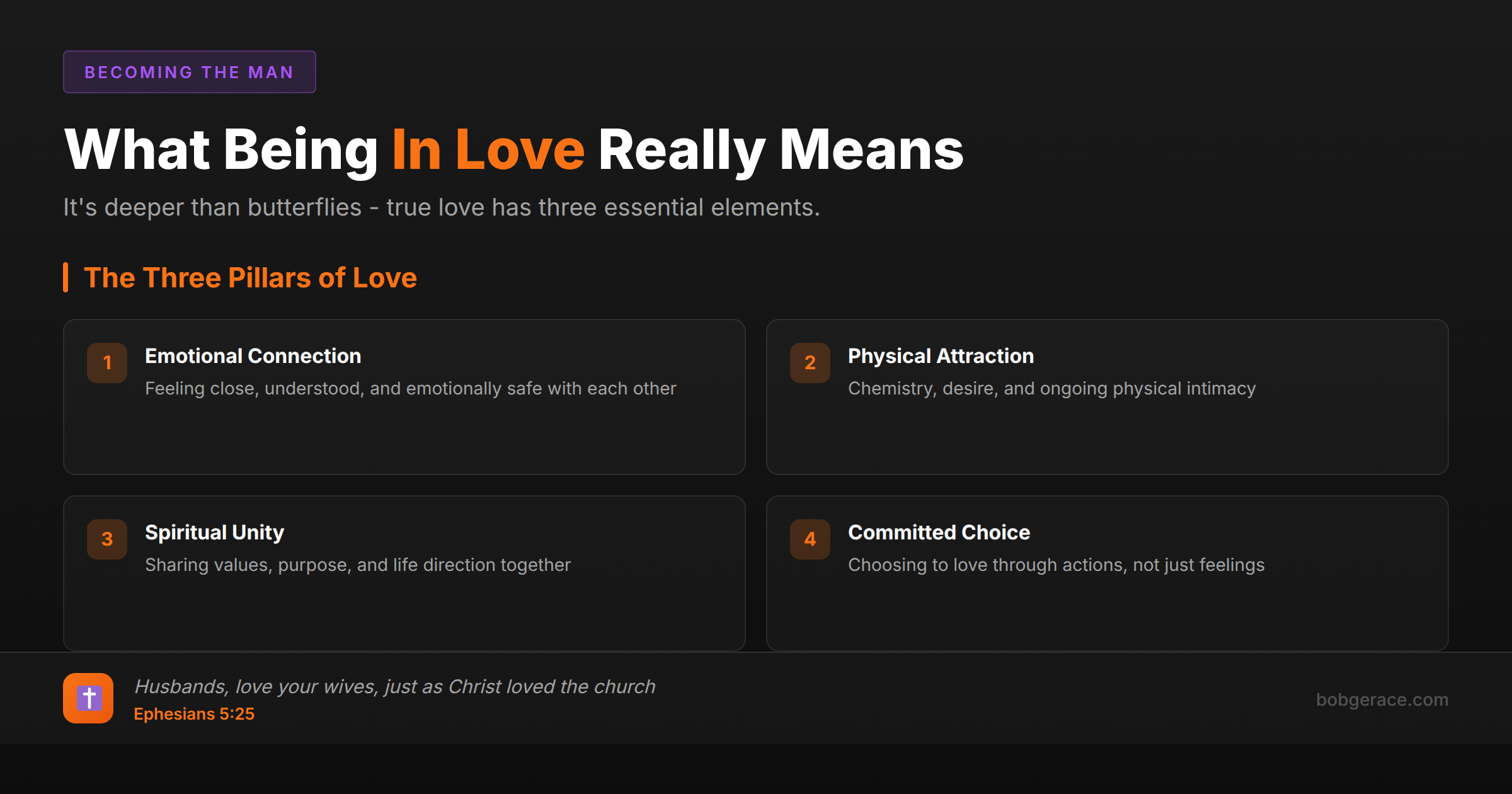
Being 'in love' is often confused with the butterflies and excitement of new attraction, but it's actually much deeper than that. True 'in love' combines three elements: emotional connection (feeling close and understood), physical attraction (chemistry and desire), and spiritual unity (sharing values and purpose together). The confusion comes because many people think being 'in love' is just about feelings, but lasting love requires choice and commitment alongside emotion. When your wife says she's not 'in love' anymore, she's usually saying the emotional connection has been damaged or neglected. The good news? This can be rebuilt when both people are willing to do the work.
The Full Picture
Let's cut through the Hollywood nonsense and get real about what being 'in love' actually means. Most people think it's just butterflies and passion, but that's only scratching the surface.
True 'in love' has three components:
Emotional intimacy - This is feeling deeply connected, understood, and safe with your spouse. It's when you can share your real thoughts and fears without judgment. It's feeling like your spouse 'gets' you and genuinely cares about your inner world.
Physical attraction - Yes, chemistry matters. This isn't just about looks - it's about desire, affection, and wanting to be physically close. It includes everything from holding hands to sexual intimacy.
Spiritual connection - This is sharing values, dreams, and purpose together. It's feeling like you're on the same team, working toward common goals, and that your lives are truly intertwined.
When all three are present, you feel 'in love.' When one or more is missing, that feeling fades.
Here's what most people get wrong: They think being 'in love' is purely emotional and happens *to* you. But mature love is also a choice you make *with* someone. The feelings follow the actions and decisions to love well.
When your spouse says they're not 'in love' anymore, they're not necessarily saying it's over. They're often saying one of these three areas has been neglected and needs attention. The emotional connection is usually the first to go, followed by physical attraction, while spiritual connection might hang on longer.
The tragedy is that many couples throw in the towel when the feelings fade, not realizing that rebuilding 'in love' is absolutely possible with the right approach and commitment from both people.
What's Really Happening
From a clinical perspective, being 'in love' involves specific neurochemical and psychological processes that we can actually measure and understand. The initial 'falling in love' phase floods the brain with dopamine, norepinephrine, and phenylethylamine - creating that euphoric, obsessive feeling that typically lasts 12-18 months.
But sustainable 'in love' feelings require different brain chemistry - primarily oxytocin and vasopressin, which are produced through consistent positive interactions, physical touch, shared experiences, and emotional attunement. This is why couples who stop investing in their relationship often report feeling like 'roommates' - they've literally stopped producing the bonding chemicals.
When someone says they're not 'in love' anymore, they're often experiencing what we call 'emotional flooding' or 'negative sentiment override.' Their nervous system has become conditioned to expect conflict or disappointment from their partner, making it neurologically difficult to access loving feelings, even when their spouse is being kind.
The hopeful news is that these neural pathways can be rebuilt through consistent positive experiences over time. Research shows that couples can literally rewire their brains for love through intentional practices like gratitude exercises, physical affection, novel shared activities, and learning to manage conflict constructively.
However, this process requires both partners to be willing participants. One person cannot restore the 'in love' feelings alone - it takes mutual effort to rebuild the emotional safety and positive associations that create lasting romantic connection.
What Scripture Says
Scripture gives us the clearest picture of what real love looks like, and it's both deeper and more practical than our culture's version of being 'in love.'
Love is a choice and action, not just a feeling: *"Husbands, love your wives, just as Christ loved the church and gave himself up for her"* (Ephesians 5:25). Notice it's a command, not a suggestion based on how you feel.
True love seeks the other's good: *"Love is patient, love is kind. It does not envy, it does not boast, it is not proud. It does not dishonor others, it is not self-seeking, it is not easily angered, it keeps no record of wrongs"* (1 Corinthians 13:4-5). This describes character and choice, not just emotion.
Love requires commitment through difficult times: *"Above all, love each other deeply, because love covers over a multitude of sins"* (1 Peter 4:8). Real love doesn't bail when things get hard.
Physical and emotional intimacy matter: *"Let him kiss me with the kisses of his mouth—for your love is more delightful than wine"* (Song of Songs 1:2). God celebrates the passionate, romantic aspect of marriage too.
Unity creates lasting connection: *"That is why a man leaves his father and mother and is united to his wife, and they become one flesh"* (Genesis 2:24). True 'in love' involves becoming genuinely united in all areas of life.
Love can be rekindled: *"Yet I hold this against you: You have forsaken the love you had at first. Consider how far you have fallen! Repent and do the things you did at first"* (Revelation 2:4-5). Even when love grows cold, it can be restored through returning to loving actions.
What To Do Right Now
-
1
Assess all three areas - Rate your marriage 1-10 on emotional intimacy, physical attraction, and spiritual connection to identify what needs the most attention
-
2
Start with emotional safety - Focus on becoming a safe person to talk to by listening without getting defensive, critical, or trying to fix everything
-
3
Rebuild positive experiences - Plan weekly activities you both enjoy, have meaningful conversations, and create new positive memories together
-
4
Increase physical affection - Start with non-sexual touch like hand-holding, hugs, and sitting close together to rebuild physical connection
-
5
Address the real issues - Have honest conversations about what's broken the emotional connection and commit to specific changes
-
6
Get professional help - If you can't make progress alone, find a qualified Christian marriage counselor who understands how to rebuild emotional intimacy
Related Questions
- She says she loves me but isn't 'in love'
- What is limerence?
- Is she in love or in limerence?
- What does 'I love you but I'm not in love with you' really mean?
- What is 'responsive desire' vs. 'spontaneous desire'?
- What does she need to hear that I haven't said?
- What does 'I love you but I'm not in love with you' really mean?
- What is 'negative sentiment override' and does she have it?
- How long does limerence last?
- What is the neuroscience of limerence?
Also find Bob on
Subscribe for weekly videos on Christian marriage.
Your Marriage Isn't a Textbook Case
Rebuilding connection in your specific situation requires someone who knows your story, not just the theory. Bob works with men one-on-one to calibrate the work to where your marriage actually is.
Talk to Bob →