What does my pattern protect me from?
6 min read
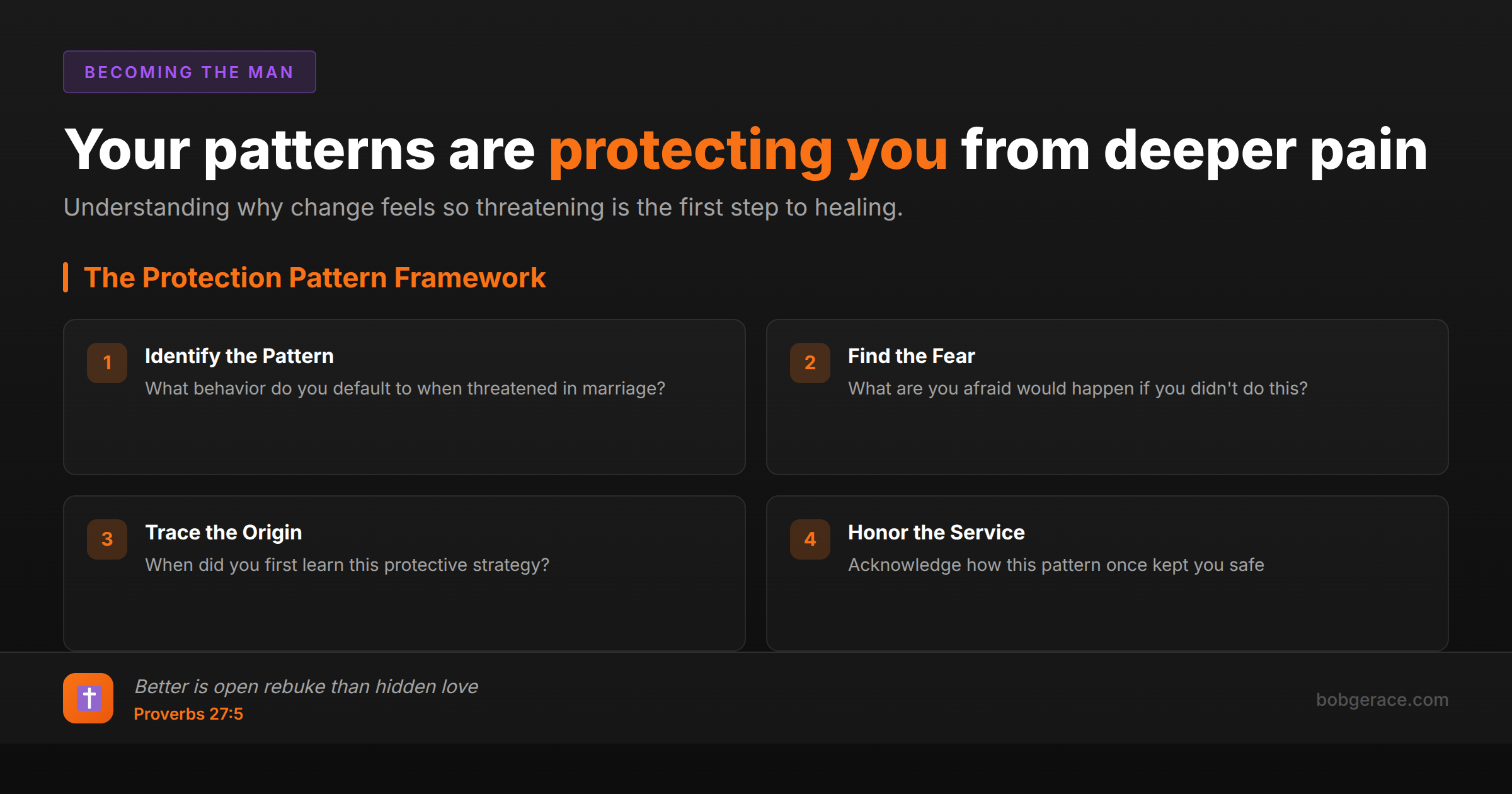
Your destructive patterns aren't random—they're sophisticated defense systems protecting you from deeper pain. Whether it's withdrawing to avoid rejection, picking fights to maintain distance, or people-pleasing to prevent abandonment, these behaviors once served a vital purpose. They likely developed in childhood or past relationships as survival mechanisms when you genuinely needed protection. The pattern that's now damaging your marriage probably shields you from core fears like being truly seen and found lacking, experiencing overwhelming vulnerability, or reliving past trauma. Understanding this protective function isn't about excusing harmful behavior—it's about recognizing why change feels so threatening and approaching healing with both courage and compassion.
The Full Picture
Here's what most people miss: your destructive pattern isn't your enemy—it's a bodyguard that's overstayed its welcome. Every behavior that's currently wreaking havoc in your marriage once served a crucial protective function. The problem isn't that you developed these defenses; it's that they're still running the show when the original threat is long gone.
Think about it this way. If you constantly withdraw when conflict arises, you're probably protecting yourself from feeling overwhelmed, criticized, or emotionally flooded. If you blow up in anger, you might be protecting against feeling powerless or dismissed. If you people-please until you're exhausted, you're likely guarding against abandonment or disapproval.
These patterns typically protect against five core vulnerabilities: the fear of being truly known and rejected, the terror of complete powerlessness, the pain of abandonment or loss, the overwhelming nature of big emotions, and the replay of past trauma or deep wounds.
The tricky part is that these defenses often create the very thing they're trying to prevent. Withdrawing to avoid criticism creates distance that feels like rejection to your spouse. Anger meant to establish power often pushes people away. People-pleasing that's supposed to secure love often breeds resentment and inauthenticity.
Your pattern became automatic because it worked—at least initially. A child who learned to be perfect to avoid a parent's rage, an adult who built walls after betrayal, or someone who learned to fight rather than be vulnerable—these responses made sense given the circumstances. They kept you psychologically or emotionally safe when you needed safety most.
Recognizing what your pattern protects you from isn't about finding excuses or staying stuck. It's about understanding why change feels so dangerous and approaching your growth with the wisdom that lasting transformation requires addressing both the behavior and the underlying fear it's guarding against.
What's Really Happening
From a clinical standpoint, what we're discussing is the protective function of maladaptive behaviors—a cornerstone concept in understanding why people persist in patterns that clearly aren't working. These behaviors represent adaptive responses to past circumstances that have become rigidly maintained even when the context has completely changed.
Neurologically, these protective patterns become deeply embedded in our limbic system, operating below conscious awareness. When your brain perceives a threat—real or imagined—it automatically activates the familiar response pattern because it's been reinforced through repetition. This is why simply deciding to change often isn't enough; the threat-detection system is still online and functioning.
Attachment theory provides another crucial lens here. If someone's early attachment experiences involved inconsistency, rejection, or trauma, their adult relationships will likely trigger those same defensive strategies. An avoidant attachment style protects against the pain of unmet needs by minimizing dependence. An anxious attachment style protects against abandonment by maximizing connection-seeking behaviors, even when those behaviors push partners away.
What's particularly important to understand is that these patterns often involve what we call 'developmental arrests'—parts of us that stopped growing emotionally at the point of wounding. That angry, defensive part might be protecting a hurt child within. The people-pleasing pattern might be safeguarding someone who learned early that their authentic self wasn't acceptable.
Effective change requires what we call 'earned security'—consciously developing the capacity to tolerate the emotions and experiences our patterns have been protecting us from. This means gradually building distress tolerance, developing self-compassion, and creating new neural pathways through repeated experiences of safety in relationship. The goal isn't to eliminate protection entirely, but to update our threat-detection system to match current reality.
What Scripture Says
Scripture acknowledges that we all develop protective mechanisms, but it also calls us toward the courage and healing that make true intimacy possible. Proverbs 27:5-6 reminds us, *'Better is open rebuke than hidden love. Wounds from a friend can be trusted, but an enemy multiplies kisses.'* Sometimes our patterns protect us from the very honesty and vulnerability that could lead to deeper connection.
Psalm 139:23-24 gives us a framework for this kind of self-examination: *'Search me, God, and know my heart; test me and know my anxious thoughts. See if there is any offensive way in me, and lead me in the way everlasting.'* This isn't about self-condemnation, but about inviting God into the hidden places where our protective patterns were born.
The story of the woman at the well in John 4 shows us how Jesus responds to our protective strategies. Rather than condemning her pattern of serial relationships—likely a protection against true intimacy or vulnerability—He offered her living water that would satisfy her deepest thirst. He saw through her defenses to her genuine need.
2 Corinthians 12:9-10 speaks directly to this: *'But he said to me, "My grace is sufficient for you, for my power is made perfect in weakness." Therefore I will boast all the more gladly about my weaknesses, so that Christ's power may rest on me.'* Our patterns often protect us from acknowledging our weaknesses, but God's strength is revealed when we stop hiding behind our defenses.
1 John 4:18 addresses the root of many protective patterns: *'There is no fear in love. But perfect love drives out fear, because fear has to do with punishment. The one who fears is not made perfect in love.'* Many of our patterns protect us from various forms of fear, but God's love provides the security that makes those defenses unnecessary.
The goal isn't to become defenseless, but to find our ultimate security in God's unchanging love rather than in our own protective strategies.
What To Do Right Now
-
1
Identify your primary protective pattern - write down the behavior you default to when feeling threatened or vulnerable in your marriage
-
2
Trace the fear - ask yourself 'What am I afraid would happen if I didn't do this?' Keep asking until you hit the core fear
-
3
Find the origin story - consider when you first learned this protective strategy and what circumstances made it necessary
-
4
Acknowledge the pattern's service - write a brief 'thank you note' to your pattern for how it has protected you
-
5
Assess current reality - evaluate whether the original threat still exists in your current marriage relationship
-
6
Take one small risk - choose one low-stakes situation to respond differently, allowing yourself to feel the protective fear without automatically engaging the pattern
Related Questions
- What is 'repetition compulsion'?
- What is 'secondary gain' from destructive behavior?
- What would I have to face if I actually changed?
- What is self-sabotage serving?
- What is the 'inner critic' and why does it sabotage?
- What parts of me resist change?
- What role did my childhood play in my anger patterns?
- What attachment injuries did I experience?
- What's underneath the anger — fear, shame, hurt?
Also find Bob on
Subscribe for weekly videos on Christian marriage.
Your Pattern Has a Name in Your Marriage
A coach who knows your specific story can see what you're protecting yourself from—and help you build something safer than the pattern that's costing you your wife.
Talk to Bob →