What does protecting and providing mean today?
6 min read
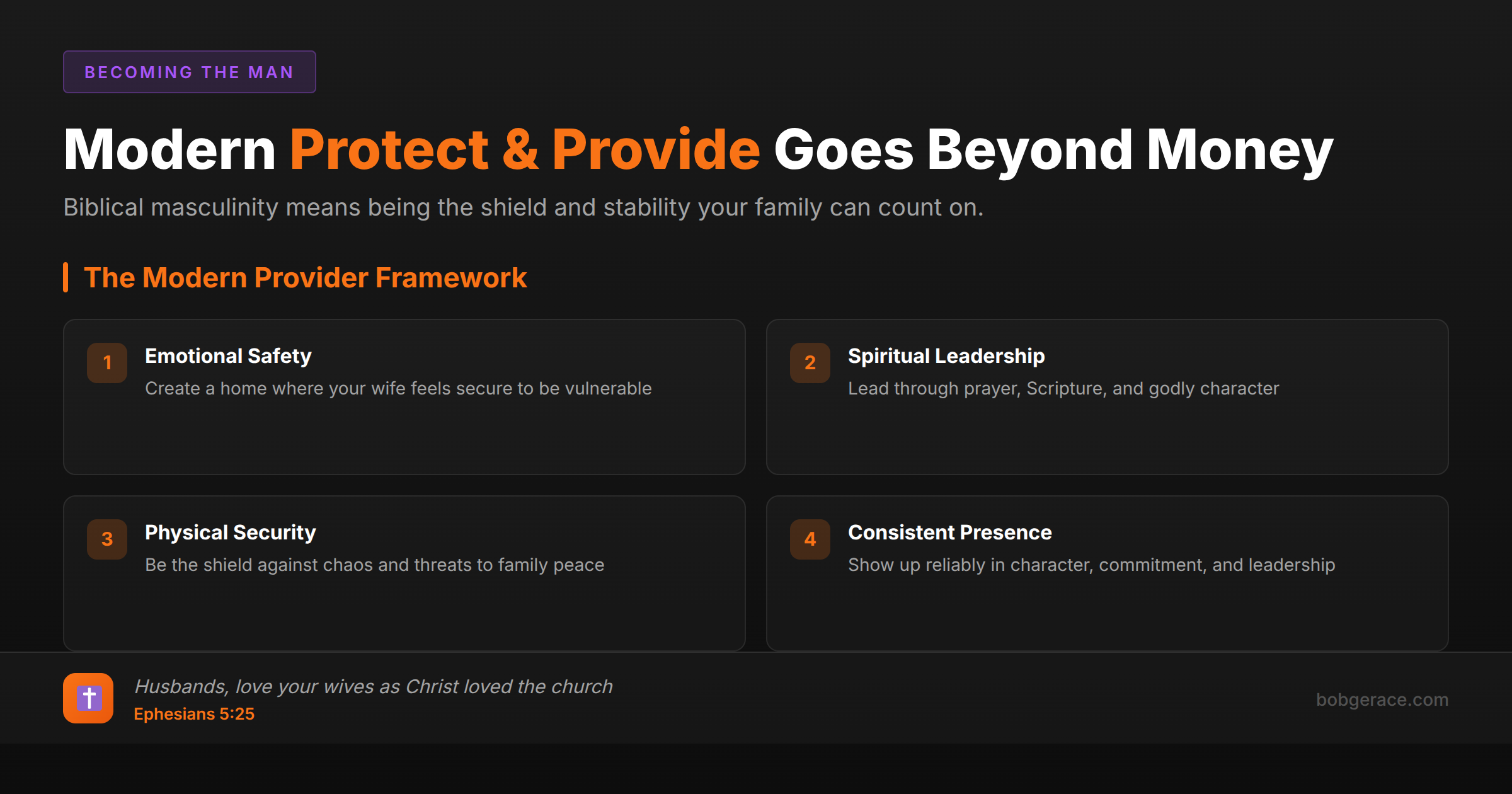
Protecting and providing in today's marriages goes far beyond the traditional breadwinner model. Biblical protection means creating emotional safety, spiritual leadership, and physical security for your family. It's about being a shield against chaos, negativity, and anything that threatens your wife's peace and your family's wellbeing. Providing isn't just about money—though financial responsibility matters. It's about providing emotional stability, spiritual direction, and consistent presence. In our dual-income world, this means being the rock your family can count on, whether that's through your career, your character, or your commitment to lead your household well.
The Full Picture
Let's get something straight: the world has confused men about what it means to protect and provide. Some guys think it's outdated. Others think it means controlling every dollar and decision. Both are dead wrong.
Protection in the modern context means:
- Emotional protection: You're the thermostat, not the thermometer. When life gets chaotic, you stay calm and lead through it - Spiritual protection: You're praying for your family, leading devotions, and making sure your home reflects God's values - Physical protection: Yes, you'd defend your family if needed, but more often it's about making sure they feel safe and secure - Relational protection: You don't let anyone—including extended family—disrespect or harm your wife and kids
Providing today looks like:
- Financial stewardship: Whether you're the sole earner or part of a dual-income household, you're actively involved in ensuring financial stability - Emotional provision: Your family gets your best energy, not your leftovers after work - Spiritual provision: You're not just attending church, you're actively shepherding your family's spiritual growth - Presence provision: You show up consistently, reliably, and fully engaged
Here's what's changed: your wife might out-earn you, and that's fine. What hasn't changed: your responsibility to ensure your family is protected and provided for, whether that's through your income, your partnership, or your leadership in managing what God has given you both.
What's Really Happening
I see men struggling with this constantly in my practice. They've been told that traditional masculine roles are toxic, but they still feel a deep, God-given drive to protect and provide. This creates internal conflict and marital tension.
Research shows that men derive significant meaning and identity from their ability to contribute to their family's wellbeing. When this drive is suppressed or misunderstood, it often leads to depression, anxiety, and relational disconnection. The key is channeling this drive appropriately.
What I observe in healthy marriages: men who understand that protection and provision are about service, not control. They're not threatened by their wife's success or independence. Instead, they see themselves as partners in ensuring the family thrives.
The clinical reality is that families still need someone to take ultimate responsibility for their wellbeing. In biblical marriages, this falls to the husband—not as a dictator, but as a servant-leader who ensures nothing falls through the cracks. This might mean he's the primary earner, or it might mean he's managing the household while she advances her career. The principle remains: he's actively ensuring his family is protected and provided for.
What Scripture Says
Scripture is clear about a man's responsibility to protect and provide, but it's always within the context of servant leadership and sacrificial love.
Ephesians 5:25-29: *"Husbands, love your wives, just as Christ loved the church and gave himself up for her... In this same way, husbands ought to love their wives as their own bodies. He who loves his wife loves himself. After all, no one ever hated their own body, but they feed and care for it."*
This passage shows provision (feeding and caring) and protection (giving himself up) as expressions of love, not control.
1 Timothy 5:8: *"Anyone who does not provide for their relatives, and especially for their own household, has denied the faith and is worse than an unbeliever."*
Note that 'provide' here encompasses all needs—physical, emotional, and spiritual.
Psalm 91:4: *"He will cover you with his feathers, and under his wings you will find refuge; his faithfulness will be your shield and rampart."*
This shows God as our protector—and husbands are called to reflect this character in their families.
Nehemiah 4:13-14: *"So I stationed some of the people behind the lowest points of the wall at the exposed places, posting them by families, with their swords, spears and bows... 'Don't be afraid of them. Remember the Lord, who is great and awesome, and fight for your families, your sons and your daughters, your wives and your homes.'"*
Nehemiah shows both physical protection and spiritual leadership—remembering the Lord while taking practical action.
What To Do Right Now
-
1
Have an honest conversation with your wife about how you can better protect and provide for your family in today's context
-
2
Evaluate your family's financial situation and take active responsibility for ensuring stability and growth
-
3
Identify the top 3 things that create stress or insecurity for your wife and develop a plan to address them
-
4
Establish consistent spiritual leadership through prayer, Bible reading, or family devotions
-
5
Set boundaries that protect your family's time, energy, and values from outside pressures
-
6
Create systems that ensure nothing important falls through the cracks—schedules, finances, or family needs
Related Questions
Ready to Lead Your Family Well?
Stop second-guessing your role as a husband. Get the clarity and tools you need to protect and provide in a way that honors God and serves your family.
Work With Me →