What does 'renewing of the mind' actually require?
6 min read
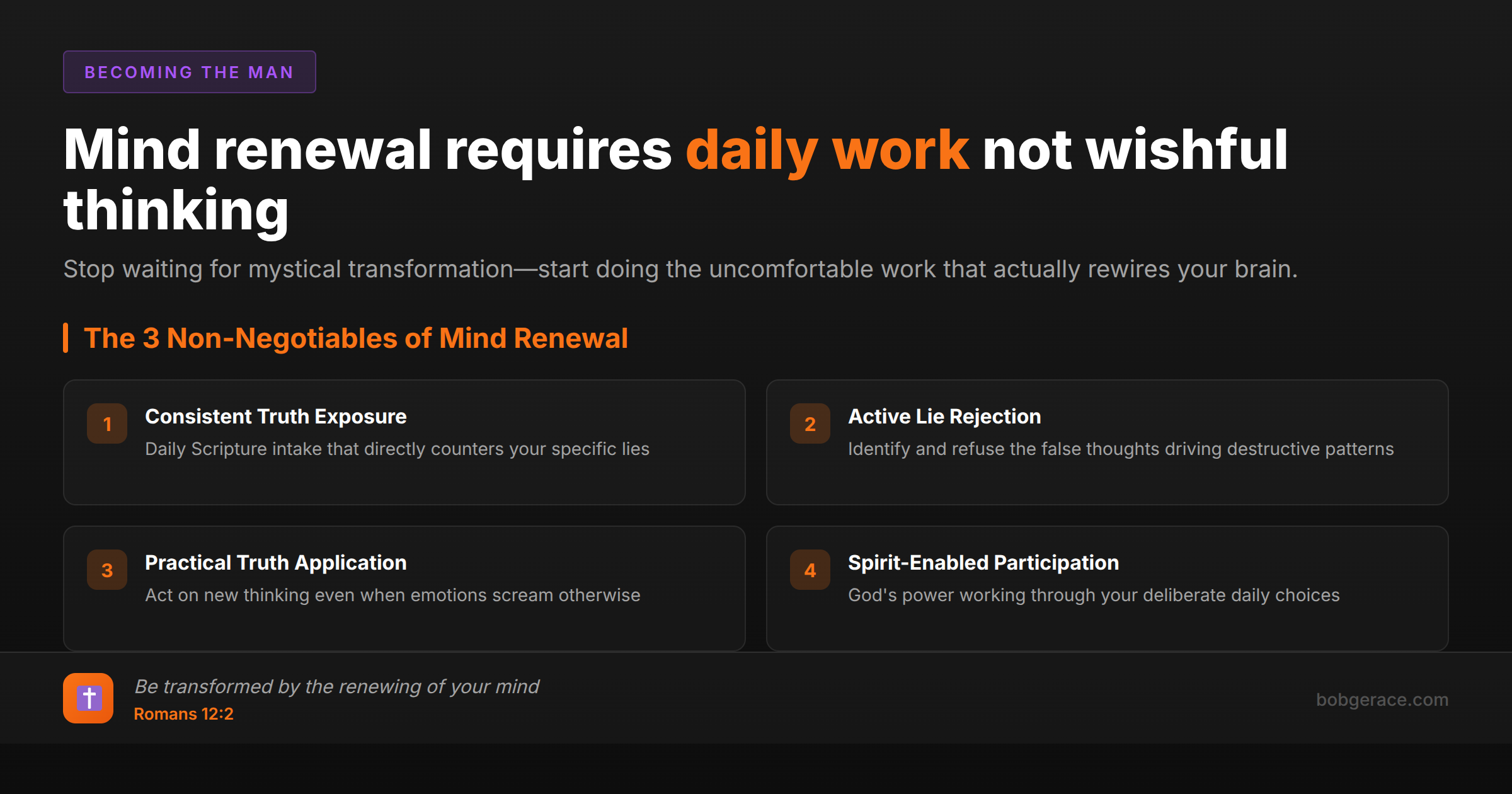
Renewing your mind isn't a mystical process—it's deliberate, daily work that requires three non-negotiables: consistent exposure to truth, active rejection of lies, and practical application of new thinking. Romans 12:2 calls this transformation, not reformation. You're not just changing behavior; you're rewiring how you process reality. This means identifying the specific lies driving your destructive patterns ("My spouse will never change," "I'm not capable of real love"), replacing them with Scripture-based truth, and then acting on that truth even when your emotions scream otherwise. It's uncomfortable work that requires both God's power and your daily participation. Most people want the results without the process—that's why they keep repeating the same mistakes.
The Full Picture
Here's what most people get wrong about renewing the mind: they think it's about trying harder or thinking positive thoughts. That's not biblical transformation—that's self-help with a Christian label slapped on it.
Real mind renewal happens at the belief level, not the behavior level. You keep "blowing it" because you're operating from corrupted mental software. Your mind has been programmed by years of lies, trauma, family patterns, and cultural messaging. Simply deciding to "do better" doesn't rewrite that programming.
## The Three-Part Process
First: Truth saturation. This isn't casual Bible reading—it's strategic exposure to specific truths that counter your specific lies. If you believe "I always mess things up," you need concentrated doses of your identity in Christ, not random devotional thoughts.
Second: Lie identification and rejection. Most people can't even identify the lies driving their behavior. You explode at your spouse and think it's about the dishes. Really? Or is it the lie that says "My needs don't matter" combined with "I have to fight to be heard"? You have to get ruthlessly honest about the false beliefs fueling your reactions.
Third: New neural pathways through repetition. Your brain has superhighways of old thinking patterns. New truth creates dirt paths. Those paths only become highways through consistent use. This means acting on new truth even when it feels foreign, choosing new responses even when old ones feel more natural.
This process takes time. Your patterns didn't develop overnight, and they won't change overnight. But with consistent application, you'll start seeing transformation in weeks, not years.
What's Really Happening
From a neuroplasticity perspective, Paul's instruction to "renew your mind" aligns perfectly with what we know about brain change. Your current patterns exist because of neural pathways strengthened through repetition. Every time you react the same way, you're literally reinforcing those pathways.
Here's the clinical reality: change requires both cognitive and behavioral components working together. You can't just think your way into new patterns, and you can't just behavior-modify your way out of deeply held beliefs. This is why so many marriage improvement attempts fail—couples focus on communication techniques without addressing the underlying belief systems driving their reactions.
## The Transformation Process
Awareness phase: Most people are unconscious of their automatic thoughts. They know they feel angry or hurt, but they haven't identified the split-second interpretations creating those emotions. "He left dishes in the sink" becomes "He doesn't respect me" becomes "I'm not valued" becomes explosive anger. Mind renewal starts with catching these automatic interpretations.
Disruption phase: Once you're aware of the pattern, you have a choice point. This is where Scripture becomes powerful—not as positive self-talk, but as objective truth that challenges subjective interpretation. "He doesn't respect me" gets challenged by "I don't need his validation because my worth comes from Christ."
Integration phase: New thinking must be reinforced through new actions. If you believe "I'm secure in Christ's love," but you still demand constant reassurance from your spouse, the new belief isn't integrated. True mind renewal shows up in changed behavior patterns.
This process typically takes 6-8 weeks of consistent practice to see meaningful change, with deeper integration occurring over 3-6 months.
What Scripture Says
Scripture presents mind renewal as both God's work in you and your active participation with Him. This isn't self-improvement—it's Spirit-enabled transformation.
Romans 12:2 - "Do not conform to the pattern of this world, but be transformed by the renewing of your mind. Then you will be able to test and approve what God's will is—his good, pleasing and perfect will." The word "transformed" (metamorphoo) is the same word used for Christ's transfiguration. This is radical change from the inside out.
2 Corinthians 10:5 - "We demolish arguments and every pretension that sets itself up against the knowledge of God, and we take captive every thought to make it obedient to Christ." Notice the active language: demolish, take captive, make obedient. This requires your participation.
Ephesians 4:22-24 - "You were taught, with regard to your former way of life, to put off your old self, which is being corrupted by its deceitful desires; to be made new in the attitude of your minds; and to put on the new self, created to be like God in true righteousness and holiness." There's a putting off, a renewing, and a putting on. It's a complete wardrobe change for your mind.
Philippians 4:8 - "Finally, brothers and sisters, whatever is true, whatever is noble, whatever is right, whatever is pure, whatever is lovely, whatever is admirable—if anything is excellent or praiseworthy—think about such things." This isn't positive thinking—it's truth-based thinking.
Colossians 3:16 - "Let the message of Christ dwell among you richly." The word "dwell" means to inhabit completely. God's truth doesn't just visit your mind—it takes up residence and transforms everything.
What To Do Right Now
-
1
Identify your trigger pattern: Write down your last three "blow-ups" and trace the automatic thoughts that led to each reaction.
-
2
Find the lies: Look for common themes in your automatic thoughts—what false beliefs about yourself, your spouse, or your situation keep showing up?
-
3
Choose specific Scripture: Select 3-5 verses that directly counter your identified lies, not random encouraging verses.
-
4
Create replacement thoughts: Write out new truth-based responses to your trigger situations, based on your chosen Scripture.
-
5
Practice in low-stakes moments: Start applying your new thought patterns in minor frustrations, not major conflicts.
-
6
Track your progress: Note when you catch old patterns and when you successfully apply new ones—celebrate small wins consistently.
Related Questions
- What is sanctification?
- What does 'put off/put on' mean practically?
- How does the Spirit actually change a person?
- What spiritual disciplines address anger?
- How do I put off the old man when he keeps showing up?
- What does repentance look like for accumulated sin?
- What is 'renewal of the mind' for anger patterns?
- What does 'godly sorrow' look like in practice?
- How long does real transformation take?
Also find Bob on
Subscribe for weekly videos on Christian marriage.
Renewing Your Mind in Your Marriage
The lies running your marriage aren't generic—they're specific to your story, your wounds, your patterns. A coach helps you identify what's actually driving your behavior and calibrate the work to where you are today.
Talk to Bob →