What does self-protective boundary-setting look like?
6 min read
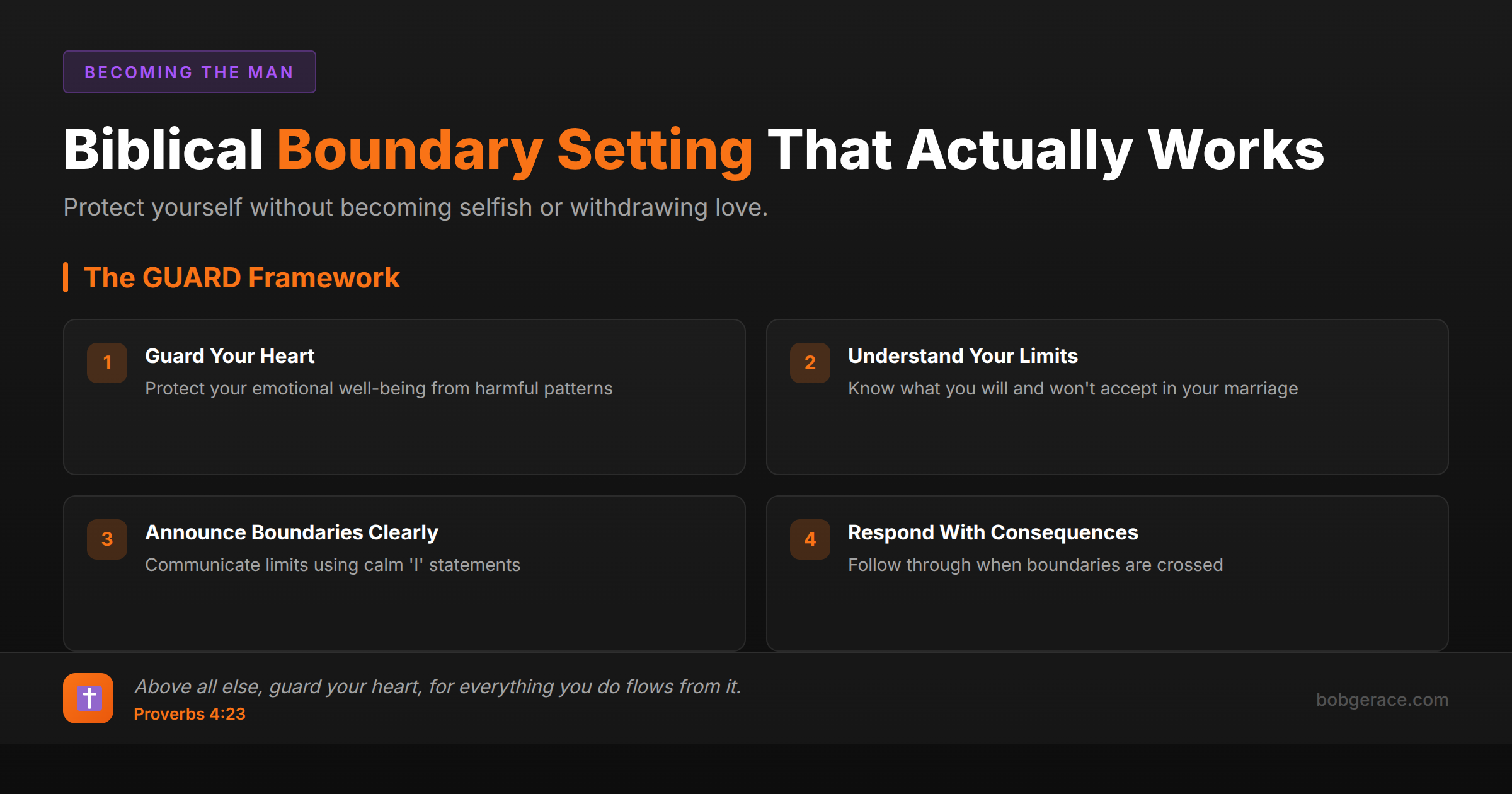
Self-protective boundary-setting is about creating healthy limits that preserve your well-being, dignity, and values while remaining committed to your marriage. It's not about punishing your spouse or withdrawing love—it's about protecting yourself from harmful patterns while creating space for genuine connection to grow. Healthy self-protective boundaries look like clearly communicating your limits, following through with consequences when those limits are crossed, and maintaining your own emotional and physical well-being. This might include refusing to engage in circular arguments, protecting your time and energy, or setting limits around disrespectful communication. The goal is always restoration and health, not retaliation or control.
The Full Picture
Self-protective boundary-setting is one of the most misunderstood concepts in marriage. Many women struggle with guilt when they consider setting limits with their husbands, believing it's unloving or unsubmissive. But here's the truth: healthy boundaries are actually expressions of love—both for yourself and your spouse.
Boundaries are not walls; they're gates with hinges. They protect what's valuable while allowing healthy connection. When you set self-protective boundaries, you're creating conditions where your marriage can actually thrive rather than just survive.
Self-protective boundaries address several key areas:
Emotional Protection: This means refusing to absorb your spouse's unprocessed emotions or take responsibility for their feelings. You might say, "I can see you're upset, but I won't let you take that anger out on me through yelling."
Time and Energy Protection: This involves safeguarding your capacity by not overextending yourself or allowing your spouse to monopolize your time through excessive demands or crisis-driven behavior.
Physical Protection: This includes maintaining your right to personal space, sleep, and physical safety. It also means protecting your body from the stress of constant conflict.
Value Protection: This means refusing to compromise your core beliefs, integrity, or standards to keep peace or avoid conflict.
The key is implementation. Healthy boundaries require both clear communication and consistent follow-through. They're not ultimatums or threats—they're loving limits that create space for your marriage to heal and grow. Remember: you're not responsible for your spouse's reaction to your boundaries, but you are responsible for maintaining them with love and consistency.
What's Really Happening
From a clinical perspective, self-protective boundary-setting is essential for maintaining individual identity and emotional health within marriage. Many women I work with have lost themselves in their marriages, becoming so focused on their spouse's needs and reactions that they've abandoned their own well-being.
This pattern often stems from childhood experiences where boundaries were either too rigid or completely absent. Women may have learned that their worth comes from taking care of others, even at their own expense. In marriage, this translates to over-functioning, people-pleasing, and absorbing responsibility for their spouse's emotions and behaviors.
Healthy self-protective boundaries serve several psychological functions: they preserve your sense of self, reduce anxiety and resentment, and actually improve intimacy by allowing you to show up authentically in your relationship. When you're not constantly walking on eggshells or managing your spouse's emotions, you have energy available for genuine connection.
It's important to understand that boundary-setting often triggers anxiety—both in you and your spouse. This is normal. Your nervous system may interpret boundary-setting as dangerous, especially if you've learned that others' approval equals safety. Your spouse may also react strongly because boundaries disrupt established patterns.
The goal isn't to eliminate all discomfort but to tolerate it while maintaining your limits. Over time, consistent boundaries actually create more safety and predictability in your relationship. They communicate that you value both yourself and your marriage enough to protect what's precious.
What Scripture Says
Scripture is clear that we are called to love others while also being wise stewards of what God has given us—including our own hearts, minds, and bodies.
Proverbs 4:23 reminds us: *"Above all else, guard your heart, for everything you do flows from it."* This isn't selfishness; it's biblical wisdom. You cannot pour from an empty cup or love others well when you're depleted and resentful.
Proverbs 27:14 warns us about the futility of enabling harmful patterns: *"Whoever blesses their neighbor with a loud voice early in the morning will have it counted as a curse."* Sometimes our efforts to keep peace actually enable destructive behavior rather than promoting genuine love.
Ephesians 4:15 calls us to speak *"the truth in love."* Self-protective boundaries are truth-telling. When you set a limit, you're being honest about what you can and cannot accept, which creates opportunity for genuine relationship.
Galatians 6:2-5 provides crucial balance: *"Carry each other's burdens... for each one should carry their own load."* We're called to support one another, but not to carry what rightfully belongs to our spouse. Boundaries help distinguish between burdens we should share and loads each person must carry.
Matthew 10:16 instructs us to be *"as shrewd as snakes and as innocent as doves."* Wisdom includes protecting yourself from harm while maintaining a heart of love. Biblical love doesn't require you to accept abuse, manipulation, or disrespect.
Remember: Jesus himself set boundaries. He withdrew from crowds when needed, spoke truth that made people uncomfortable, and didn't allow others to dictate his schedule or mission. Following Christ means learning to love wisely, not just sacrificially.
What To Do Right Now
-
1
Identify one area where you feel regularly overwhelmed, resentful, or depleted in your marriage
-
2
Write down what boundary you need to set, using 'I' statements: 'I will not...' or 'I need...'
-
3
Communicate this boundary clearly and calmly to your spouse during a peaceful moment
-
4
Decide in advance what you'll do if this boundary is crossed—and be prepared to follow through
-
5
Practice self-care and stress management as you implement boundaries, knowing it may feel uncomfortable initially
-
6
Seek support from a trusted friend, counselor, or mentor who understands healthy boundaries
Related Questions
Ready to Create Healthier Boundaries?
Learning to set loving boundaries takes courage and wisdom. You don't have to figure this out alone.
Get Support →