What does sustainable change require?
6 min read
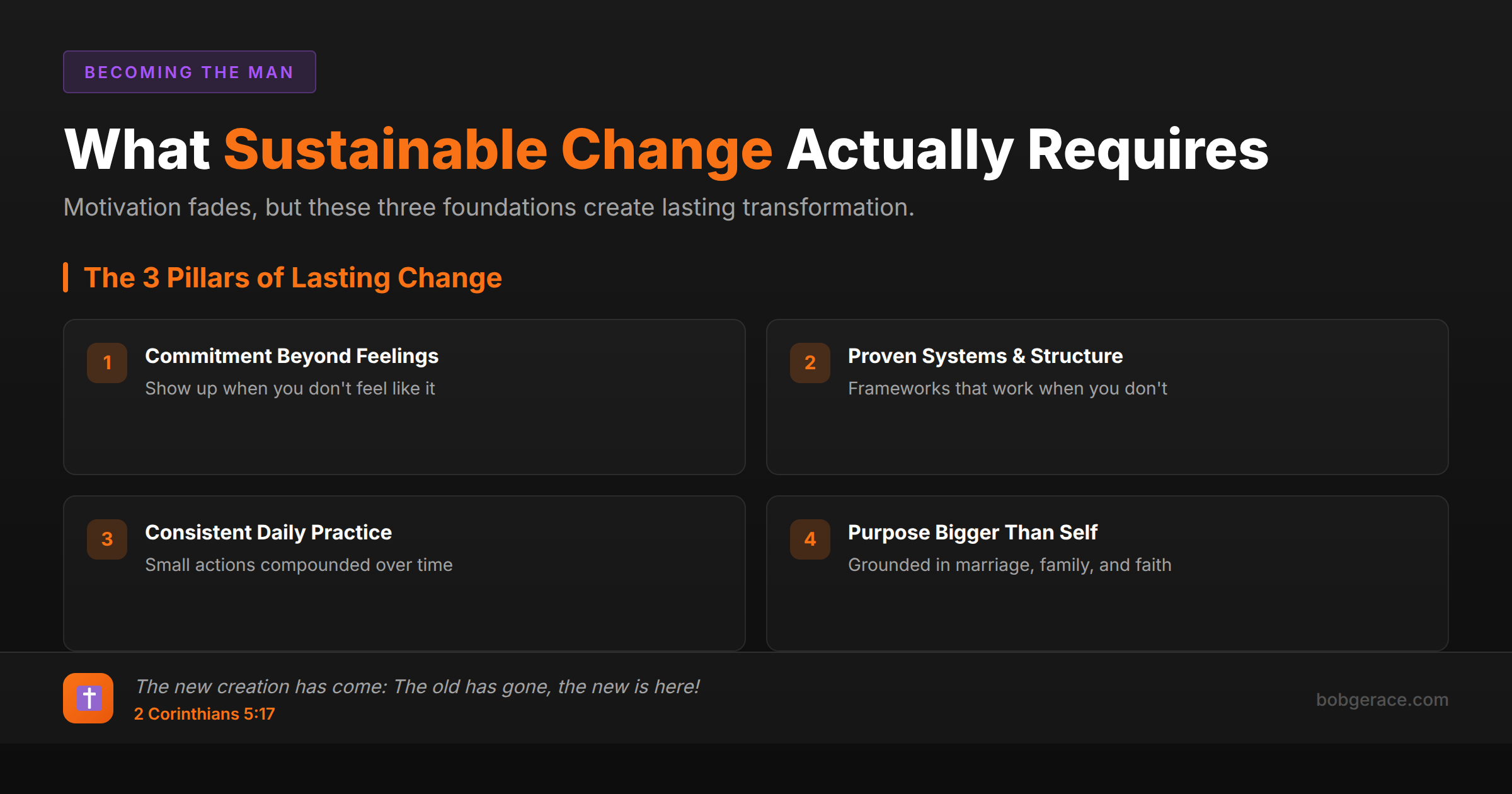
Sustainable change requires three foundational elements: genuine commitment beyond feelings, proven systems and structures, and consistent daily practice over time. You can't rely on motivation alone—it fades. You need frameworks that work when you don't feel like working. The men who create lasting transformation understand that change isn't an event, it's a process. They commit to showing up daily, especially when it's hard. They build accountability systems, create non-negotiable routines, and measure their progress consistently. Most importantly, they ground their transformation in something bigger than themselves—their marriage, their family, and their faith.
The Full Picture
Here's what I've learned after coaching hundreds of men: sustainable change has nothing to do with motivation. Motivation is what gets you started. Systems are what keep you going.
The men who transform their marriages don't rely on feeling inspired every day. They build what I call "change architecture"—structures that support growth even when life gets chaotic. This includes:
Non-negotiable daily practices. Prayer, exercise, planning your day, connecting with your wife—these become as automatic as brushing your teeth. You do them whether you feel like it or not.
Measurement systems. You track what matters. How many days did you initiate meaningful conversation? How often did you lead spiritually? When you measure, you manage.
Environmental design. Your surroundings either support change or sabotage it. The men who succeed remove temptations and create environments that make good choices easier.
Identity shifts, not just behavior changes. Instead of "I'm trying to be a better husband," it becomes "I am a man who leads his family well." When your identity changes, your behaviors follow naturally.
Recovery protocols. You will mess up. Sustainable change isn't about perfection—it's about having systems to get back on track quickly when you fall off.
The transformation process is simple but not easy. It requires you to show up consistently, especially when you don't want to. But when you build the right systems, change becomes inevitable.
What's Really Happening
From a neuroplasticity standpoint, sustainable change requires approximately 66 days to form new neural pathways, but lasting transformation takes much longer. The brain resists change through what we call "homeostatic pressure"—your nervous system literally fights to return to familiar patterns, even destructive ones.
Successful transformation happens in three phases: Disruption (breaking old patterns), Integration (building new neural pathways), and Embodiment (making new behaviors automatic). Most men quit during the integration phase because it's uncomfortable and progress feels slow.
The key is understanding that your brain will sabotage change through rationalization, procrastination, and emotional dysregulation. This is normal, not failure. Men who succeed expect this resistance and build coping strategies in advance.
Research shows that sustainable change requires multiple support systems: environmental modifications, social accountability, and what we call "implementation intentions"—if-then scenarios that automate good decisions. For example: "If I feel triggered by my wife's tone, then I will take three deep breaths before responding."
The most important factor is what psychologists call "process goals" versus outcome goals. Instead of focusing on "having a better marriage," focus on "spending 15 minutes in intentional conversation daily." Process goals create momentum; outcome goals create frustration.
What Scripture Says
Scripture is clear that lasting transformation requires both God's power and our consistent participation. It's not passive waiting or self-powered effort—it's cooperative work with the Holy Spirit.
"Therefore, if anyone is in Christ, the new creation has come: The old has gone, the new is here!" (2 Corinthians 5:17). Your identity in Christ provides the foundation for all sustainable change. You're not trying to become someone new—you're learning to live out who you already are.
"Continue to work out your salvation with fear and trembling, for it is God who works in you to will and to act in order to fulfill his good purpose" (Philippians 2:12-13). Notice the balance: you work, but God works in you. Sustainable change requires both divine empowerment and human discipline.
"But his delight is in the law of the Lord, and on his law he meditates day and night" (Psalm 1:2). Daily engagement with God's Word isn't religious duty—it's the primary system for renewing your mind and maintaining spiritual momentum.
"Above all else, guard your heart, for everything you do flows from it" (Proverbs 4:23). Sustainable change starts with heart transformation, not just behavior modification. When your heart changes, your actions follow naturally.
"The simple believe anything, but the prudent give thought to their steps" (Proverbs 14:15). God expects you to be strategic about change, not just hope it happens. Planning, systems, and intentionality honor Him.
Transformation is God's specialty, but He works through consistent, faithful obedience in the small daily choices.
What To Do Right Now
-
1
Choose one specific area where you want to see change and define exactly what success looks like
-
2
Create a daily non-negotiable practice related to this change—start with 15 minutes maximum
-
3
Set up your environment to make good choices easier and bad choices harder
-
4
Establish a weekly review time to measure progress and adjust your approach
-
5
Find an accountability partner who will ask you hard questions about your consistency
-
6
Develop a recovery protocol for when you fail—decide in advance how you'll get back on track
Related Questions
- What does real transformation look like?
- How do I change from the inside out?
- What's the difference between first-order and second-order change?
- What makes change sustainable vs. temporary?
- How long does it take to rewire the brain?
- What is 'identity-based change'?
- How long does recovery take?
- What is 'white-knuckling' vs. real transformation?
- How long does real change actually take?
- What does integration mean vs. just learning?
Also find Bob on
Subscribe for weekly videos on Christian marriage.
You Don't Have to Build This Alone
A coach who knows your marriage can see what you can't—where you're stuck, what's actually working, and what needs to shift next week, not someday.
Talk to Bob →