What does 'washing feet' look like in marriage?
6 min read
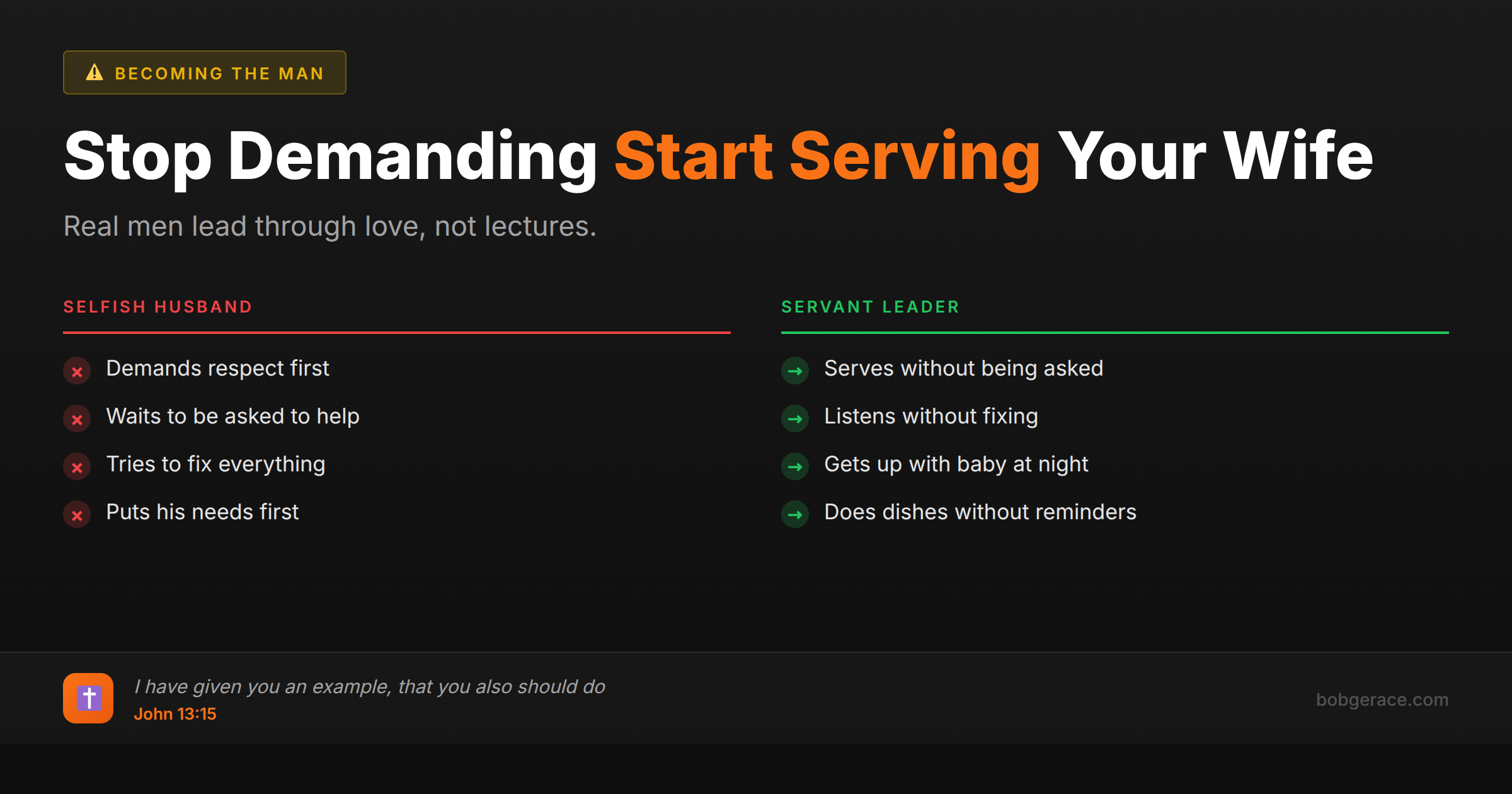
Washing feet in marriage means choosing humble service over demanding respect. It's the husband who gets up at night with the baby, who listens without trying to fix everything, who serves his wife's needs before his own comfort. This isn't about being a doormat—it's about leading through love. Just as Jesus shocked His disciples by taking the servant's role, husbands shock the world by choosing service over selfishness. It's doing dishes without being asked, prioritizing her emotional needs, and laying down your agenda for hers. This kind of love doesn't diminish your masculinity—it defines it.
The Full Picture
When Jesus knelt down with a towel and basin, He wasn't just cleaning dirty feet. He was redefining leadership forever. In a culture where washing feet was reserved for the lowest servants, the Son of God chose the humble path—and He's calling husbands to do the same.
Washing feet in marriage isn't about grand gestures or occasional acts of service. It's about a daily posture of the heart that says, "Your needs matter more than my comfort." It's the husband who notices his wife is overwhelmed and starts folding laundry without being asked. It's choosing to listen to her frustrations about work instead of immediately offering solutions. It's getting up early to make coffee so she can sleep in.
This kind of service requires genuine humility—not the false humility that seeks recognition, but the authentic humility that serves without keeping score. It means checking your ego at the door and asking, "How can I make her life better today?" It's washing dishes, changing diapers, running errands, and doing whatever needs to be done.
But here's what many men miss: washing feet isn't weakness—it's the strongest form of leadership. When you serve your wife consistently and sacrificially, you're not diminishing your authority; you're establishing it on the only foundation that matters—love. You're showing her what Christ's love looks like with skin on.
The world tells men to demand respect, to assert dominance, to make sure they get their due. Jesus says the exact opposite: "Whoever wants to be great among you must be your servant." In marriage, greatness isn't measured by how much your wife serves you, but by how faithfully you serve her.
What's Really Happening
From a clinical perspective, the foot-washing model of marriage creates profound psychological safety and emotional intimacy. When a husband consistently demonstrates servant leadership, it activates his wife's attachment system in the healthiest possible way—she experiences security, care, and unconditional positive regard.
This behavior pattern directly counters the toxic masculinity that damages so many marriages. Instead of power-over dynamics that create defensiveness and emotional withdrawal, servant leadership creates power-with dynamics that foster collaboration and vulnerability. The wife feels safe to be authentic, to express needs, and to reciprocate love freely rather than from obligation or fear.
Neurologically, acts of humble service trigger oxytocin release in both partners—the hormone associated with bonding and trust. When a husband serves without expecting immediate reciprocation, it breaks cycles of transactional relationship patterns that keep couples stuck in scorekeeping and resentment.
What's fascinating is how this challenges cultural narratives about respect. Many men believe they must demand respect to receive it, but research shows the opposite. Consistent, humble service actually increases a wife's admiration and respect for her husband. She experiences his strength through his gentleness, his leadership through his willingness to serve.
This doesn't mean becoming passive or losing healthy boundaries. True servant leadership requires emotional intelligence, clear communication, and the courage to love even when it's not immediately reciprocated. It's actually one of the most psychologically mature approaches to marriage—requiring emotional regulation, empathy, and secure attachment patterns.
What Scripture Says
The biblical foundation for washing feet in marriage starts with Jesus Himself: "He poured water into a basin and began to wash the disciples' feet and to wipe them with the towel that was wrapped around him" (John 13:5). This wasn't just a nice gesture—it was a complete redefinition of greatness.
Jesus made the principle crystal clear: "If I then, your Lord and Teacher, have washed your feet, you also ought to wash one another's feet. For I have given you an example, that you also should do just as I have done to you" (John 13:14-15). This command extends directly into marriage relationships.
Paul reinforces this servant-leadership model: "Husbands, love your wives as Christ loved the church and gave himself up for her" (Ephesians 5:25). Christ's love wasn't passive or sentimental—it was active, sacrificial, and service-oriented. He didn't love the church from a distance; He served her needs completely.
The heart attitude behind washing feet is captured in Philippians: "Do nothing from selfish ambition or conceit, but in humility count others more significant than yourselves. Let each of you look not only to his own interests, but also to the interests of others" (Philippians 2:3-4). This is the daily choice of marriage—her interests before your comfort.
"Whoever would be great among you must be your servant, and whoever would be first among you must be slave of all" (Mark 10:43-44). In marriage, greatness isn't measured by how well you're served, but by how faithfully you serve.
Finally, "Above all, keep loving one another earnestly, since love covers a multitude of sins" (1 Peter 4:8). Washing feet is love in action—earnest, consistent, and covering her weaknesses with grace just as Christ covers ours.
What To Do Right Now
-
1
Ask your wife directly: 'What's one way I could serve you better this week?' Then do it without reminding her you did it.
-
2
Identify three household tasks she typically handles and take them over permanently—dishes, laundry, bedtime routine, whatever she needs.
-
3
Practice the 'towel test'—when you come home, ask yourself: 'How can I serve?' before asking: 'What do I need?'
-
4
Start each morning by praying: 'God, show me how to love my wife like You love the church today.'
-
5
Institute a weekly 'listening hour'—sixty minutes where you listen to her heart, dreams, frustrations, and needs without offering solutions unless asked.
-
6
End each day by asking: 'Did I wash her feet today?' Be honest about areas where you chose comfort over service.
Related Questions
- What does Jesus model about masculine leadership?
- How do I lead without controlling?
- What does humble leadership look like?
- What does 'dying for your wife' mean practically?
- What does 'love your wife as Christ loves the church' mean?
- How do I make amends for years of failure?
- What does proactive repair look like?
Also find Bob on
Subscribe for weekly videos on Christian marriage.
Bring Your Marriage to a Coach
Servant leadership looks different in every marriage. A coach who knows your story can help you figure out what it actually looks like in yours.
Talk to Bob →