What is the path from boy to man?
6 min read
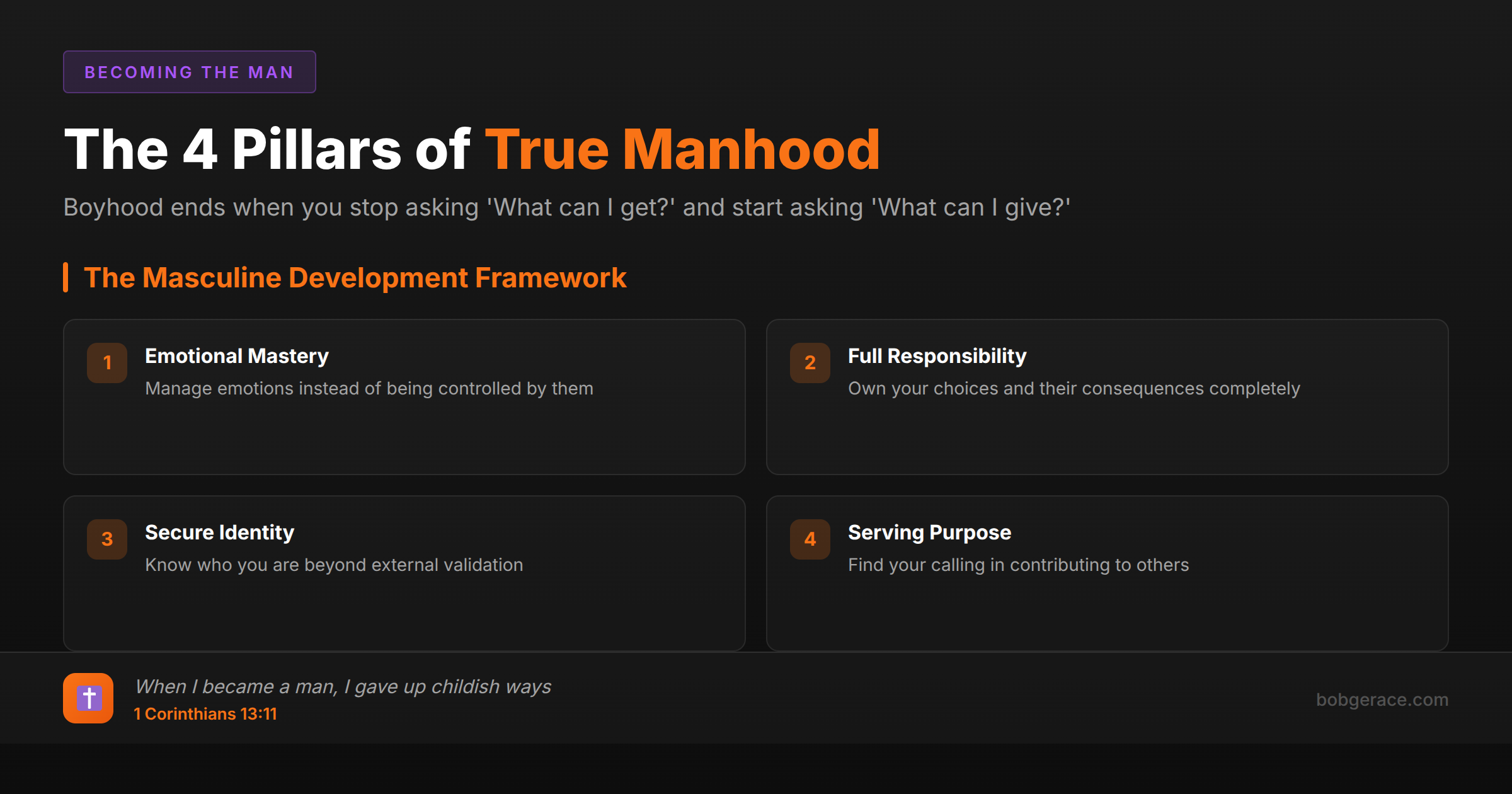
The path from boy to man isn't automatic - it requires intentional development across four key areas: emotional maturity, responsibility, identity, and purpose. Unlike physical growth, masculine development demands conscious effort, mentorship, and often difficult experiences that forge character. This journey typically involves learning to manage emotions rather than being controlled by them, accepting responsibility for your choices and their consequences, discovering who you are beyond external validation, and finding your unique calling in serving others. Many men get stuck in boyhood patterns because our culture lacks clear rites of passage and masculine mentorship. True manhood emerges when you stop asking "What can I get?" and start asking "What can I give?"
The Full Picture
The transition from boyhood to manhood is one of life's most critical journeys, yet our culture has largely abandoned the roadmap. Unlike previous generations where clear rites of passage marked this transition, modern men often stumble through decades without understanding what true masculinity looks like.
The Four Pillars of Masculine Development:
Emotional Mastery - Boys are ruled by their emotions; men learn to rule theirs. This doesn't mean suppressing feelings, but developing the strength to feel deeply while acting wisely. A mature man can experience anger without becoming violent, feel fear without being paralyzed, and face rejection without crumbling.
Responsibility Ownership - The boy asks "Who's fault is this?" The man asks "How do I fix this?" This shift represents perhaps the most fundamental change in masculine development. Taking ownership of your choices, your reactions, and your life's direction separates men from boys more than age ever could.
Identity Formation - Boys derive their worth from external validation - performance, appearance, others' opinions. Men develop an internal compass based on character, values, and purpose. This internal foundation becomes unshakeable because it's not dependent on circumstances or other people's approval.
Purpose Discovery - Boys live for themselves; men live for something greater. This might be family, faith, community, or a calling that serves others. Purpose transforms selfish ambition into meaningful contribution.
The journey isn't linear. Men can be advanced in one area while remaining boyish in another. The goal isn't perfection but progression - becoming more mature, responsible, and purposeful each year.
What's Really Happening
From a developmental psychology perspective, the transition to manhood involves significant neurological, emotional, and social changes that extend well beyond adolescence. The male brain doesn't fully mature until the mid-20s, particularly the prefrontal cortex responsible for decision-making and impulse control.
What we're seeing clinically is an epidemic of "extended adolescence" - men in their 20s, 30s, and even 40s who remain stuck in boyhood patterns. This manifests as difficulty with commitment, emotional regulation problems, avoidance of responsibility, and a persistent need for external validation.
The absence of traditional masculine mentorship and rites of passage has created what I call "developmental drift" - men who age chronologically but struggle to mature psychologically. Without clear markers and guidance, they remain uncertain about what manhood actually requires.
Neuroplasticity research shows us that the brain can rewire itself throughout life, meaning it's never too late to develop mature masculine traits. However, this requires intentional practice and often therapeutic intervention to address underlying patterns of avoidance, dependency, or emotional dysregulation.
The most successful masculine development occurs within supportive relationships that provide both challenge and accountability. Men need other men who can model mature behavior and call out destructive patterns. This isn't about becoming "alpha" or dominant - it's about developing the internal resources to lead yourself and serve others effectively.
What Scripture Says
Scripture provides the clearest roadmap for masculine development, showing us that God designed men to grow from dependence to independence to interdependence in service of His kingdom.
From Childish to Mature: "When I was a child, I spoke like a child, I thought like a child, I reasoned like a child. When I became a man, I gave up childish ways." (1 Corinthians 13:11). Paul makes it clear that manhood requires actively abandoning childish patterns - it's not automatic.
Embracing Responsibility: "But if anyone does not provide for his relatives, and especially for members of his household, he has denied the faith and is worse than an unbeliever." (1 Timothy 5:8). Biblical manhood means accepting responsibility for those under your care.
Character Development: "Count it all joy, my brothers, when you meet trials of various kinds, for you know that the testing of your faith produces steadfastness. And let steadfastness have its full effect, that you may be perfect and complete, lacking in nothing." (James 1:2-4). God uses difficult experiences to forge masculine character.
Servant Leadership: "Whoever wants to become great among you must be your servant, and whoever wants to be first must be slave of all." (Mark 10:43-44). True masculine strength is exercised in service to others.
Strength and Courage: "Be watchful, stand firm in the faith, act like men, be strong." (1 Corinthians 16:13). Biblical masculinity combines spiritual vigilance with courageous action.
Wisdom Over Knowledge: "The fear of the Lord is the beginning of wisdom, and the knowledge of the Holy One is insight." (Proverbs 9:10). Mature men seek God's wisdom rather than just accumulating information.
What To Do Right Now
-
1
Find a mentor - Identify an older man whose character and life you respect, and ask for regular guidance
-
2
Take full responsibility - Stop blaming others for your problems and start owning your choices completely
-
3
Develop emotional intelligence - Learn to identify, understand, and appropriately express your emotions
-
4
Serve someone besides yourself - Volunteer, help family members, or find ways to contribute to your community
-
5
Face your fears deliberately - Identify what scares you most and take concrete steps toward it
-
6
Study biblical masculinity - Read books on godly manhood and study how Jesus demonstrated perfect masculinity
Related Questions
Ready to Step Into True Manhood?
The journey from boy to man doesn't happen alone. Get the guidance and accountability you need to become the man God called you to be.
Start Today →