What is the role of emotions in spiritual life?
6 min read
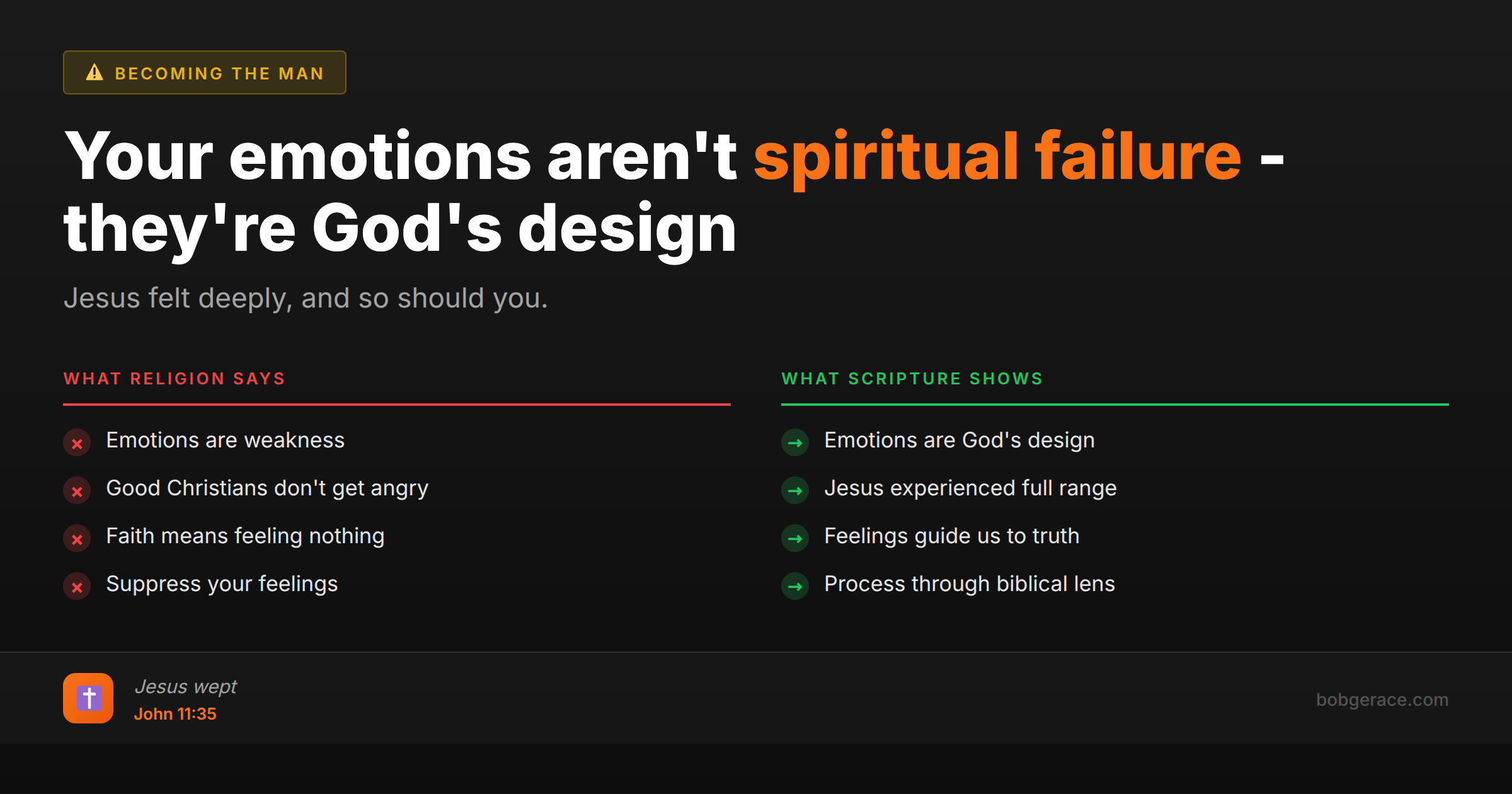
Emotions are God's design, not obstacles to overcome. They serve as indicators of what's happening in our hearts and guide us toward deeper relationship with God and others. Scripture shows us that Jesus experienced the full range of human emotions - joy, sorrow, anger, compassion - demonstrating that feeling deeply is part of being created in God's image. Your emotions aren't sinful; they're signals. They point to what you value, what you fear, what you love. The key isn't suppressing them but learning to process them through a biblical lens. When you understand emotions as God's gift rather than spiritual weakness, you can use them as tools for growth, intimacy, and worship.
The Full Picture
Too many Christian men have been taught that emotions are weakness or somehow unspiritual. This is not only wrong - it's damaging. God created you as an emotional being, and your capacity to feel is part of bearing His image.
Emotions serve three critical spiritual functions:
First, they're diagnostic tools that reveal the condition of your heart. When you feel anxious, it might reveal misplaced trust. When you feel angry, it could expose injustice or unmet expectations. When you feel joy, it often points to alignment with God's purposes.
Second, emotions fuel motivation for spiritual action. Compassion moves you to serve others. Righteous anger motivates you to fight injustice. Gratitude drives worship. Without emotional engagement, faith becomes mechanical and lifeless.
Third, emotions deepen intimacy - both with God and your spouse. When you learn to share your emotional world appropriately, you create connections that surface-level interaction never can. God doesn't want your stoic performance; He wants your authentic heart.
The problem isn't having emotions - it's being ruled by them instead of stewarding them well. Emotional maturity means feeling deeply while thinking clearly, allowing both heart and mind to inform your responses. This isn't weakness; it's the integrated life God designed you to live.
What's Really Happening
From a clinical perspective, emotions serve as your internal guidance system, providing crucial information about your psychological and spiritual state. When we suppress or dismiss emotions, we lose access to vital data about our inner world.
Neurologically, emotions originate in the limbic system and involve complex interactions between brain regions responsible for memory, meaning-making, and decision-making. This isn't accidental - God designed your emotional system to integrate with higher-order thinking processes.
Many men struggle with what I call 'emotional alexithymia' - difficulty identifying and expressing feelings. This often stems from cultural messaging that emotions are feminine or weak. However, research consistently shows that emotional awareness and expression are linked to better mental health, stronger relationships, and even physical well-being.
In marriage therapy, I frequently see couples where emotional disconnection creates distance and conflict. The husband who can't access or communicate his emotions leaves his wife feeling unknown and unloved. Learning to recognize, process, and appropriately share emotions isn't just spiritually healthy - it's relationally essential.
The goal isn't emotional control in the sense of suppression, but emotional regulation - the ability to experience feelings fully while choosing wise responses. This requires developing what researchers call 'emotional granularity' - the capacity to distinguish between different emotional states and understand their messages.
What Scripture Says
Scripture presents a God who feels deeply and people of faith who experience the full spectrum of human emotion. Consider these examples:
Jesus wept (John 11:35) at Lazarus's tomb, showing us that grief and sorrow are not spiritual failures but appropriate responses to loss and suffering.
"In your anger do not sin" (Ephesians 4:26) - Paul doesn't say 'don't get angry.' He acknowledges anger as a legitimate emotion while calling for righteous expression.
"Weep with those who weep; rejoice with those who rejoice" (Romans 12:15) commands emotional engagement and empathy as Christian virtues.
"Be angry and do not sin; do not let the sun go down on your anger" (Ephesians 4:26) provides practical guidance for processing difficult emotions in healthy ways.
David's Psalms overflow with raw emotion - fear, anger, joy, despair, hope. God preserved these emotional expressions as Scripture, validating the spiritual significance of our feeling life.
"Above all else, guard your heart, for everything you do flows from it" (Proverbs 4:23) - The heart in Hebrew thought includes emotions, and we're called to steward this emotional center carefully.
The biblical pattern is clear: God feels, Jesus felt, and faithful people throughout Scripture experienced and expressed emotions. Your emotional life isn't separate from your spiritual life - it's integral to it.
What To Do Right Now
-
1
Practice daily emotional check-ins: Ask yourself 'What am I feeling right now?' and name specific emotions rather than defaulting to 'fine' or 'stressed.'
-
2
Create an emotion vocabulary list: Learn words beyond 'mad,' 'sad,' 'glad' to better identify and communicate your internal experience.
-
3
Pray through your emotions: Bring your feelings directly to God in prayer, following David's example in the Psalms.
-
4
Share one emotion daily with your spouse: Practice emotional transparency in low-stakes moments to build intimacy and communication skills.
-
5
Study Jesus's emotional expressions in the Gospels: Notice how He felt and expressed emotions appropriately in different situations.
-
6
Process difficult emotions before responding: Take time to understand what you're feeling and why before making decisions or having important conversations.
Related Questions
Ready to Integrate Your Heart and Faith?
Learning to steward your emotions well transforms both your relationship with God and your marriage. Let's work together on this crucial area of growth.
Get Started →