What would I have to face if I actually changed?
6 min read
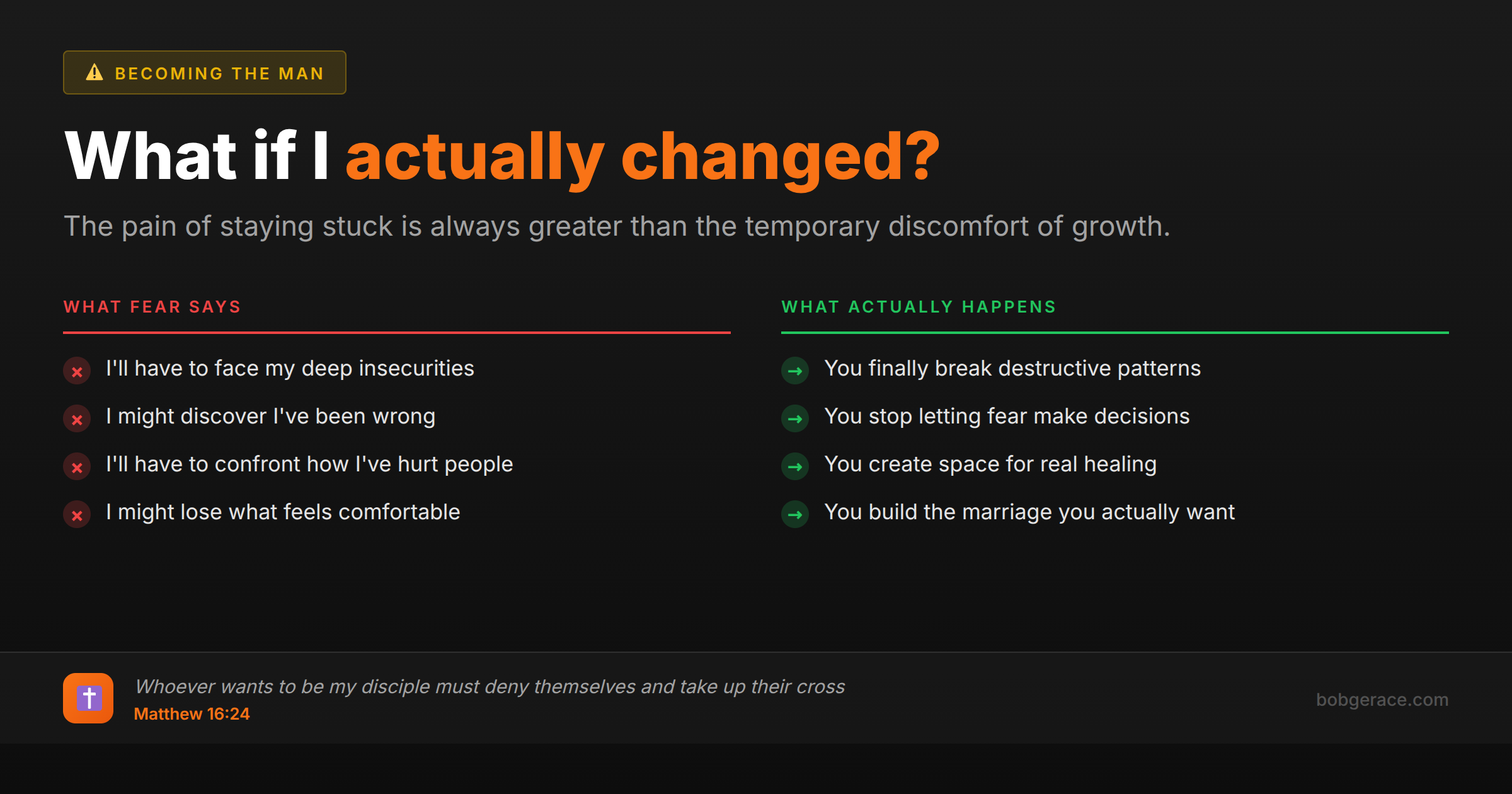
The fear of what we'd have to face if we actually changed is often what keeps us trapped in destructive patterns. Real change means confronting the parts of ourselves we've been avoiding - our deep insecurities, unhealed wounds, and the comfortable lies we tell ourselves. It means facing the possibility that we've been wrong, that we've hurt people we love, and that we might have to make difficult decisions about relationships, careers, or lifestyles that no longer serve us. But here's what I've learned after years of coaching: the pain of staying stuck is always greater than the temporary discomfort of growth. Yes, change is scary. Yes, it requires courage. But the alternative - continuing to damage your marriage and repeat the same destructive cycles - is far worse. The question isn't whether change will be challenging; it's whether you're ready to stop letting fear make your decisions.
The Full Picture
Let's be brutally honest about what real change requires. When you've been stuck in destructive patterns - whether it's anger, withdrawal, addiction, or emotional unavailability - part of you has gotten comfortable with the dysfunction. It's familiar territory, even if it's painful.
The Identity Crisis: Changing means letting go of who you think you are. If you've always been "the victim" or "the one who's right," growth requires releasing those identity anchors. You might have to admit you're not the person you thought you were, or worse, that you're exactly the person you've been afraid you might be.
The Relationship Earthquake: Your spouse has learned to navigate around your dysfunction. When you change, it disrupts the entire system. They might not trust it initially. They might even resist it because it forces them to change too. Some relationships don't survive one person's genuine transformation because the dysfunction was holding it together.
The Responsibility Weight: Real change means taking full ownership of your choices and their consequences. No more blaming your spouse, your childhood, or your circumstances. You have to look in the mirror and accept that you've been an active participant in creating the problems you're experiencing.
The Unknown Territory: When you let go of familiar patterns, you enter uncharted waters. You don't know who you'll become or how others will respond. That uncertainty can feel terrifying, especially when the old patterns provided a sense of control or predictability.
But here's what most people don't realize: avoiding change doesn't eliminate these challenges - it just delays and intensifies them.
What's Really Happening
From a psychological perspective, the resistance to change often stems from what we call "secondary gains" - the hidden benefits we receive from our dysfunctional patterns. These might include avoiding responsibility, maintaining control, getting attention, or protecting ourselves from deeper vulnerabilities.
The fear of change also activates our nervous system's threat detection mechanisms. Our brains are wired to perceive the unknown as potentially dangerous, which triggers fight-flight-freeze responses that can paralyze us. This is why people often sabotage their own progress right when breakthrough seems possible.
Shame and Self-Concept Protection: Many individuals struggling with change are protecting themselves from confronting deep-seated shame. If I admit I need to change, what does that say about who I've been? This shame can be so overwhelming that people choose familiar suffering over the risk of facing their core wounds.
Attachment Fears: Change often brings up fundamental questions about worthiness and belonging. Will my spouse still love me if I'm different? Will I lose important relationships? These attachment fears can be unconsciously driving the resistance to growth.
The Integration Challenge: Real transformation requires integrating all parts of ourselves - including the parts we've rejected or hidden. This process, while ultimately liberating, can initially feel destabilizing as we learn to hold complexity rather than splitting into "good" and "bad" parts.
Understanding these psychological dynamics is crucial because it normalizes the difficulty of change and helps individuals approach transformation with appropriate support and realistic expectations.
What Scripture Says
Scripture is remarkably honest about the challenges and costs of transformation. God doesn't promise easy change, but He does promise to be with us through it.
The Cost of Discipleship: Jesus said, *"Whoever wants to be my disciple must deny themselves and take up their cross and follow me"* (Matthew 16:24). Following Christ isn't about surface-level adjustments - it's about fundamental transformation that requires dying to old ways of being.
Facing Our True Condition: *"The heart is deceitful above all things and beyond cure. Who can understand it?"* (Jeremiah 17:9). Change requires acknowledging the depth of our brokenness, which can be a humbling and painful process.
The Refining Process: *"See, I have refined you, though not as silver; I have tested you in the furnace of affliction"* (Isaiah 48:10). God uses difficulty - including the difficulty of change - to purify and strengthen us. The process isn't comfortable, but it's purposeful.
New Creation Reality: *"Therefore, if anyone is in Christ, the new creation has come: The old has gone, the new is here!"* (2 Corinthians 5:17). This promise reminds us that transformation is possible, but it requires letting go of old identities and ways of being.
Courage in Fear: *"Have I not commanded you? Be strong and courageous. Do not be afraid; do not be discouraged, for the Lord your God will be with you wherever you go"* (Joshua 1:9). God acknowledges that courage is needed precisely because the path forward can be frightening.
The Better Way: *"'For I know the plans I have for you,' declares the Lord, 'plans to prosper you and not to harm you, to give you hope and a future'"* (Jeremiah 29:11). God's call to change isn't punishment - it's an invitation to something better than what we're clinging to.
What To Do Right Now
-
1
Write down specifically what you're afraid you'd have to face if you changed - name the fears concretely
-
2
Identify what you're getting from staying stuck - what needs are your current patterns meeting, even if destructively?
-
3
Ask your spouse or a trusted friend what they think you'd gain if you actually transformed in this area
-
4
Start with one small change that moves you toward growth while building your courage for bigger shifts
-
5
Find an accountability partner or counselor who can support you through the discomfort of transformation
-
6
Commit to facing one uncomfortable truth about yourself this week and taking action based on that awareness
Related Questions
- What is 'secondary gain' from destructive behavior?
- What does my pattern protect me from?
- What is self-sabotage serving?
- Why does 'trying harder' often backfire?
- What parts of me resist change?
- What is 'repetition compulsion'?
- What if I change and she still leaves?
- How do I grieve what I wasn't taught?
- What did I not receive from my father that I need?
- Is my suffering redemptive?
Also find Bob on
Subscribe for weekly videos on Christian marriage.
You Don't Have to Face This Alone
Coaching means a human who knows your specific marriage, sees what you're actually avoiding, and helps you move through it without the guesswork.
Talk to Bob →