At what point am I just torturing myself?
6 min read
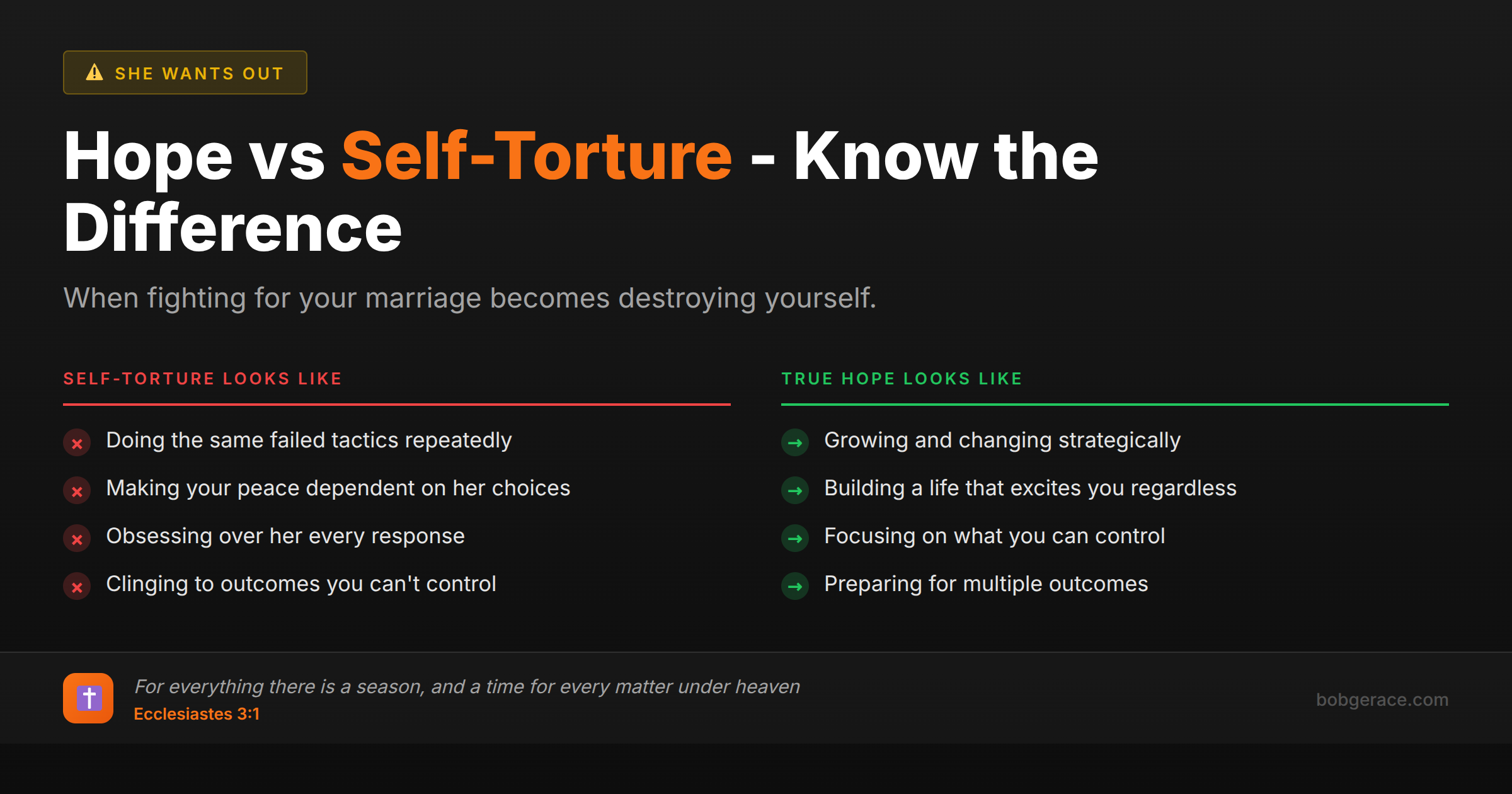
You cross from hope into self-torture when you're no longer growing, learning, or changing - you're just enduring. The line is crossed when your efforts become compulsive rather than strategic, when you're clinging to outcomes instead of committing to process, and when hope has become a drug that prevents you from facing reality. Self-torture looks like doing the same ineffective things repeatedly while expecting different results. It's staying stuck in victim mode, obsessing over her responses, and making your peace contingent on her choices. True hope, by contrast, involves honest assessment, personal growth, and preparing yourself for multiple outcomes - including ones you don't want.
The Full Picture
The difference between healthy persistence and self-torture isn't about time - it's about trajectory and intentionality. Many men torture themselves for months in marriages that could be restored, while others give up prematurely when they're actually making progress.
Signs you've crossed into self-torture: • You're not sleeping, eating, or functioning normally for extended periods • Your entire identity has become "saving the marriage" • You're monitoring her every move, mood, and word like a detective • You've stopped growing personally and are just "trying harder" at the same things • You're making decisions based on fear rather than wisdom • You've isolated yourself from friends, family, and activities that bring life
What healthy persistence looks like: • You're growing stronger, wiser, and more grounded regardless of her response • You have clear boundaries and stick to them • You're building a life you can be proud of whether she stays or goes • You're addressing your own issues with honesty and courage • You maintain perspective and can see progress even in small steps • You have support systems and outside interests that feed your soul
The goal isn't to eliminate all pain - crisis is supposed to hurt. The goal is ensuring your pain is productive pain that's moving you forward, not pointless pain that's keeping you stuck. When pain stops producing growth, it becomes torture.
What's Really Happening
From a psychological perspective, self-torture in marriage crisis often stems from trauma bonding and intermittent reinforcement. When someone we love withdraws affection unpredictably, our brains respond like a gambling addict - constantly seeking the next 'hit' of connection or hope.
This creates a neurochemical addiction to the pursuit itself. The anxiety, hypervigilance, and obsessive thoughts aren't just emotional responses - they're your brain's attempt to regain control in an uncontrollable situation. Unfortunately, this often leads to learned helplessness, where you become so focused on external validation that you lose touch with your own agency and worth.
Therapeutic research shows several key indicators of when hope becomes pathological: Cognitive rigidity (inability to consider alternative outcomes), emotional dysregulation lasting months without improvement, social isolation and loss of personal identity, and compulsive behaviors around monitoring or 'fixing' the relationship.
Healthy coping involves what we call radical acceptance - fully acknowledging reality while maintaining your capacity to influence what you can control. This doesn't mean giving up; it means shifting from outcome-focused hope to process-focused commitment. The goal becomes becoming the best version of yourself regardless of her response, which paradoxically creates the best possible conditions for reconciliation while protecting your mental health.
What Scripture Says
Scripture calls us to hope, but it also warns against foolish persistence that ignores reality. Proverbs 27:14 reminds us that even good things can become harmful when pursued without wisdom: "Whoever blesses his neighbor with a loud voice, rising early in the morning, will be counted as cursing."
Ecclesiastes 3:1-3 teaches us about seasons: "For everything there is a season, and a time for every matter under heaven: a time to be born, and a time to die; a time to plant, and a time to pluck up what is planted; a time to kill, and a time to heal." Sometimes the most loving thing is to stop pursuing and start preparing.
Galatians 6:9 encourages persistence: "Let us not grow weary of doing good, for in due season we will reap, if we do not give up." But notice it says "doing good" - not "doing the same ineffective things." Biblical persistence involves wisdom, growth, and adaptation.
Matthew 10:14 shows Jesus himself modeling healthy boundaries: "And if anyone will not receive you or listen to your words, shake off the dust from your feet when you leave that house or town." Even Christ didn't torture himself trying to convince people who weren't ready to receive his love.
The biblical balance is found in 1 Corinthians 13:7 - love "bears all things, believes all things, hopes all things, endures all things." But this same chapter defines love as patient, kind, not self-seeking, and not easily angered. Self-torture violates love itself.
What To Do Right Now
-
1
Conduct an honest 90-day review of your efforts and her responses - are you seeing any positive movement or just spinning wheels?
-
2
Identify three areas where you've been trying to control outcomes and commit to releasing them while controlling your own growth instead
-
3
Establish non-negotiable boundaries around your physical and mental health - sleep, exercise, nutrition, and time with supportive people
-
4
Create a life plan that excites you whether she participates or not - career, friendships, hobbies, spiritual growth, physical goals
-
5
Seek outside perspective from a counselor, coach, or trusted friends who will tell you truth rather than just what you want to hear
-
6
Set a specific timeline for major decisions and stick to it - not arbitrary deadlines, but realistic timeframes based on actual progress metrics
Related Questions
- How long do I wait before giving up?
- When is it actually over?
- Is there a point of no return?
- How do I know if I'm in denial or in faith?
- What does healthy hope look like vs. fantasy?
- When does waiting become enabling?
- Can I forgive before I'm ready?
- How do I live with uncertainty?
- What does self-care look like in this season?
- How do I grow regardless of outcome?
Also find Bob on
Subscribe for weekly videos on Christian marriage.
You Don't Have to Sort This Alone
A coach who knows your marriage can tell you what you can't see from inside it—whether you're building or just bleeding. Bring this question to someone in your corner.
Talk to Bob →