Why is this approach different from other things we've tried?
7 min read
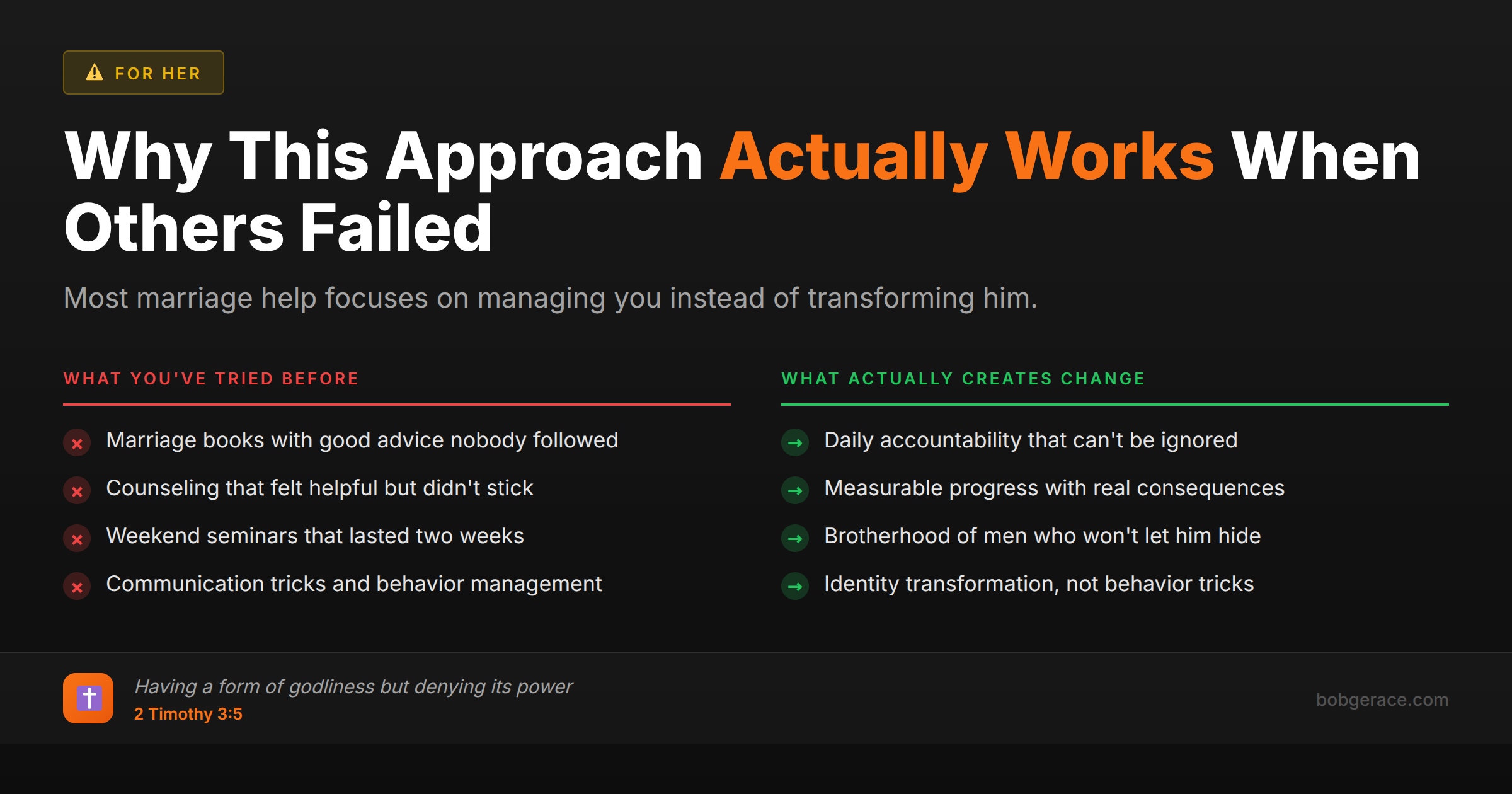
Most marriage approaches fail because they focus on the relationship while ignoring the people in it, they provide information without accountability, and they try to change behavior without addressing the identity beneath it. This approach is different because it focuses on transforming the man himself—not managing your reactions or teaching communication tricks—through daily accountability, measurable progress, and a brotherhood of men who won't let him hide. You've probably tried marriage books that gave good advice nobody followed. Counseling sessions that felt helpful but didn't translate to real life. Weekend seminars where he came home fired up for two weeks before reverting. The difference here isn't better information—it's a structure that makes transformation inevitable when he actually engages.
The Full Picture
Let me validate something: it's not your imagination that nothing has worked before. The marriage improvement industry is full of programs that sound good, feel helpful in the moment, and produce zero lasting change. You're not crazy for being skeptical.
Here's why those approaches failed and why this one is structured differently:
Most programs focus on 'the marriage.' This one focuses on the man.
Traditional marriage counseling puts two wounded people in a room and asks them to work on 'the relationship.' But the relationship isn't the problem—the people in it are. If he's emotionally unregulated, spiritually disconnected, physically neglected, and vocationally lost, no amount of communication techniques will save your marriage. This program transforms the man first, which transforms his capacity for relationship.
Most programs provide information. This one provides accountability.
Your husband probably knows what he's supposed to do. He's read the books or heard the sermons. Knowledge isn't his problem—implementation is. This program includes daily check-ins, weekly reporting, measurable metrics, and other men who call out his excuses. There's nowhere to hide behind good intentions.
Most programs work on behavior. This one works on identity.
Behavior change without identity change is performance. It's exhausting and unsustainable. When a man fundamentally sees himself differently—as a warrior, a protector, a leader worth following—his behaviors naturally align. This program doesn't just tell him to be different; it makes him different at the core.
Most programs isolate him with you. This one surrounds him with men.
Research is clear: men change in the company of other men who hold them to standards. Your nagging hasn't worked because that's not how men are wired to receive correction. But when he's in a brotherhood of men who've walked this path, who see through his excuses, and who model what he's trying to become—that's when change becomes possible.
Most programs end. This one transitions to lifestyle.
The 'I finished the program' mentality is why most approaches fail long-term. This isn't a program to complete; it's a way of living to adopt. The daily disciplines, the accountability structures, the ongoing brotherhood—these continue because they're not homework, they're habits.
What's Really Happening
Research in behavioral psychology identifies several factors that predict successful versus unsuccessful intervention. Most marriage programs fail on multiple counts:
Information deficit is rarely the actual problem. Studies show that most people in dysfunctional patterns know what they should do differently. The gap isn't knowledge—it's implementation. Effective intervention must bridge the 'knowing-doing gap' through structure, accountability, and sustained support.
Motivation through insight alone doesn't produce change. Traditional talk therapy operates on the assumption that understanding leads to change. But research shows that insight without behavioral practice and environmental restructuring rarely produces lasting transformation. This program combines insight with daily behavioral requirements and accountability structures.
Couples work often fails when individual pathology isn't addressed first. Asking two dysregulated individuals to 'work on communication' is clinically naive. One or both partners typically need individual work before couples intervention becomes effective. This program addresses his individual issues first.
Peer support dramatically increases success rates. Research on addiction //blog.bobgerace.com/christian-marriage-recovery-theater-3-breakthrough/:recovery, weight loss, and behavior change consistently shows that peer accountability outperforms individual effort by significant margins. The brotherhood component isn't optional—it's clinically essential.
Staged intervention prevents premature reconciliation. A major predictor of relapse is attempting intimacy work before safety and trust are established. The Four Theater system builds in appropriate staging that prevents the premature reconciliation trap.
What Scripture Says
Scripture warns against approaches that look spiritual but lack transformative power.
"Having a form of godliness but denying its power" (2 Timothy 3:5). Many Christian marriage resources have the right language but lack the structure to produce real change. They feel godly without actually transforming anyone.
"Do not merely listen to the word, and so deceive yourselves. Do what it says" (James 1:22). The emphasis on daily, measurable, accountable action reflects this biblical priority. Information without implementation is self-deception.
"As iron sharpens iron, so one person sharpens another" (Proverbs 27:17). The brotherhood component isn't a nice addition—it's biblically essential. Men sharpen men. Your role isn't to be his accountability partner; that's what the brotherhood is for.
"Walk with the wise and become wise, for a companion of fools suffers harm" (Proverbs 13:20). Surrounding himself with men who are ahead of him on this journey—men who won't accept his excuses—is the path Scripture prescribes.
"The one who is faithful in a very little is also faithful in much" (Luke 16:10). Real change shows up in daily habits before it shows up in grand gestures. This approach builds from the ground up through consistent daily faithfulness.
Consider how Jesus developed His disciples: He didn't send them to a weekend seminar. He walked with them daily for years. He gave them assignments and accountability. He corrected them consistently. Transformation happened through sustained, daily, accountable relationship—exactly what this program provides.
What This Means for You Right Now
-
1
Release expectations from past failures - What didn't work before doesn't predict what will work now if the approach is fundamentally different
-
2
Notice the structure, not just the content - Is he actually being held accountable daily? Is there measurement and consequence? That's what makes this different
-
3
Let go of the 'meeting halfway' expectation - His transformation is his work. You don't have to change for him to change
-
4
Give it enough time to evaluate fairly - A new approach deserves a real trial period before judgment, typically 3-6 months minimum
-
5
Watch for the signs of this different approach - Individual focus, daily accountability, measurable progress, appropriate staging for your situation
-
6
Maintain healthy skepticism without premature dismissal - You're right to be cautious, but don't let past failures prevent you from recognizing something genuinely different
Related Questions
- What is this program actually teaching him?
- What are the Four Theaters he keeps mentioning?
- How long does real change actually take?
- What should I expect during this process?
- What if he's only doing this to keep me from leaving?
- Is he just learning to manipulate me better?
- What does 'the work' actually mean?
- What makes change sustainable vs. temporary?
- Why do behavior changes alone not work?
Also find Bob on
Subscribe for weekly videos on Christian marriage.
Think This Could Help Your Husband?
If you believe your husband could benefit from the structured transformation process we offer, share this with him. Real change is possible when men commit to the work.
Learn About the Program →