What does biblical forgiveness require of me?
6 min read
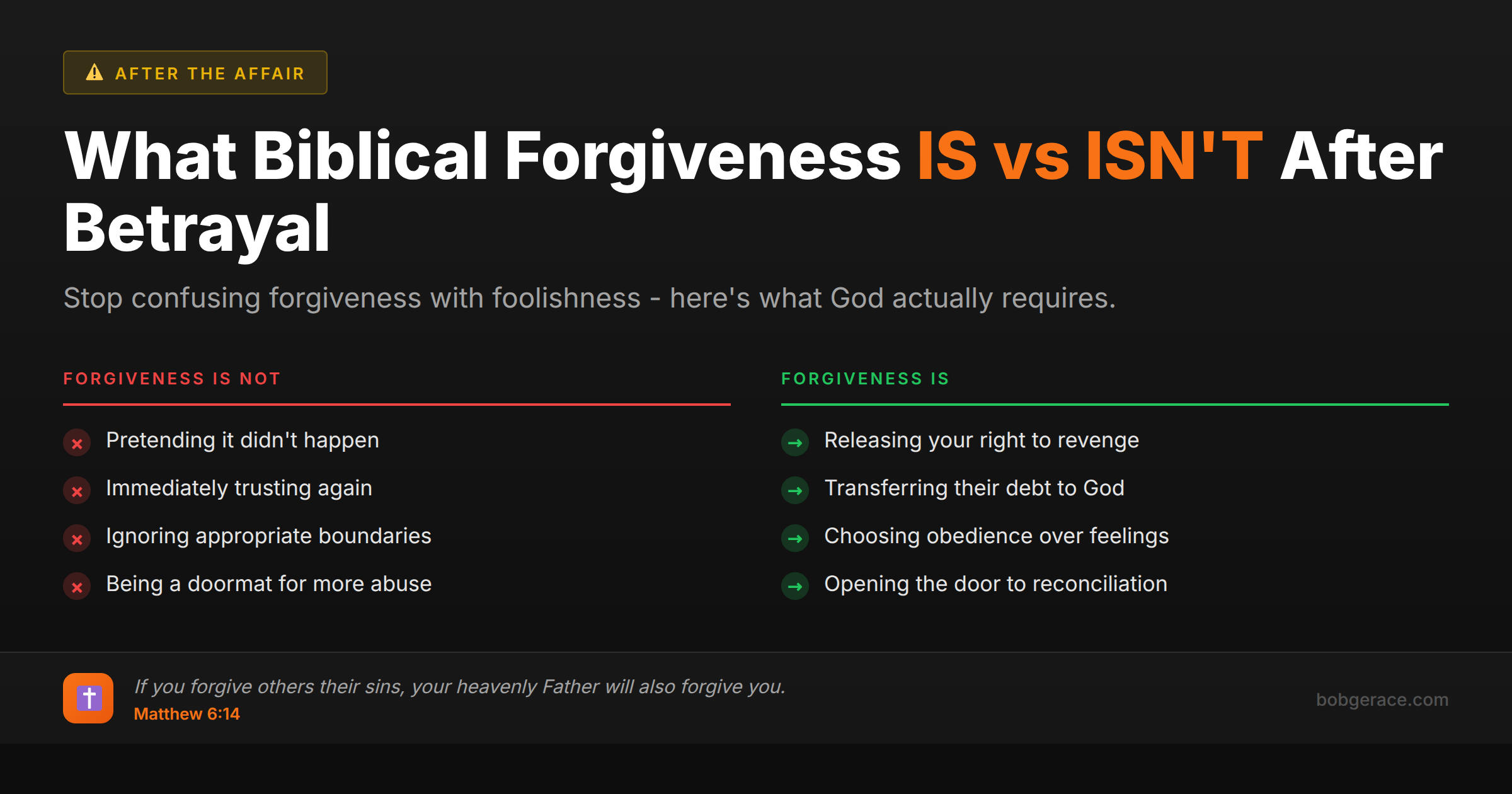
Biblical forgiveness requires you to make a deliberate choice to release your right to revenge and transfer the debt your spouse owes you to God's account. This doesn't mean pretending the betrayal didn't happen or immediately trusting again - it means choosing not to hold their sin against them while still maintaining appropriate boundaries. Forgiveness is not a feeling but an act of obedience to Christ. It requires acknowledging the full weight of the hurt, choosing to forgive despite the pain, and committing to not use their betrayal as ammunition in future conflicts. True biblical forgiveness opens the door for potential reconciliation but doesn't guarantee it or require you to expose yourself to continued harm.
The Full Picture
Biblical forgiveness after an affair is one of the most misunderstood concepts in Christian marriage recoveryy. Too often, well-meaning believers are told to "just forgive and move on" or that forgiveness means immediate reconciliation and trust restoration. This shallow understanding causes more damage than healing.
True biblical forgiveness is both costly and freeing. It costs you your right to revenge, your desire to make them pay, and your justification for withholding love indefinitely. But it frees you from the prison of bitterness and opens your heart to God's healing work.
Forgiveness doesn't mean: - Pretending the affair didn't happen - Immediately trusting your spouse again - Removing all consequences for their choices - Suppressing your emotions or pain - Accepting responsibility for their infidelity - Rushing back into intimacy before healing occurs
What forgiveness does require is a transfer of the debt. Instead of your spouse owing you for their betrayal, you hand that debt over to God. This doesn't minimize their sin - it acknowledges that ultimately, all sin is against God, and He is the righteous judge who will settle all accounts.
This process rarely happens in a single moment. For most betrayed spouses, forgiveness is a daily choice, especially in early recovery when triggers and new discoveries can reignite the pain. Each time you choose forgiveness over revenge, you're walking in obedience to Christ and creating space for God to work in both your hearts.
What's Really Happening
From a therapeutic perspective, //blog.bobgerace.com/marriage-vision-biblical-transformation-frog-king/:biblical forgiveness aligns beautifully with healthy psychological recovery from betrayal trauma. When we understand forgiveness as a choice rather than a feeling, we empower the betrayed spouse to take agency in their healing process rather than waiting for emotions to change.
Neurologically, holding onto resentment keeps the brain's threat-detection systems activated, flooding the body with stress hormones that impede healing. The act of forgiveness - releasing the right to revenge - begins to calm these systems and allows for genuine processing of the trauma.
However, forgiveness without boundaries is not biblical or psychologically healthy. True forgiveness creates space for accountability, consequences, and the rebuilding of trust through demonstrated change. When we conflate forgiveness with immediate reconciliation, we often enable further betrayal and prevent genuine repentance.
In my practice, I've observed that spouses who embrace biblical forgiveness while maintaining appropriate boundaries experience deeper healing and more sustainable marriage restoration. They're able to process their pain without becoming imprisoned by it, and they create an environment where authentic repentance and change can occur.
The key is understanding that forgiveness is about your relationship with God and your own spiritual health, not about letting your spouse off the hook or rushing the reconciliation process.
What Scripture Says
Scripture provides clear guidance on the nature and requirements of forgiveness, especially in the context of marriage covenant.
Matthew 6:14-15 establishes the non-negotiable nature of forgiveness: *"For if you forgive other people when they sin against you, your heavenly Father will also forgive you. But if you do not forgive others their sins, your Father will not forgive your sins."* This isn't about earning God's forgiveness but about maintaining an open heart that can receive and extend grace.
Ephesians 4:31-32 describes the transformation forgiveness brings: *"Get rid of all bitterness, rage and anger, brawling and slander, along with every form of malice. Be kind and compassionate to one another, forgiving each other, just as in Christ God forgave you."* Notice that forgiveness follows the removal of bitterness - it's not about suppressing emotions but processing them in healthy ways.
Luke 17:3-4 shows that forgiveness doesn't eliminate accountability: *"If your brother or sister sins against you, rebuke them; and if they repent, forgive them. Even if they sin against you seven times in a day and seven times come back to you saying 'I repent,' you must forgive them."* Biblical forgiveness actually requires confronting sin, not ignoring it.
Matthew 18:15-17 provides the framework for addressing sin in relationships, showing that forgiveness works alongside accountability and consequences. When someone sins against you, you address it directly, involve witnesses if needed, and even separate if there's no repentance.
These passages reveal that biblical forgiveness is both merciful and just, both gracious and truthful.
What To Do Right Now
-
1
Acknowledge the full extent of your pain and anger to God - don't minimize or spiritualize away your emotions
-
2
Make a conscious choice to release your right to revenge, even if you don't feel like it yet
-
3
Pray specifically for God to settle the accounts, transferring the debt from your spouse to Him
-
4
Set clear boundaries that protect you while creating space for your spouse's repentance and change
-
5
Refuse to use the affair as ammunition in arguments or as a weapon to punish your spouse
-
6
Seek godly counsel to help you distinguish between forgiveness, reconciliation, and trust rebuilding
Related Questions
- Can I forgive without trusting?
- What's the difference between forgiveness and reconciliation?
- Does forgiveness mean no consequences?
- How do I forgive when she hasn't fully repented?
- What does 'seventy times seven' mean practically?
- How do I model grace without enabling?
- What does forgiveness require regarding consequences?
- What does grace look like practically?
- How do I honor my parents while breaking from their patterns?
- How do I pray for my wife when she's hurting me?
Also find Bob on
Subscribe for weekly videos on Christian marriage.
Forgiveness in Your Actual Marriage
Biblical forgiveness is clear in theory. Applying it to the specific betrayal you're carrying—without losing yourself or enabling—requires a coach who knows your story.
Talk to Bob →