What did the Pharisees believe about divorce?
6 min read
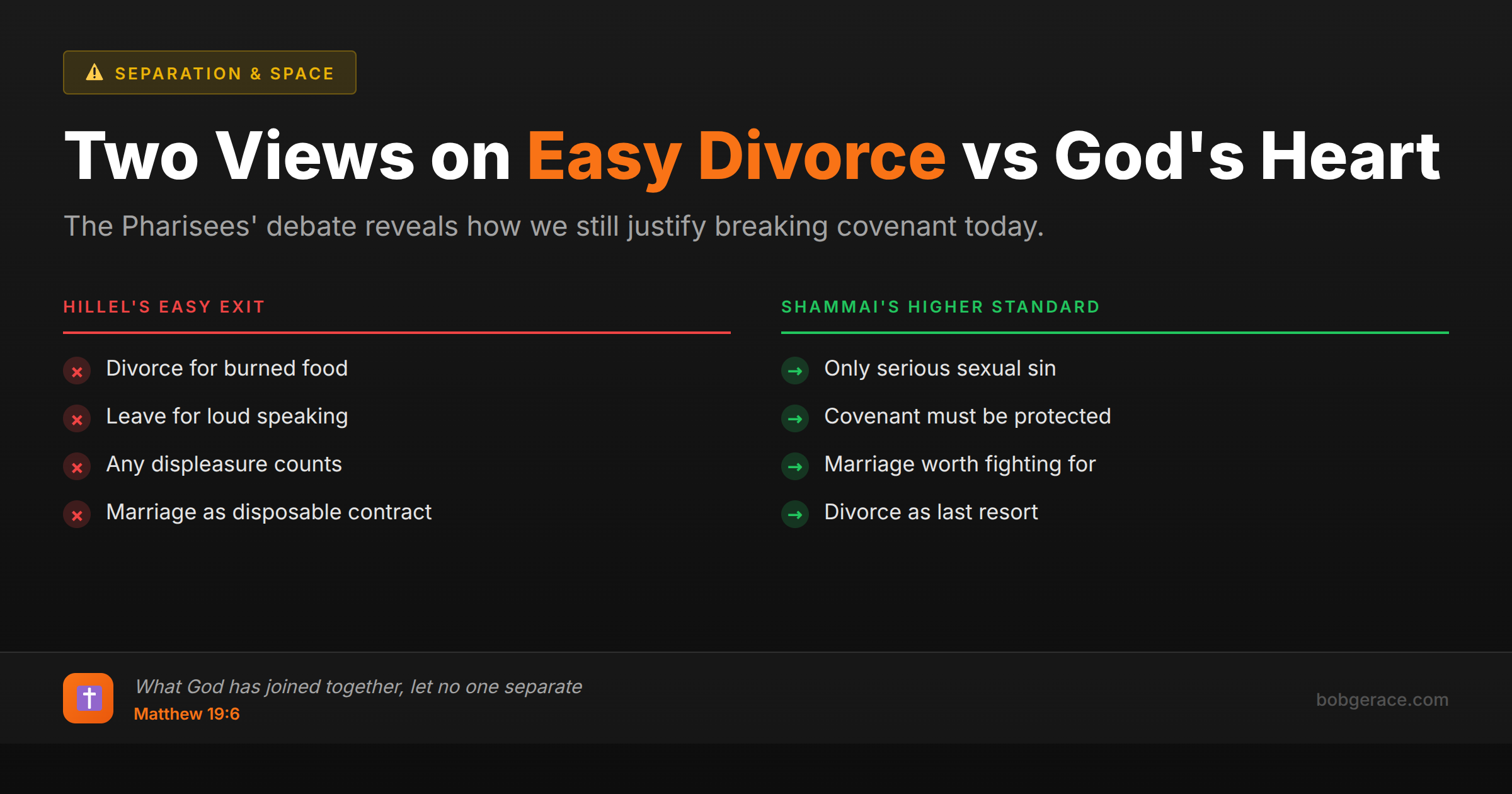
The Pharisees held two major schools of thought on divorce during Jesus' time. The school of Hillel took a liberal approach, allowing divorce for almost any reason a husband found displeasing about his wife - even burning his food or speaking too loudly. They interpreted 'some uncleanness' in Deuteronomy 24:1 very broadly. The school of Shammai was much stricter, teaching that divorce was only permissible for serious sexual immorality or adultery. This created ongoing debate among Jewish religious leaders. When the Pharisees questioned Jesus about divorce in Matthew 19, they weren't seeking genuine guidance - they were trying to trap Him into taking sides in this controversial debate that had divided their religious community for generations.
The Full Picture
To understand what the Pharisees believed about divorce, we need to step into first-century Jewish culture where religious leaders were deeply divided on this issue. The Pharisees weren't a monolithic group - they represented different schools of thought with dramatically different interpretations of God's law.
The School of Hillel: The Liberal View
Rabbi Hillel's followers took an extremely permissive stance on divorce. They interpreted Deuteronomy 24:1, which mentions a man divorcing his wife because he found 'some uncleanness in her,' to mean virtually anything that displeased a husband. According to their teaching, a man could divorce his wife for: - Burning his dinner - Speaking too loudly in public - Talking to other men - Not bearing children - Simply finding another woman more attractive
This interpretation gave men almost unlimited power to end their marriages for trivial reasons, leaving women vulnerable and often destitute.
The School of Shammai: The Strict View
Rabbi Shammai's school took the opposite approach, interpreting 'some uncleanness' to mean serious sexual impropriety or adultery. They believed divorce should be rare and only for the most serious moral failures.
The Trap They Set for Jesus
When the Pharisees asked Jesus about divorce in Matthew 19:3, they weren't seeking wisdom - they were setting a trap. No matter which school Jesus sided with, He would alienate half the religious establishment and potentially face political consequences. If He supported Hillel's view, He'd be seen as too liberal. If He supported Shammai's view, He might face the same fate as John the Baptist, who was killed for condemning Herod's divorce and remarriage.
What's Really Happening
The Pharisees' conflicting divorce teachings reveal a pattern we still see today - people interpreting Scripture to justify what they want to do rather than seeking God's true intent. This phenomenon, called 'confirmation bias' in psychology, occurs when individuals cherry-pick information that supports their predetermined conclusions while ignoring contradictory evidence.
The school of Hillel's extremely liberal interpretation essentially made marriage a disposable contract, which created significant psychological trauma for the women and children involved. When marriage lacks permanence and security, it cannot provide the stable foundation that healthy families require. Modern research consistently shows that children from broken homes face higher rates of behavioral problems, academic difficulties, and relationship struggles - patterns that likely existed in ancient times as well.
Conversely, the school of Shammai's rigid approach, while closer to God's original design, could trap people in genuinely dangerous or destructive situations. This legalistic interpretation missed the heart of God's compassion for those truly suffering in their marriages.
What's particularly striking is how both schools focused on men's rights while largely ignoring women's welfare. In that patriarchal society, women had little voice in these debates despite being the most affected by these decisions. This reflects how religious systems can become tools of oppression rather than liberation when they lose sight of God's heart for justice and mercy.
The psychological principle here is crucial: when we approach Scripture primarily to justify our desires rather than to understand God's will, we inevitably distort its meaning and cause harm to ourselves and others.
What Scripture Says
Scripture provides clear insight into both the Pharisees' beliefs and God's true intent for marriage. Let's examine the key passages:
The Foundational Text They Debated: *"When a man takes a wife and marries her, if then she finds no favor in his eyes because he has found some indecency in her, and he writes her a certificate of divorce and puts it in her hand and sends her out of his house..."* - Deuteronomy 24:1
This passage wasn't commanding divorce but regulating an existing practice. The Hebrew phrase 'ervat davar' (some indecency) became the center of controversy between the schools of Hillel and Shammai.
Jesus' Response to Their Trap: *"He answered, 'Have you not read that he who created them from the beginning made them male and female, and said, "Therefore a man shall leave his father and his mother and hold fast to his wife, and the two shall become one flesh"? So they are no longer two but one flesh. What therefore God has joined together, let not man separate.'"* - Matthew 19:4-6
Notice that Jesus didn't choose either Pharisaical school. Instead, He went back to God's original design in Genesis, emphasizing marriage's permanence and sacred nature.
God's Heart on the Matter: *"'For the man who does not love his wife but divorces her, says the Lord, the God of Israel, covers his garment with violence, says the Lord of hosts. So guard yourselves in your spirit, and do not be faithless.'"* - Malachi 2:16
The Principle Behind the Law: *"And this second thing you do. You cover the Lord's altar with tears, with weeping and groaning because he no longer regards the offering or accepts it with favor from your hand."* - Malachi 2:13
God's concern wasn't just about legal technicalities but about the pain and injustice caused by cavalier attitudes toward marriage.
What To Do Right Now
-
1
Study Scripture to understand God's heart, not just to find justification for what you want to do
-
2
Recognize that marriage is a covenant relationship, not a disposable contract based on feelings
-
3
Examine whether you're approaching your marriage conflicts with a Hillel mindset (looking for easy exits) or seeking genuine reconciliation
-
4
If you're struggling in marriage, seek biblical counseling before considering any major decisions
-
5
Pray for God's wisdom to see your spouse and marriage through His eyes, not cultural expectations
-
6
Commit to fighting FOR your marriage rather than fighting AGAINST your spouse
Related Questions
- What does Scripture say about divorce?
- What did Jesus say about divorce?
- What is the Deuteronomy 24 background?
- What is Jesus' teaching in Matthew 5 vs. Matthew 19?
- What does Mark 10 add to the picture?
- What's the exception clause?
- What does biblical forgiveness require of me?
- What does the Bible say about boundaries?
- Does God want me to stay in this marriage?
Also find Bob on
Subscribe for weekly videos on Christian marriage.
Bring Your Actual Marriage to a Coach
Theology is one thing. Your specific situation is another. A coach who knows your story can help you apply what's true to what's real in your marriage right now.
Talk to Bob →