What is the Deuteronomy 24 background?
6 min read
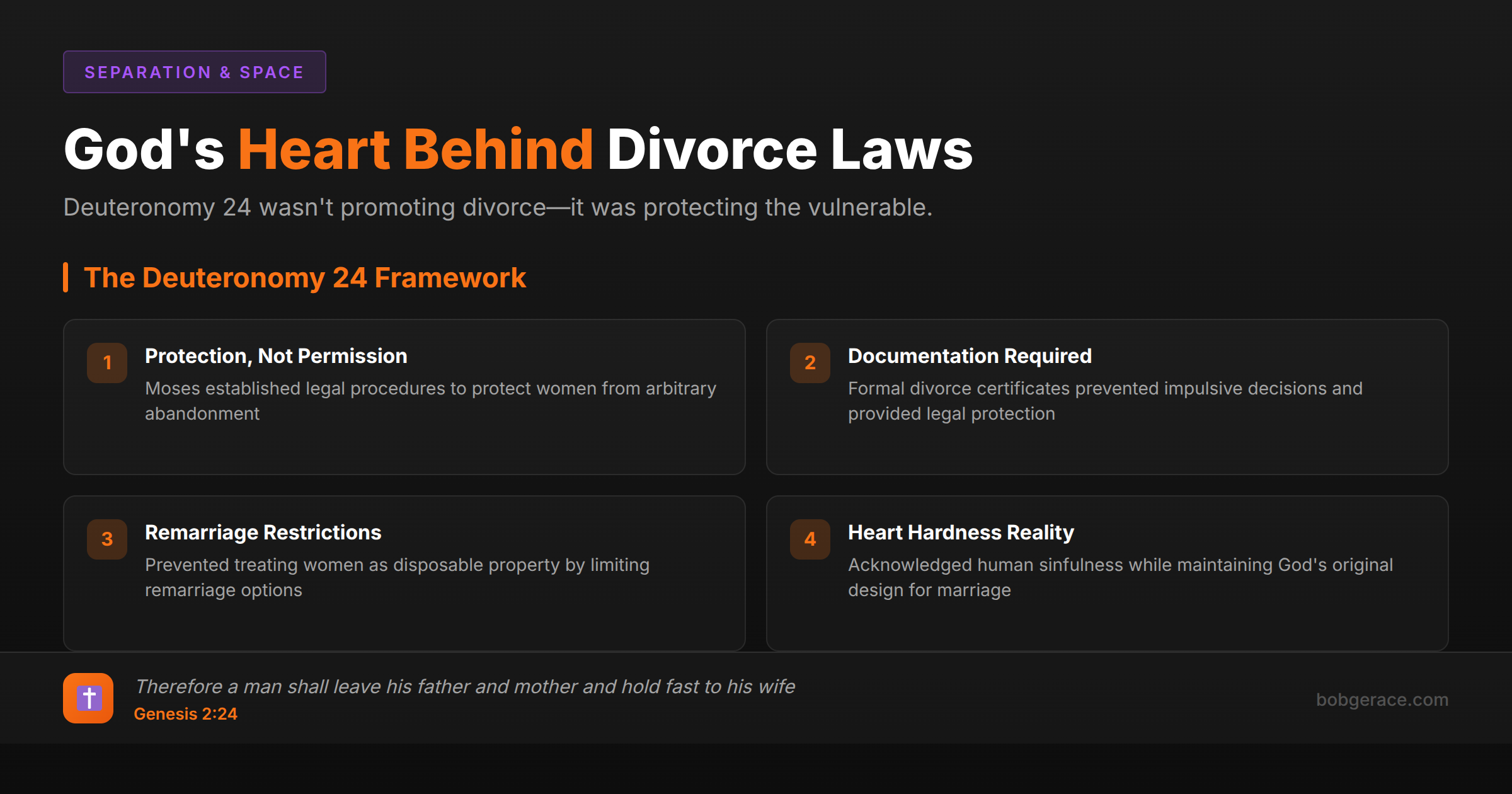
Deuteronomy 24:1-4 addresses divorce in ancient Israel, establishing legal procedures rather than promoting divorce. Moses permitted divorce certificates due to the hardness of people's hearts, as Jesus later explained. This passage protected women from arbitrary abandonment by requiring formal documentation and preventing remarriage to the original husband after divorce and remarriage to another. The law provided social and economic protection for women in a patriarchal society where divorced women faced severe disadvantages. Understanding this background helps us see that God's original design for marriage remains permanent union, while recognizing the reality of human sinfulness requires practical provisions.
The Full Picture
Deuteronomy 24:1-4 sits within Israel's comprehensive legal code, addressing the messy reality of broken marriages in ancient society. This wasn't God endorsing divorce—it was Moses establishing guardrails around an already existing practice.
The historical context matters enormously. In ancient Near Eastern cultures, men could dismiss wives on a whim, leaving women destitute and defenseless. Moses' law required written documentation, creating legal accountability and social protection. The Hebrew phrase "some uncleanness" (erwat dabar) was deliberately vague, leading to later rabbinic debates between strict and lenient interpretations.
The prohibition against remarrying the original spouse after divorce and remarriage to another served multiple purposes. It prevented casual divorce-and-remarriage cycles, treated marriage seriously as covenant relationship, and avoided what God calls "detestable" behavior that would defile the land.
Jesus' commentary in Matthew 19:3-9 provides crucial interpretation. He explained that Moses "permitted" divorce due to hardness of heart, but "from the beginning it was not so." This reveals God's original intent: permanent, exclusive marriage union reflecting His covenant faithfulness.
The passage functions as case law, establishing precedent for handling divorce situations while upholding marriage's sacred nature. It balances practical reality with divine ideals, protecting the vulnerable while maintaining covenant standards.
What's Really Happening
Understanding Deuteronomy 24's background helps modern couples navigate marriage challenges with proper perspective. This passage reveals timeless principles about covenant commitment, legal protection, and human nature that remain relevant today. Moses addressed divorce not to encourage it, but to regulate an existing practice that was causing harm, particularly to women who had no legal recourse.
The psychological insight here is profound: humans struggle with permanent commitment due to what Scripture calls "hardness of heart." This refers to our tendency toward self-protection, pride, and resistance to sacrificial love. Modern couples face identical challenges—the temptation to abandon marriage when difficulties arise rather than working through problems with grace and perseverance.
The legal protections Moses established mirror what healthy marriages need today: clear communication, mutual accountability, and safeguards against impulsive decisions. The requirement for written documentation forced deliberation rather than emotional reactivity. Similarly, modern couples benefit from structured approaches to conflict resolution, counseling, and community accountability.
Most importantly, this passage demonstrates God's heart for the vulnerable. The regulations protected women from economic and social devastation. Today's application involves creating marriages where both spouses feel secure, valued, and protected—emotionally, spiritually, and practically.
What Scripture Says
Scripture presents a consistent framework for understanding marriage and divorce, with Deuteronomy 24 fitting within God's broader covenant purposes.
Genesis 2:24 establishes the original design: *"Therefore a man shall leave his father and mother and hold fast to his wife, and they shall become one flesh."* This permanent union reflects God's intent from creation.
Malachi 2:16 reveals God's heart: *"For the man who does not love his wife but divorces her, says the Lord, the God of Israel, covers his garment with violence."* God hates divorce because it violates covenant love and causes deep harm.
Matthew 19:8-9 provides Jesus' authoritative interpretation: *"Because of your hardness of heart Moses allowed you to divorce your wives, but from the beginning it was not so. And I say to you: whoever divorces his wife, except for sexual immorality, and marries another, commits adultery."*
1 Corinthians 7:10-11 gives clear direction: *"To the married I give this charge (not I, but the Lord): the wife should not separate from her husband (but if she does, she should remain unmarried or else be reconciled to her husband), and the husband should not divorce his wife."*
Ephesians 5:25-33 elevates marriage as a picture of Christ's relationship with the church, demonstrating the sacrificial love that makes permanent union possible.
These passages together show that while God made provision for divorce due to human sinfulness, His design and desire remain lifelong covenant marriage.
What To Do Right Now
-
1
Study the full biblical context of marriage and divorce, not just isolated verses
-
2
Examine your own heart for areas of hardness that resist sacrificial love and commitment
-
3
Seek to understand God's protective heart behind biblical marriage laws
-
4
Apply the protective principles—clear communication, accountability, and safeguards against impulsive decisions
-
5
Focus on covenant love that mirrors Christ's commitment to the church
-
6
Get biblical counseling if your marriage is struggling rather than considering divorce as first option
Related Questions
- What does Scripture say about divorce?
- What did Jesus say about divorce?
- What's the exception clause?
- What did the Pharisees believe about divorce?
- What is Jesus' teaching in Matthew 5 vs. Matthew 19?
- What does Mark 10 add to the picture?
- What does biblical forgiveness require of me?
- What's the difference between forgiveness and reconciliation?
- Does the Bible require me to stay after an affair?
Also find Bob on
Subscribe for weekly videos on Christian marriage.
Bring Your Marriage to a Coach
Biblical principles matter most when applied to your actual situation. A coach who knows your story can help you see what obedience looks like in your marriage, not just marriage in general.
Talk to Bob →