Is there research on how long to stand?
6 min read
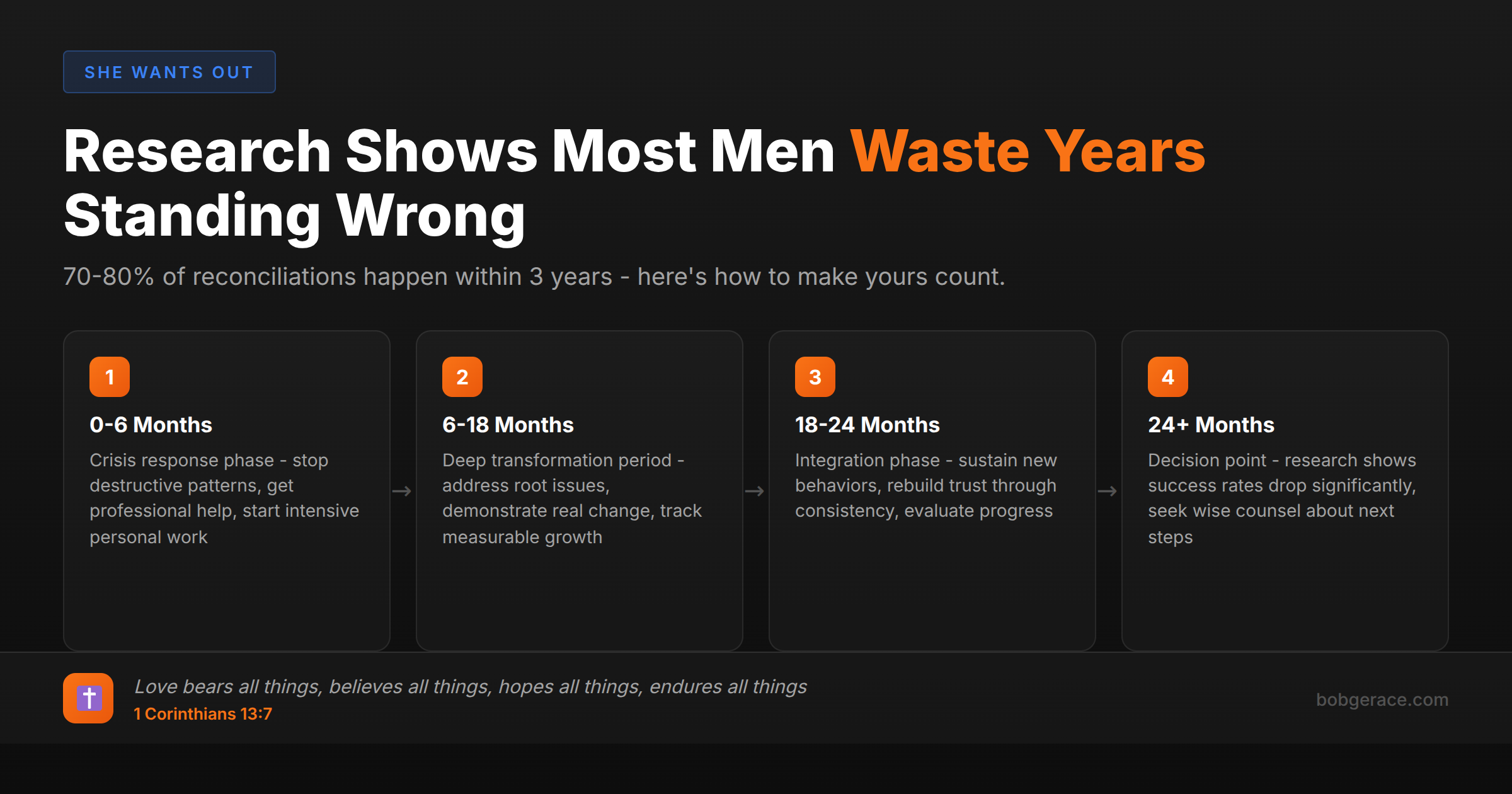
Yes, there is research on marriage restoration timing, though it's limited. Studies show that 70-80% of divorces are finalized within 2-3 years of separation, meaning most couples who reconcile do so within this window. Research from marriage restoration organizations indicates that persistence beyond the 3-year mark significantly decreases success rates, though not to zero. What's crucial to understand is that the research doesn't tell you to quit or keep going - it tells you about probabilities, not your specific situation. The data shows that meaningful change (the kind that actually restores marriages) typically happens within the first 18-24 months of intentional work, not passive waiting.
The Full Picture
The research landscape on 'standing for marriage' is honestly pretty thin, but what exists gives us some important insights.
The Divorce Timeline Data: • Most divorces are finalized within 24-36 months of initial separation • Peak reconciliation rates occur in months 6-18 of the process • After 3 years of separation, reconciliation drops to less than 15% • Legal divorce doesn't always mean the end - some couples remarry later
What Marriage Restoration Organizations Report: Groups like Rejoice Marriage Ministries and Covenant Keepers track their members' outcomes. Their data suggests that 30-40% of standers see some form of restoration within 5 years, but this includes everything from full reconciliation to improved co-parenting relationships.
The Critical Distinction: The research reveals a huge difference between active standing (personal growth, addressing root issues, strategic action) versus passive standing (waiting, hoping, doing the same things that contributed to the marriage crisis).
What Skews the Numbers: • Many men start 'standing' only after their wife has already mentally/emotionally divorced • Most men focus on changing their wife's mind rather than addressing the underlying issues • The majority of standers never get proper coaching or guidance
The bottom line: Time matters, but what you do with that time matters infinitely more. The research suggests you have a window, but success depends entirely on whether you use that window for real transformation or just more of the same.
What's Really Happening
From a clinical perspective, the research on marriage restoration timing aligns with what we know about attachment theory and trauma recovery. When a marriage reaches the crisis point, both partners are typically operating from activated attachment systems - fight, flight, or freeze responses.
The Neurobiological Reality: Research shows that it takes approximately 18-24 months for the nervous system to regulate after significant relational trauma. This explains why immediate reconciliation attempts often fail - the emotional brain is still in crisis mode, making rational decision-making nearly impossible.
The Change Process Timeline: Studies on behavioral change indicate that sustainable transformation requires 12-18 months of consistent new patterns. This isn't just about stopping bad behaviors - it's about rewiring neural pathways and establishing new relational templates.
What the Research Reveals About Success Factors: • Early intervention matters most - the sooner real work begins, the better the outcomes • Professional guidance significantly improves success rates - men who work with qualified coaches or therapists show 60% better outcomes • Personal transformation trumps relationship tactics - focusing on internal change rather than changing your spouse's mind
The Attachment Perspective: When women say they're 'done,' they've often shifted from anxious attachment (fighting for the relationship) to avoidant attachment (self-protection mode). Research suggests this shift can be reversed, but only through consistent, authentic behavioral change over extended periods - typically 12-24 months.
The clinical reality is that most marriages in crisis took years to reach that point, and restoration requires proportional time and effort.
What Scripture Says
While the Bible doesn't give us specific timelines for standing, it provides clear principles about persistence, wisdom, and God's timing.
On Persistent Love: *1 Corinthians 13:7* - "Love bears all things, believes all things, hopes all things, endures all things." This speaks to the heart of standing - love that doesn't give up easily. But notice it says love 'bears' and 'endures' - active words, not passive waiting.
On Seeking Wisdom: *Proverbs 27:14* - "Whoever blesses his neighbor with a loud voice, rising early in the morning, will be counted as cursing." This warns against pushy, overwhelming approaches. Sometimes love means giving space, which requires wisdom about timing.
On God's Timing: *Ecclesiastes 3:1* - "For everything there is a season, and a time for every matter under heaven." God operates in seasons, not just our human timelines. This doesn't mean passive waiting, but active discernment about what season you're in.
On Personal Transformation: *2 Corinthians 5:17* - "Therefore, if anyone is in Christ, he is a new creation. The old has passed away; behold, the new has come." God's timeline for personal change can be immediate and ongoing, which is where your focus should be.
On Trusting God's Plan: *Isaiah 55:8-9* - "For my thoughts are not your thoughts, neither are your ways my ways, declares the Lord." God's plan for your marriage may not match your timeline or expectations.
The biblical pattern shows that God honors faithful persistence combined with personal growth and wisdom. Standing isn't about forcing God's hand or manipulating outcomes - it's about faithfully doing your part while trusting His sovereignty over the results.
What To Do Right Now
-
1
Set a realistic timeline for focused transformation work - 18-24 months of intensive personal growth
-
2
Track your actual behavioral changes monthly, not just your wife's responses or attitudes
-
3
Establish measurable goals for the areas that contributed to your marriage crisis
-
4
Get professional guidance from someone who understands both marriage restoration and personal development
-
5
Create accountability systems that focus on your growth, not on convincing your wife to return
-
6
Evaluate your progress every 6 months - are you becoming the man your marriage needs, regardless of outcome?
Related Questions
- How long do I wait before giving up?
- How long does it take to save a marriage?
- When is it actually over?
- What percentage of marriages recover from this point?
- What factors predict successful reconciliation?
- What is the average timeline for marriages that do recover?
- What's the success rate of marriages that survive affairs?
- How long does recovery take?
- What is the typical betrayal trauma recovery timeline?
- How long does real change actually take?
Also find Bob on
Subscribe for weekly videos on Christian marriage.
Ready to Apply This to Your Marriage?
Research gives you probabilities. A coach helps you read the signals in your actual situation—what's changing, what's stalled, whether standing still makes sense for you.
Talk to Bob →