Kids are caught in the middle — how do I protect them?
6 min read
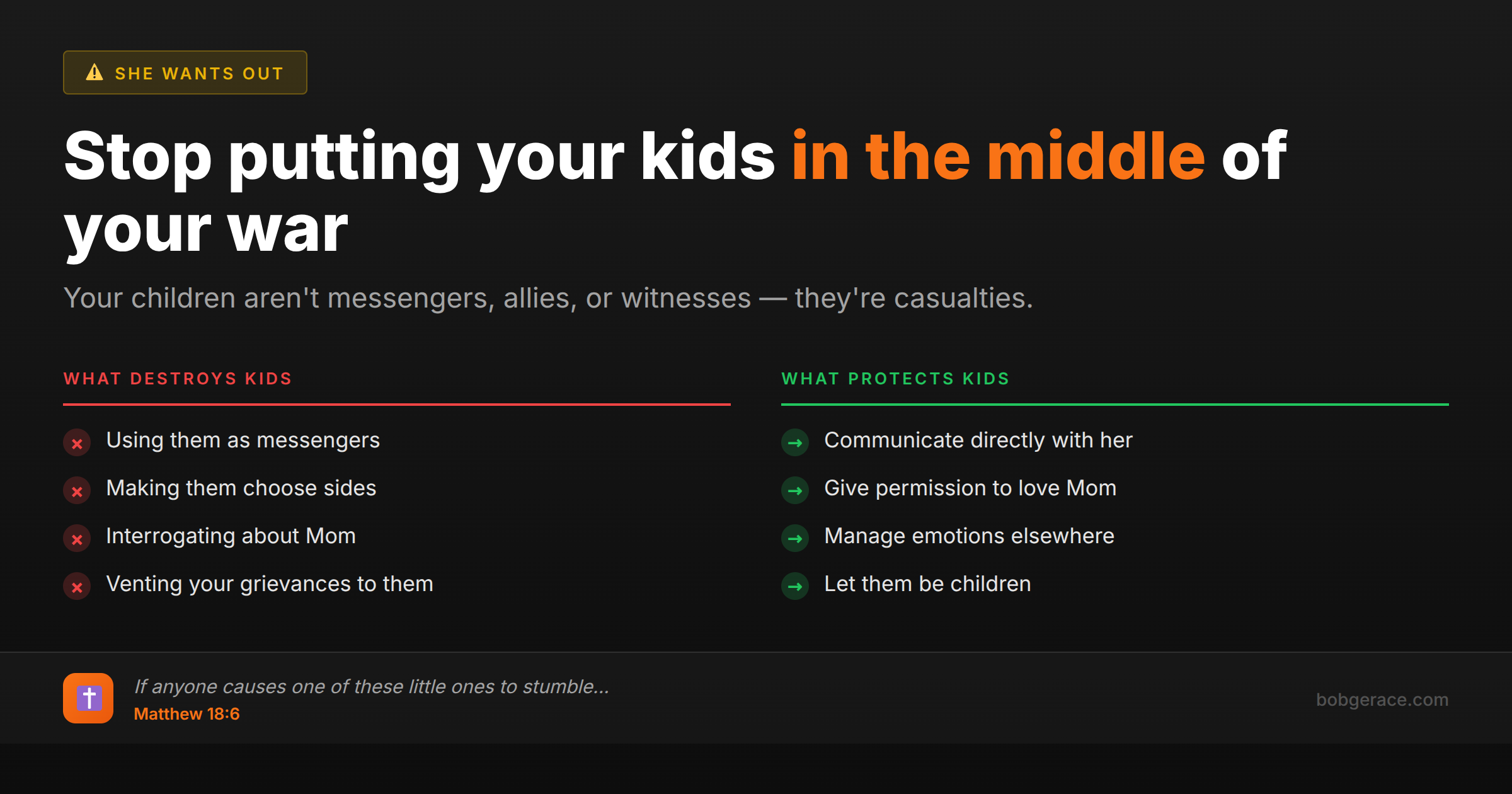
Stop putting them there. They're 'in the middle' because adults are treating them as messengers, allies, or witnesses. Your job: communicate directly with her (not through them), never ask them to choose sides, don't interrogate them about her, don't share your grievances with them, and manage your own emotions instead of leaking them all over your children. They should feel loved by both parents, not caught between two warring camps.
The Full Picture
Children get 'caught in the middle' through adult behavior, not their own choices. Protecting them means changing how you operate.
How children end up in the middle:
As messengers: 'Tell your mom I need the schedule.' Children shouldn't carry information between parents. Use direct communication.
As spies: 'What does Mom do on weekends? Is anyone else around?' Interrogating them about her life puts them in an impossible position.
As confidants: 'You understand why I'm so upset, right? You see how hard this is?' Children shouldn't be your emotional support system.
As judges: 'Who do you want to live with? Whose fault do you think this is?' Never ask them to evaluate or choose.
As weapons: Using them to hurt her — limiting access, coaching responses, celebrating when they prefer you.
As trophies: Competing for their affection, one-upping each other with gifts or experiences.
How to get them out:
Direct communication. Anything related to co-parenting goes directly to her, never through the children.
Protect her relationship with them. Even if she's not doing the same. Speak neutrally or positively about their mother.
Contain your emotions. Get support elsewhere. Therapy, friends, support groups — not your children.
Present calm. Even if you're dying inside, they need to see you regulated. Your calm is their security.
Give them permission to love both. Explicitly: 'I want you to have a great time with Mom. I'm glad you love her.'
Shield them from adult information. Finances, legal matters, her behavior, the reasons for the split — these are not their burden.
What's Really Happening
Children in the middle experience 'loyalty conflict' — the painful sense that loving one parent means betraying the other. This conflict has significant psychological costs.
Effects of being caught in the middle:
- Anxiety and depression — the impossible position creates chronic stress - Damaged relationships — with one or both parents - Trust issues — if parents can't be trusted to protect them, who can? - Parentification — taking on adult emotional responsibilities - Guilt — feeling responsible for parent emotions - Identity confusion — especially if they're asked to take sides against part of themselves
What helps:
Explicit permission to love both. Children need to hear — repeatedly — that loving their other parent is not only okay but desired.
Zero interrogation. When they return from time with her, don't ask //blog.bobgerace.com/marriage-readiness-assessment-christian-husband-leadership/:leading questions. Let them share what they want.
Emotional containment. Process your feelings with adults, not children. They should never feel responsible for your wellbeing.
Consistent message from both. If possible, agree with her that neither of you will put them in the middle. A coordinated approach works best.
Therapeutic support. A child therapist gives them a safe space to process without loyalty conflict.
The research is clear: parental conflict, more than divorce itself, determines child outcomes. Getting them out of the middle is the single most important thing you can do.
What Scripture Says
Matthew 18:6: 'If anyone causes one of these little ones — those who believe in me — to stumble, it would be better for them to have a large millstone hung around their neck and to be drowned in the depths of the sea.'
Putting children in the middle causes them to stumble. It teaches them that love is conditional, that family is war, that they must choose sides to survive. This is spiritual harm.
Ephesians 6:4: 'Fathers, do not exasperate your children.' Being caught between parents exasperates children profoundly. They didn't ask for this war. Don't draft them as soldiers.
Colossians 3:21: 'Fathers, do not embitter your children, or they will become discouraged.' Children in the middle become bitter and discouraged. They lose faith in family, in love, often in God.
Proverbs 22:6: 'Train up a child in the way he should go.' The way they should go includes believing that both parents love them, that conflict can be handled without casualties, that they are not responsible for adult problems.
Mark 10:14: Jesus said, 'Let the little children come to me, and do not hinder them.' We hinder children when we burden them with our battles. Create space for them to come to Jesus — not to be conscripted into our wars.
What To Do Right Now
-
1
Audit your behavior. Have you used them as messengers? Interrogated them? Vented to them? Stop today.
-
2
Establish direct communication with her. Use email, text, or a co-parenting app. Nothing goes through the children.
-
3
Give explicit permission. 'I want you to love Mom and have a great time with her.' Say it often.
-
4
Manage your emotions elsewhere. Therapist, friend, support group — anyone but your children.
-
5
When they return from time with her, don't interrogate. 'Glad you're home. Anything you want to share?' Let them lead.
-
6
If she's putting them in the middle, don't retaliate. Be the parent who doesn't — and eventually, they'll know the difference.
Related Questions
- How do I tell the kids?
- What do I say when kids ask what's happening?
- How do I co-parent during this?
- She's turning the kids against me
- How do I be a good dad through this?
- What are signs my kids are struggling?
- How do I not lose my mind right now?
- How do I manage my nervous system through legal proceedings?
- What does self-care look like in this season?
- How do I stay grounded when everything feels adversarial?
Also find Bob on
Subscribe for weekly videos on Christian marriage.
You Don't Have to Figure This Out Alone
A coach who knows your specific situation can help you see what you're missing and calibrate how you show up as their father right now.
Talk to Bob →