Should I stay together for the kids?
5 min read
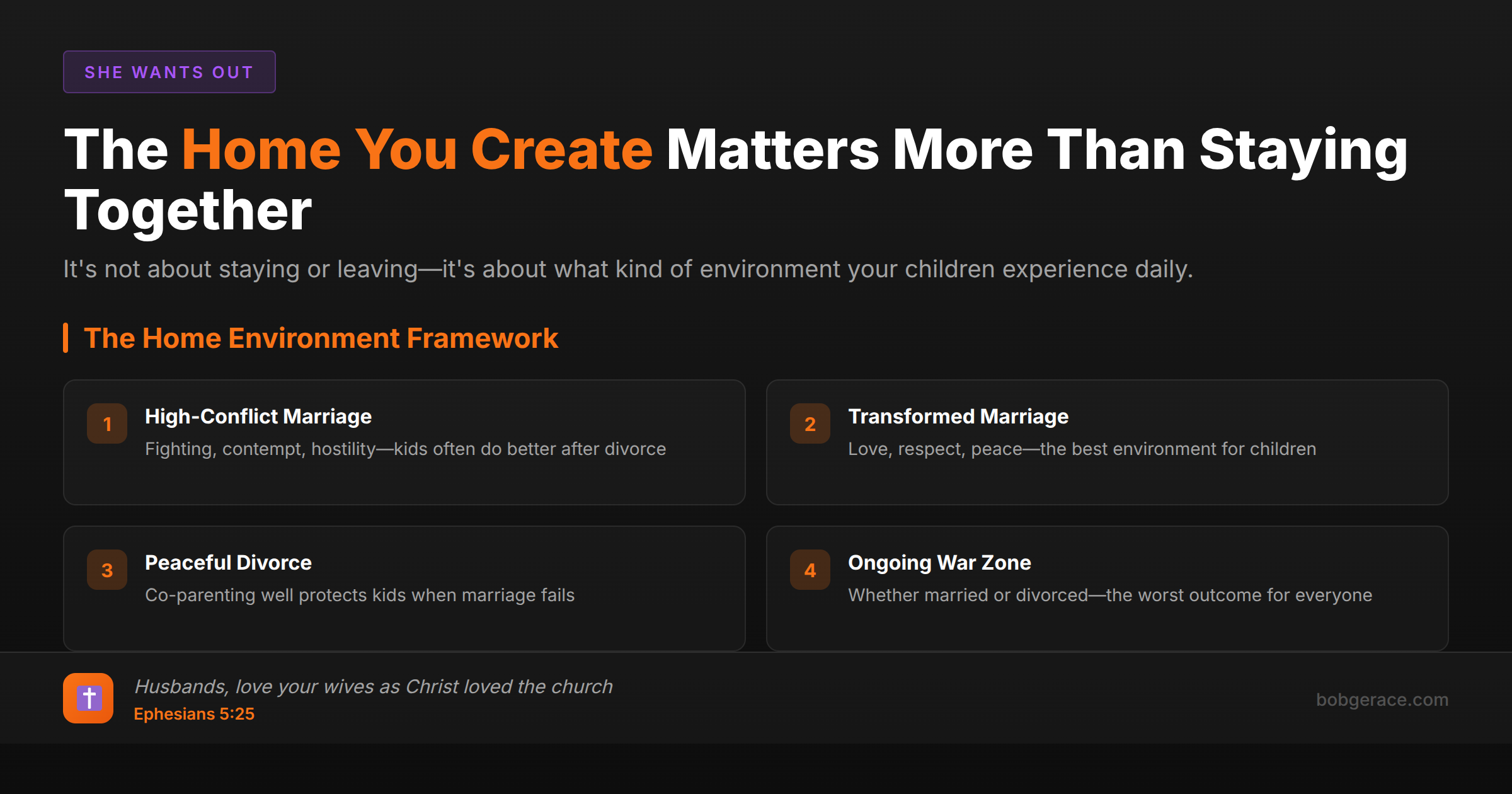
Here's the hard truth: staying in a toxic, conflict-filled marriage doesn't protect your kids—it teaches them that dysfunction is normal. Children don't need their parents under the same roof; they need parents who are emotionally healthy, present, and capable of love. That said, don't use 'the kids' as an excuse to avoid the hard work of fixing your marriage. If there's genuine potential for healing and both spouses are willing to fight for change, your children benefit most from watching you rebuild something beautiful. The question isn't whether to stay or go—it's whether you're willing to do whatever it takes to become the husband and father your family needs, regardless of living arrangements.
The Full Picture
Most men asking this question are really asking: "How do I minimize damage while avoiding the scariest decisions of my life?" I get it. You're terrified of losing daily access to your kids, worried about finances, and clinging to the hope that somehow staying put protects everyone.
But here's what research consistently shows: children in high-conflict homes suffer more long-term damage than children whose parents divorce amicably. Kids absorb tension like sponges. They internalize the belief that relationships are supposed to involve walking on eggshells, explosive fights, or cold silence.
The real question isn't about geography—it's about emotional safety. Can you and your wife create a home where children see: • Respect, even during disagreements • Affection and genuine connection • Conflict resolution rather than conflict avoidance or explosion • Parents who are growing, not just surviving
If your marriage has devolved into roommate status, constant bickering, or emotional withdrawal, your kids are already experiencing the worst effects of divorce—without any of the potential relief that healthy boundaries might provide.
Common mistakes men make: • Using children as emotional support systems • Badmouthing mom to gain alliance • Becoming the "fun parent" who avoids discipline • Staying physically present but emotionally checked out
Your children need you to be the healthiest version of yourself, whether that's as a husband fighting to restore his marriage or as a divorced father modeling integrity and responsibility.
What's Really Happening
From a developmental psychology perspective, children's sense of security comes from predictable, attuned caregiving—not from their parents' marital status. The landmark research by Wallerstein and Lewis found that children in high-conflict intact families showed more behavioral problems and emotional distress than children whose parents divorced but maintained cooperative co-parenting relationships.
Attachment theory teaches us that children develop their relationship templates from their earliest observations. When parents model chronic disconnection, contempt, or volatility, children often struggle with emotional regulation and relationship skills well into adulthood. They may develop anxious attachment styles, hypervigilance around conflict, or avoidant patterns in their own relationships.
The concept of "emotional contagion" explains why children in distressed marriages often exhibit symptoms like anxiety, depression, academic problems, or behavioral issues. They're not just witnessing dysfunction—they're absorbing it neurologically.
However, resilience research shows that children can thrive in various family structures when they experience: • Consistent, responsive parenting from at least one caregiver • Clear boundaries and age-appropriate information about family changes • Protection from adult conflicts and loyalty binds • Ongoing emotional support and validation of their feelings
The therapeutic goal isn't preserving a particular family structure—it's maximizing each child's opportunity for secure attachment, emotional regulation, and healthy relationship modeling, regardless of whether parents live together.
What Scripture Says
Scripture calls us to consider both the permanence of marriage and the wellbeing of children, holding these values in tension rather than opposition.
Malachi 2:16 reminds us that God "hates divorce," but the full context reveals God's heart: He hates the violence and treachery that often leads to divorce. The goal is always restoration and healing.
1 Corinthians 7:10-11 gives clear instruction: "A wife must not separate from her husband. But if she does, she must remain unmarried or else be reconciled to her husband." Paul acknowledges that separation sometimes occurs while maintaining hope for reconciliation.
Matthew 19:6 declares "what God has joined together, let no one separate," calling us to fight for our marriages with everything we have. But this doesn't mean accepting abuse or modeling dysfunction for our children.
Ephesians 6:4 commands fathers: "Do not exasperate your children; instead, bring them up in the training and instruction of the Lord." Sometimes staying in a toxic environment exasperates children more than creating healthy boundaries.
1 Timothy 5:8 warns that anyone who doesn't provide for his family "has denied the faith and is worse than an unbeliever." This provision includes emotional and spiritual wellbeing, not just financial support.
Proverbs 22:6 calls us to "train up a child in the way he should go." Part of that training involves modeling what healthy relationships look like—whether that's through marriage restoration or godly co-parenting.
The biblical framework doesn't give us easy answers, but it calls us to pursue both covenant faithfulness and the protection of the vulnerable.
What To Do Right Now
-
1
Assess honestly whether your home environment is emotionally safe for your children—ask a trusted friend or counselor for perspective
-
2
Stop using your children as confidants, allies, or sources of emotional support about marital problems
-
3
Have age-appropriate conversations with your kids about the family situation without badmouthing your wife
-
4
Seek individual therapy to process your own trauma and develop healthier relationship skills
-
5
Explore marriage counseling if your wife is willing—fight for restoration before considering separation
-
6
Create a co-parenting plan that prioritizes your children's stability and emotional wellbeing above your own convenience
Related Questions
- How do I tell the kids?
- What do I say when kids ask what's happening?
- How do I co-parent during this?
- Kids are caught in the middle — how do I protect them?
- How do I be a good dad through this?
- What do kids need most from dad during divorce?
- Can a marriage survive infidelity?
- When is it actually over?
- How do I discern God's will for my marriage?
- What does biblical forgiveness require of me?
Also find Bob on
Subscribe for weekly videos on Christian marriage.
Your Kids Need You Clear, Not Guessing
This decision is too specific to your marriage to figure out alone. A coach who knows your story can help you see what staying or leaving actually means for your family.
Talk to Bob →