She changed the locks
5 min read
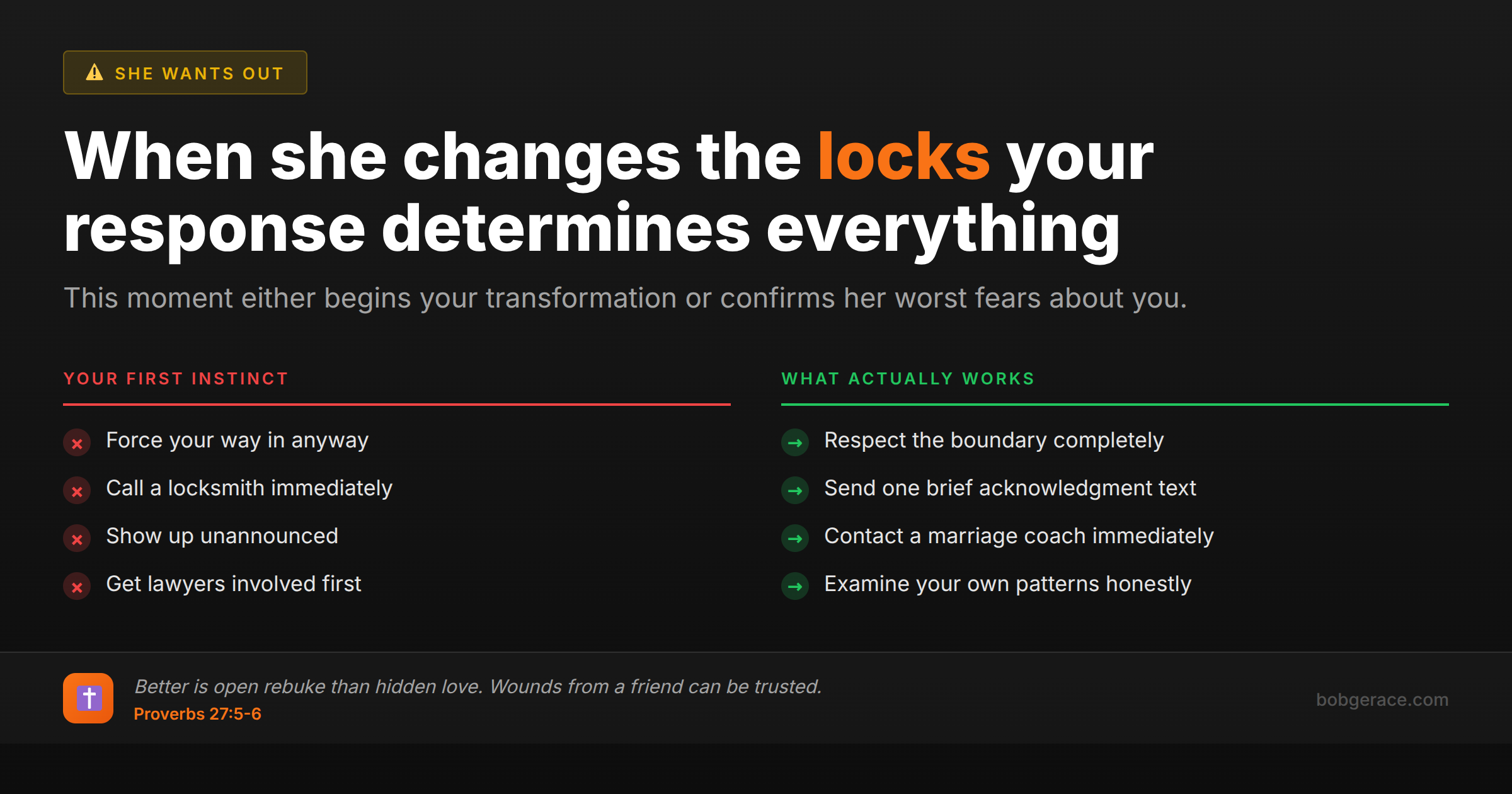
When she changes the locks, she's not just keeping you out of the house—she's drawing the hardest possible line in the sand. This isn't a momentary burst of anger; it's a calculated decision that took planning and resolve. She's telling you that she feels unsafe, unheard, or completely done with the status quo. Your first instinct might be rage, legal action, or showing up anyway. Stop. Those responses will only prove her point that you don't respect boundaries. Right now, she's watching to see if you'll respond with the same patterns that drove her to this point, or if you'll finally demonstrate the man she's been begging you to become. This moment is either the beginning of your transformation or the confirmation of her worst fears about you.
The Full Picture
Changing the locks isn't an impulse decision. She didn't wake up one morning and randomly decide to lock you out. This action represents weeks or months of internal preparation. She's crossed a psychological bridge from "trying to fix this marriage" to "protecting myself from this marriage."
What led to this moment? • Boundary violations - You've repeatedly ignored her requests for space, time, or specific changes • Safety concerns - She may feel emotionally, physically, or psychologically unsafe • Last resort thinking - She's concluded that words don't work with you, only actions do • Legal preparation - She may be building a case for separation or divorce • Support system activation - Someone (lawyer, counselor, family) likely encouraged this step
The legal reality: In most states, if you're married and it's the marital home, you have legal rights to access. But exercising those rights right now could escalate everything into a legal battle that destroys any chance of reconciliation.
What she's really saying: "I've asked, pleaded, fought, and withdrawn. Since you won't hear my words, maybe you'll understand this." She's not necessarily done with the marriage, but she's absolutely done with the version of the marriage you've been offering.
The critical window: Your response in the next 48-72 hours will determine whether this becomes a separation stepping stone to divorce, or a wake-up call that saves your marriage. She's watching to see if you'll finally take her seriously or if you'll prove that even this drastic measure can't get through to you.
What's Really Happening
From a therapeutic perspective, changing the locks represents what we call "escalation of boundary enforcement." Research shows that women typically make an average of six serious attempts to address marital problems before taking drastic action. By the time she's changing locks, she's likely exhausted her perceived options for verbal communication.
This behavior often emerges from what Dr. John Gottman identifies as "emotional flooding"—a state where the nervous system becomes so overwhelmed that fight-or-flight responses take over. The lock change isn't just about physical space; it's about creating psychological safety to regulate her nervous system.
Neurologically, her brain may now categorize the marital relationship as a threat rather than a source of safety. When the attachment system is this dysregulated, the primitive brain prioritizes self-preservation over connection. This is why rational arguments or promises rarely work at this stage—you're dealing with a neurobiological protection response.
The concept of "learned helplessness" is also relevant here. If she's repeatedly tried to communicate needs that were dismissed or minimized, her brain may have concluded that direct communication is futile. The lock change becomes her attempt to regain a sense of agency and control.
Clinically, this moment represents both crisis and opportunity. The same neural plasticity that allowed negative patterns to become entrenched can be redirected toward healing—but only if her nervous system experiences genuine safety and evidence of sustainable change, not just crisis-driven promises.
What Scripture Says
Scripture calls us to examine our hearts when faced with such decisive action from our wives. Proverbs 27:5-6 says, "Better is open rebuke than hidden love. Wounds from a friend can be trusted, but an enemy multiplies kisses." Her changing the locks might be the most loving thing she can do—a wound that forces you to face reality.
1 Peter 3:7 instructs husbands to "live with your wives in an understanding way, showing honor to the woman as the weaker vessel, since they are heirs with you of the grace of life, so that your prayers may not be hindered." If she felt the need to change the locks, ask yourself: have you been living with her in an understanding way? Have you been honoring her concerns?
Ephesians 5:25-26 commands, "Husbands, love your wives, just as Christ loved the church and gave himself up for her to make her holy, cleansing her by the washing with water through the word." Christ's love was sacrificial and transformative. If your love has made her feel unsafe enough to change the locks, that's a call to repentance and radical change.
Matthew 7:3-5 warns us about the speck in our brother's eye versus the plank in our own. Before you focus on her "extreme" reaction, ask God to reveal the planks in your own life that created this situation.
James 1:19 says, "Everyone should be quick to listen, slow to speak and slow to become angry." If she changed the locks, she likely didn't feel heard. This is your opportunity to finally listen—not to defend, not to argue, but to understand the heart of the woman God gave you to love.
The gospel calls us to die to ourselves. Sometimes that death looks like respecting boundaries we don't like and examining our hearts when faced with consequences we don't want.
What To Do Right Now
-
1
Respect the boundary completely - don't show up unannounced, don't use your key if you have one, don't test the locks
-
2
Send ONE brief text acknowledging her need for space: 'I understand you need space. I'm respecting that boundary and working on myself.'
-
3
Contact a marriage coach or counselor immediately - you need professional guidance, not advice from angry friends
-
4
Make a written inventory of every complaint she's made about you in the past year - look for patterns you've dismissed
-
5
Find temporary housing that doesn't create drama - stay with family, a hotel, anywhere that keeps this private and dignified
-
6
Pray specifically for wisdom to see your marriage through her eyes, and for the courage to change what needs changing
Related Questions
- She's already talked to a lawyer — what now?
- She filed for divorce — can I stop it?
- She opened a separate bank account
- She's looking at apartments
- Should I move out if she asks?
- How does moving out affect my legal position?
- What evidence should I secure?
- What do I do about finances immediately?
- How do I protect myself legally without being adversarial?
- What boundaries should I set?
Also find Bob on
Subscribe for weekly videos on Christian marriage.
Your Next Move Decides Everything
She changed the locks. You have maybe 30 days to show her something different. A coach who knows your exact situation can help you stop the bleeding before it's too late.
Talk to Bob →