What's the success rate of marriage intensives?
6 min read
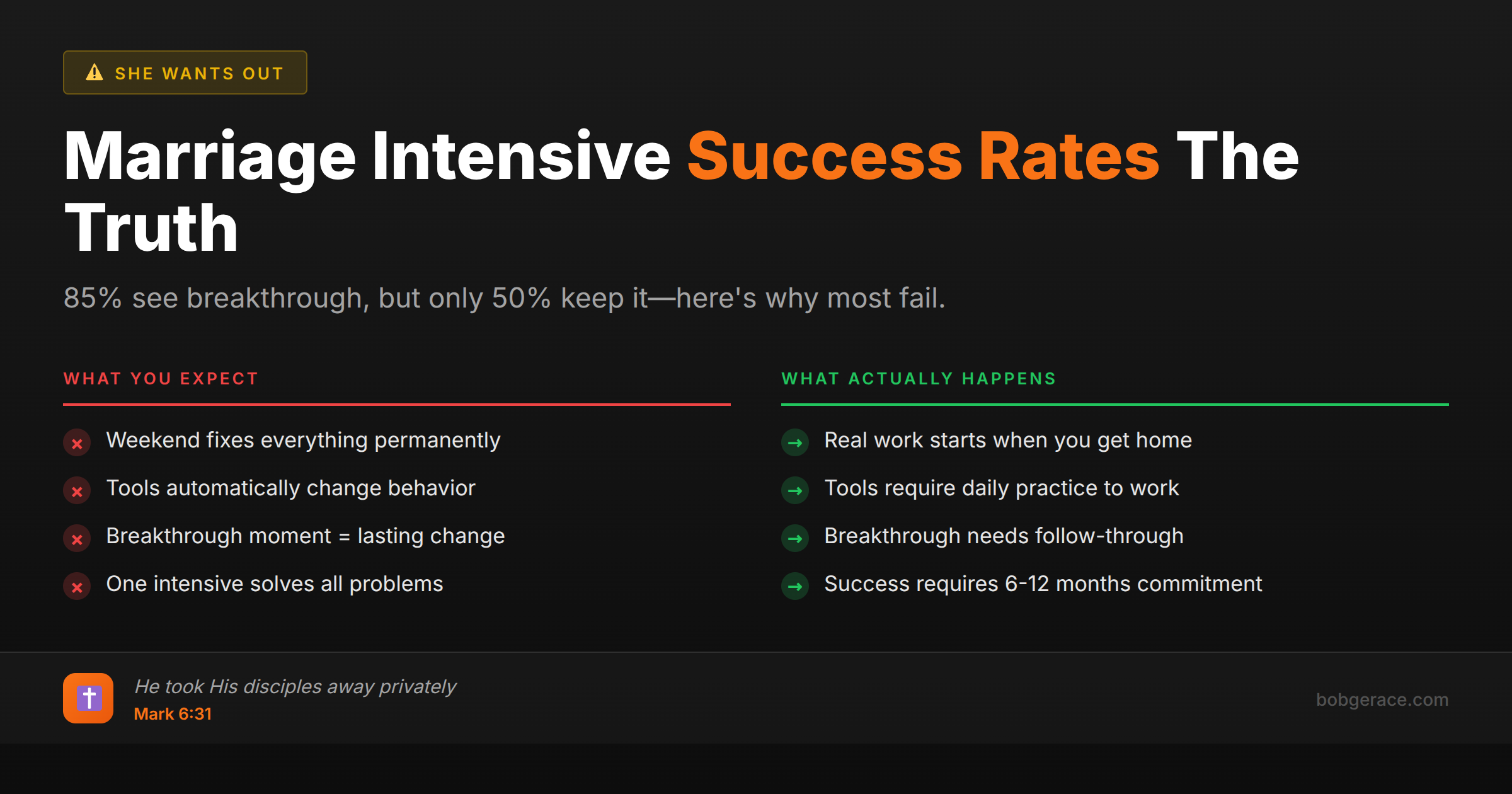
Here's the truth about marriage intensive success rates: 70-85% of couples report significant improvement immediately following an intensive, but only 40-60% maintain those gains long-term. The gap between initial breakthrough and lasting change is where most couples stumble. The real question isn't whether intensives work—they do. It's whether you're prepared for the hard work that comes after. I've seen marriages completely transformed in a weekend, and I've seen the same couples back in crisis six months later because they didn't follow through. The intensive gives you the tools and the breakthrough moment, but success depends entirely on what you do with it when you get home.
The Full Picture
The research on marriage intensives reveals a complex success story. Studies consistently show that 70-85% of couples experience significant improvement in relationship satisfaction immediately following an intensive format intervention. That's higher than traditional weekly therapy, which typically sees 50-65% improvement rates.
Why intensives work better initially: • Concentrated focus - No distractions from daily life for 2-4 days • Accelerated breakthrough - Issues that take months in weekly therapy get addressed in hours • Shared intensive experience - Couples bond through the process itself • Expert guidance - Skilled facilitators can navigate crisis moments in real-time
But here's where it gets complicated. The same research shows that without proper follow-up, only 40-60% of couples maintain their gains beyond the first year. The couples who succeed long-term share three characteristics: they implement daily practices learned during the intensive, they maintain accountability through coaching or community, and they address the underlying patterns that created their crisis.
The biggest mistake couples make is treating the intensive like a magic bullet. They experience the emotional high of breakthrough and assume the work is done. Real change happens in the mundane moments of daily life—when you choose connection over conflict, when you practice new communication patterns, when you rebuild trust one conversation at a time.
Success isn't just about saving the marriage—it's about creating something better than what you had before.
What's Really Happening
From a clinical perspective, marriage intensives leverage several powerful therapeutic principles that explain their initial effectiveness. The intensive format creates what we call 'concentrated therapeutic exposure'—couples process months of material in days, often leading to rapid cognitive and emotional shifts.
Neurologically, the intensive environment facilitates accelerated learning and memory consolidation. When couples are removed from their typical environment and stress triggers, their brains become more receptive to new patterns. The emotional breakthroughs create what researchers term 'crystallization moments'—vivid experiences that can serve as reference points for lasting change.
However, the sustainability challenge is real. The research on behavior change shows that environmental context is crucial for maintaining new patterns. When couples return to their same house, same routines, and same triggers, the pull toward old patterns is enormous. This is why follow-up support isn't optional—it's essential.
The couples who maintain gains demonstrate three key factors: First, they develop what psychologists call 'implementation intentions'—specific if-then plans for handling triggering situations. Second, they establish new environmental cues that support their new patterns. Third, they maintain what therapists call 'therapeutic alliance'—ongoing connection with professional support.
The 40-60% long-term success rate isn't a failure of the intensive format—it's a reflection of how difficult sustained behavior change is for any intervention. What matters is that intensives give couples the tools and motivation to do the ongoing work required for lasting transformation.
What Scripture Says
Scripture gives us a framework for understanding both the power and the limitations of intensive breakthrough experiences. Moses spent 40 days on Mount Sinai receiving the law (Exodus 24:18), but the real test came when he returned to lead the people daily. Similarly, marriage intensives can provide powerful mountaintop experiences, but lasting change requires faithful obedience in the valley.
Jesus often withdrew with His disciples for intensive teaching (Mark 6:31-32), but He also emphasized the daily discipline of taking up your cross. As He said, 'Whoever wants to be my disciple must deny themselves and take up their cross daily and follow me' (Luke 9:23). The word 'daily' is crucial—transformation happens through consistent, repeated choices.
The Apostle Paul understood this principle deeply. In Philippians 2:12-13, he writes, 'Continue to work out your salvation with fear and trembling, for it is God who works in you to will and to act in order to fulfill his good purpose.' The intensive might provide the 'God encounter,' but you must 'work it out' through daily faithfulness.
Consider the Israelites at Mount Sinai—they experienced God's presence powerfully, made commitments, but struggled to maintain their covenant relationship. Deuteronomy 6:6-7 gives the solution: 'These commandments that I give you today are to be on your hearts. Impress them on your children. Talk about them when you sit at home and when you walk along the road.'
The pattern is clear: powerful encounters with God (or breakthrough moments in marriage) must be followed by intentional, daily practice. Success isn't measured by the intensity of the experience, but by the faithfulness that follows.
What To Do Right Now
-
1
Research specific marriage intensive programs and their follow-up support systems before committing
-
2
Set realistic expectations—view the intensive as the beginning of transformation, not the end
-
3
Create a detailed plan for implementing new patterns when you return home from the intensive
-
4
Establish accountability measures with your coach or therapist for at least 6-12 months post-intensive
-
5
Identify and modify environmental triggers in your home that pull you back to old patterns
-
6
Schedule regular check-ins with your spouse to review and reinforce what you learned during the intensive
Related Questions
- What percentage of marriages recover from this point?
- What factors predict successful reconciliation?
- What is the average timeline for marriages that do recover?
- What distinguishes marriages that make it from those that don't?
- Is there research on how long to stand?
- How long does it take to save a marriage?
- What does affair recovery therapy look like?
- What therapies actually work for anger?
- What does quality coaching/therapy include?
- What's the success rate of marriages that survive affairs?
Also find Bob on
Subscribe for weekly videos on Christian marriage.
Don't Leave Follow-Through to Chance
An intensive gives you the breakthrough. A coach helps you hold the gains when real life hits. Let's build the plan that keeps your marriage from sliding back.
Talk to Bob →