Why didn't she tell me sooner how bad it was?
6 min read
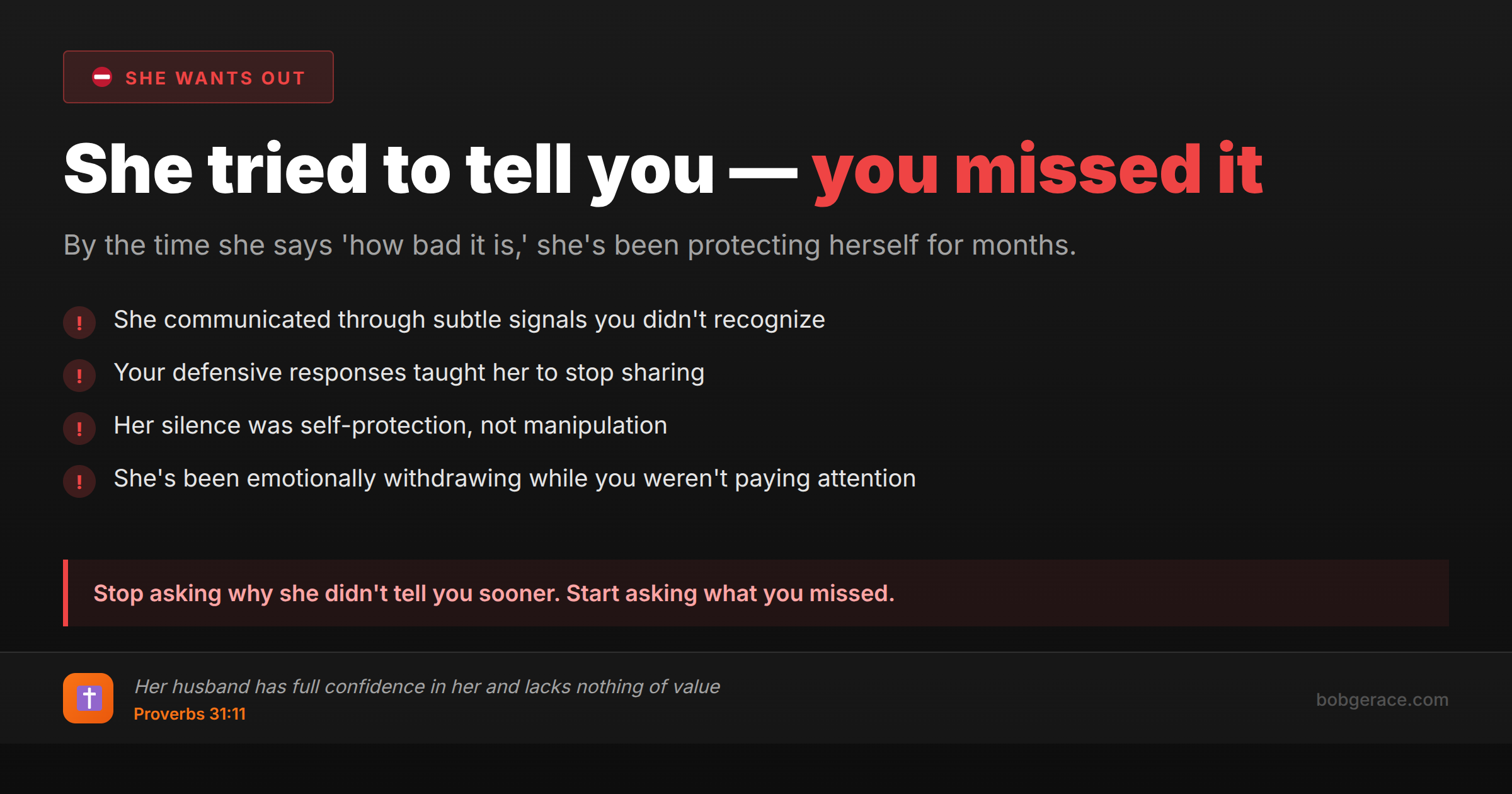
She likely tried to tell you multiple times, but in ways you didn't recognize or respond to. Women often communicate distress through subtle signals - changes in affection, withdrawal, or indirect comments - before they resort to direct confrontation. By the time she's saying "how bad it is," she's already been emotionally protecting herself for months or years. This isn't about withholding information to hurt you. It's about self-preservation. When someone feels emotionally unsafe or repeatedly unheard, they stop sharing their deepest concerns. She may have learned that bringing up problems led to defensiveness, minimizing, or conflict avoidance from you.
The Full Picture
Your wife's silence wasn't a strategic withholding of information - it was emotional self-protection. Here's what likely happened over time:
The Early Warning System Failed Women typically don't go from happy to "I want out" overnight. They send signals - decreased intimacy, less conversation, pulling back from shared activities. These aren't dramatic gestures; they're subtle shifts that most husbands either don't notice or interpret as temporary stress.
Previous Attempts Were Dismissed Think back honestly. Did she ever bring up concerns that you: • Brushed off as "no big deal" • Promised to work on but never followed through • Got defensive about and turned into an argument • Minimized with phrases like "you're overreacting" or "that's not what I meant"
The Protective Withdrawal After repeated failed attempts to connect, she likely entered what therapists call "protective withdrawal." She stopped sharing because it felt pointless or even harmful. This isn't manipulation - it's emotional survival.
The Breaking Point By the time she's telling you "how bad it is," she's often already emotionally detached. She's grieved the relationship privately, processed her pain alone, and made preliminary decisions about her future. What feels sudden to you has been a long, slow process for her.
Common Male Blind Spots • Assuming everything was fine because she stopped complaining • Missing non-verbal cues and emotional distance • Interpreting her independence as contentment rather than resignation • Focusing on external stressors while missing relational ones
What's Really Happening
This pattern reflects what we call "attachment injury" - repeated experiences that damage the emotional bond between partners. Research by Dr. Sue Johnson shows that when someone feels chronically unsafe in their relationship, they activate protective strategies that prioritize emotional survival over connection.
The Neurobiological Response When someone's attempts at connection are repeatedly met with dismissal or defensiveness, their nervous system learns to expect rejection. The brain literally rewires to avoid vulnerability. She wasn't choosing to withhold information; her attachment system was protecting her from further injury.
The Pursue-Withdraw Cycle Many couples get trapped in a destructive pattern: she pursues connection through complaints or requests, he withdraws or gets defensive, she escalates, he shuts down more, and eventually she stops pursuing altogether. The dangerous quiet period feels like peace to him but represents her emotional departure.
Learned Helplessness in Relationships When someone repeatedly tries to improve their relationship without success, they can develop learned helplessness - the belief that their actions don't matter. This leads to emotional numbing and disengagement as protective mechanisms.
The False Calm The period when she "stopped nagging" or "seemed happier" was likely when she gave up hope for change. This pseudo-harmony masks her process of emotional detachment and preparation for leaving.
Trauma-Informed Understanding Chronic relationship disappointment creates relational trauma. Her silence represents a trauma response, not a character flaw. Understanding this helps explain why she may seem so certain about leaving - she's been preparing psychologically for months or years.
What Scripture Says
Scripture calls us to be attentive listeners and gentle responders to our wives' hearts. Understanding her silence through a biblical lens reveals our responsibility as husbands.
Proverbs 31:11 - "Her husband has full confidence in her and lacks nothing of value." This confidence should extend to trusting that her concerns are valid, even when expressed indirectly. A wise husband pays attention to his wife's heart.
1 Peter 3:7 - "Husbands, in the same way be considerate as you live with your wives, and treat them with respect as the weaker partner and as heirs with you of the gracious gift of life, so that nothing will hinder your prayers." Being "considerate" means paying attention to subtle cues and emotional needs, not waiting for dramatic declarations.
James 1:19 - "My dear brothers and sisters, take note of this: Everyone should be quick to listen, slow to speak and slow to become angry." Her silence may reflect past experiences where you were quick to speak (defend, explain, minimize) rather than quick to listen to her heart.
Proverbs 27:5 - "Better is open rebuke than hidden love." When love feels hidden or unsafe to express, people withdraw. Creating safety for honest communication is a husband's biblical responsibility.
Ephesians 5:28-29 - "Husbands ought to love their wives as their own bodies. He who loves his wife loves himself. After all, no one ever hated their own body, but they feed and care for their body, just as Christ does the church." Caring for her includes being attentive to her emotional state and creating conditions where she feels safe to share her heart.
Scripture consistently calls husbands to be shepherds of their wives' hearts - attentive, gentle, and responsive to their needs.
What To Do Right Now
-
1
Stop asking why she didn't tell you sooner and start asking what you missed
-
2
Acknowledge that her silence was likely self-protection, not manipulation or withholding
-
3
Review the past 2-3 years for times she tried to communicate concerns you dismissed or minimized
-
4
Write down specific instances where you responded defensively instead of listening
-
5
Apologize specifically for creating an environment where she felt unsafe to share
-
6
Commit to becoming a safe person to talk to by practicing listening without defending or explaining
Related Questions
- What signs did I miss?
- Why didn't I see this coming?
- What is 'emotional disengagement'?
- What are Gottman's signs of 'turning away'?
- What are 'failed bids for connection' and how many did I miss?
- Why does she remember everything differently than I do?
- She won't talk about our problems
- She shuts down when I try to connect
- She says she's 'fine' but she's not
- She stopped fighting — is that worse?
Also find Bob on
Subscribe for weekly videos on Christian marriage.
You Don't Have to Guess What She Meant
A coach who knows your marriage can help you decode what you missed and respond in ways that rebuild safety. You're not doing this alone anymore.
Talk to Bob →