What does redemption do to marriage roles?
6 min read
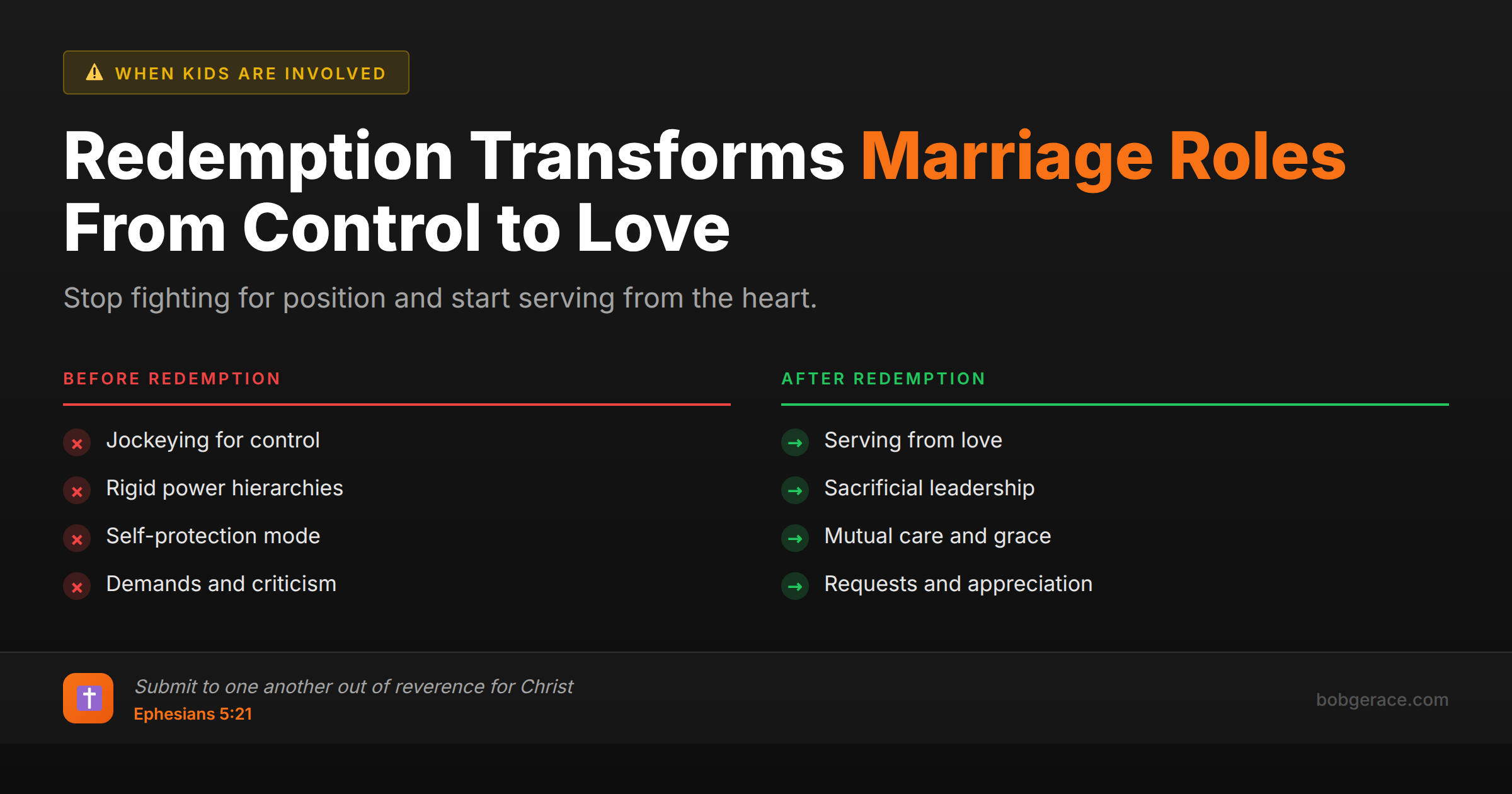
Redemption fundamentally transforms marriage roles from self-centered power dynamics to Christ-centered service. Instead of spouses jockeying for position or control, redemption creates an environment where both husband and wife serve each other out of love, not obligation or fear. The fall corrupted God's original design for marriage partnership, introducing competition, domination, and self-protection into what was meant to be unity. Through Christ's redemption, marriage roles become expressions of mutual love rather than rigid hierarchies. Husbands learn to lead through sacrificial love rather than authority, while wives respond to genuine care rather than demands. This doesn't eliminate distinct roles but redeems them, making marriage a picture of Christ's relationship with the church—marked by grace, forgiveness, and genuine care for one another's wellbeing.
The Full Picture
The fall didn't just mess up individuals—it corrupted the very fabric of marriage relationships. What God designed as perfect partnership became a battlefield of competing interests. Genesis 3:16 shows us the curse: "Your desire will be for your husband, and he will rule over you." This isn't God's ideal—it's the broken reality sin created.
Before the fall, marriage was characterized by perfect unity, mutual respect, and complementary partnership. Adam and Eve worked together as co-rulers of creation, each bringing unique strengths without competition or power struggles. There was no shame, no hiding, no jockeying for position.
After the fall, everything changed. The curse introduced tension into marriage roles. Women would struggle with either unhealthy dependence or inappropriate control. Men would tend toward either passive abdication or harsh domination. These aren't God's design—they're sin's distortion of it.
Redemption changes everything. When Christ redeems a marriage, He doesn't just forgive past sins—He transforms present dynamics. The Holy Spirit empowers couples to live beyond the curse, to experience God's original design within the context of a fallen world. This means husbands can lead without dominating, and wives can support without losing their identity.
Redemption doesn't make marriage roles identical—it makes them beautiful. Like a symphony where different instruments play distinct parts to create harmony, redeemed spouses embrace their unique contributions while serving the same beautiful purpose: displaying God's love to a watching world.
What's Really Happening
From a therapeutic perspective, redemption addresses the core psychological wounds that drive unhealthy marriage dynamics. Most role conflicts in marriage stem from unhealed trauma, unmet attachment needs, or defensive strategies developed in childhood.
When couples fight over roles, they're usually fighting over safety, significance, and security. The husband who demands submission often struggles with feelings of inadequacy. The wife who resists any form of leadership may have experienced abuse or abandonment. These aren't character flaws—they're survival mechanisms.
Redemption provides what psychology calls "corrective emotional experiences." As spouses experience unconditional love from God, they become less defensive and more generous. The anxiously attached spouse learns to trust. The avoidant spouse learns to engage. This isn't just spiritual—it's neurobiological. Love literally rewires our brains.
I've observed that couples who embrace redemption in their marriage roles report higher satisfaction, better communication, and deeper intimacy. They stop keeping score because they're both receiving from an infinite source. The husband serves his wife because Christ first served him. The wife respects her husband because she's secure in God's love for her.
This creates what we call an "upward spiral"—positive behaviors reinforce each other, building trust and connection over time. It's beautiful to witness marriages transform as couples allow God's redemption to heal their deepest wounds and reshape their most fundamental assumptions about love.
What Scripture Says
Scripture presents a clear progression from creation's design through the fall's corruption to redemption's restoration of marriage roles.
God's Original Design: "So God created mankind in his own image, in the image of God he created them; male and female he created them" (Genesis 1:27). Marriage was designed as complementary partnership, reflecting God's own nature.
The Fall's Corruption: "To the woman he said, 'I will make your pains in childbearing very severe; with painful labor you will give birth to children. Your desire will be for your husband, and he will rule over you'" (Genesis 3:16). Sin introduced competition and domination into what was meant to be cooperation.
Redemption's Call: "Submit to one another out of reverence for Christ" (Ephesians 5:21). Notice this comes before Paul addresses specific roles—mutual submission is the foundation for all Christian relationships.
Redeemed Headship: "Husbands, love your wives, just as Christ loved the church and gave himself up for her" (Ephesians 5:25). Christ's headship means sacrificial service, not selfish authority.
Redeemed Response: "However, each one of you also must love his wife as he loves himself, and the wife must respect her husband" (Ephesians 5:33). This is about meeting each other's deepest needs, not maintaining hierarchy.
The Ultimate Picture: "This is a profound mystery—but I am talking about Christ and the church" (Ephesians 5:32). Redeemed marriage roles exist to display the gospel to the world.
What To Do Right Now
-
1
Confess where you've used your role as a weapon rather than a tool for love
-
2
Ask your spouse how they experience your approach to marriage roles—then listen without defending
-
3
Identify specific ways you can serve your spouse within your biblical role this week
-
4
Pray together about God's design for your unique marriage partnership
-
5
Replace demands with requests and criticism with appreciation
-
6
Study Ephesians 5:21-33 together, focusing on how to love rather than how to be loved
Related Questions
- What does 'love your wife as Christ loves the church' mean?
- What is biblical headship?
- What happened to marriage at the Fall?
- What is the Genesis 1-2 creation pattern?
- What does 'mutual submission' mean?
- What is 'servant leadership'?
- What does biblical forgiveness require of me?
- What does restoration look like in Scripture?
- What is sanctification?
- How does the Spirit actually change a person?
Also find Bob on
Subscribe for weekly videos on Christian marriage.
Bring Your Marriage to a Coach
Redemption isn't abstract theology—it's how you lead tomorrow morning. A coach who knows your specific marriage helps you stop repeating the same broken patterns.
Talk to Bob →