What is 'servant leadership'?
6 min read
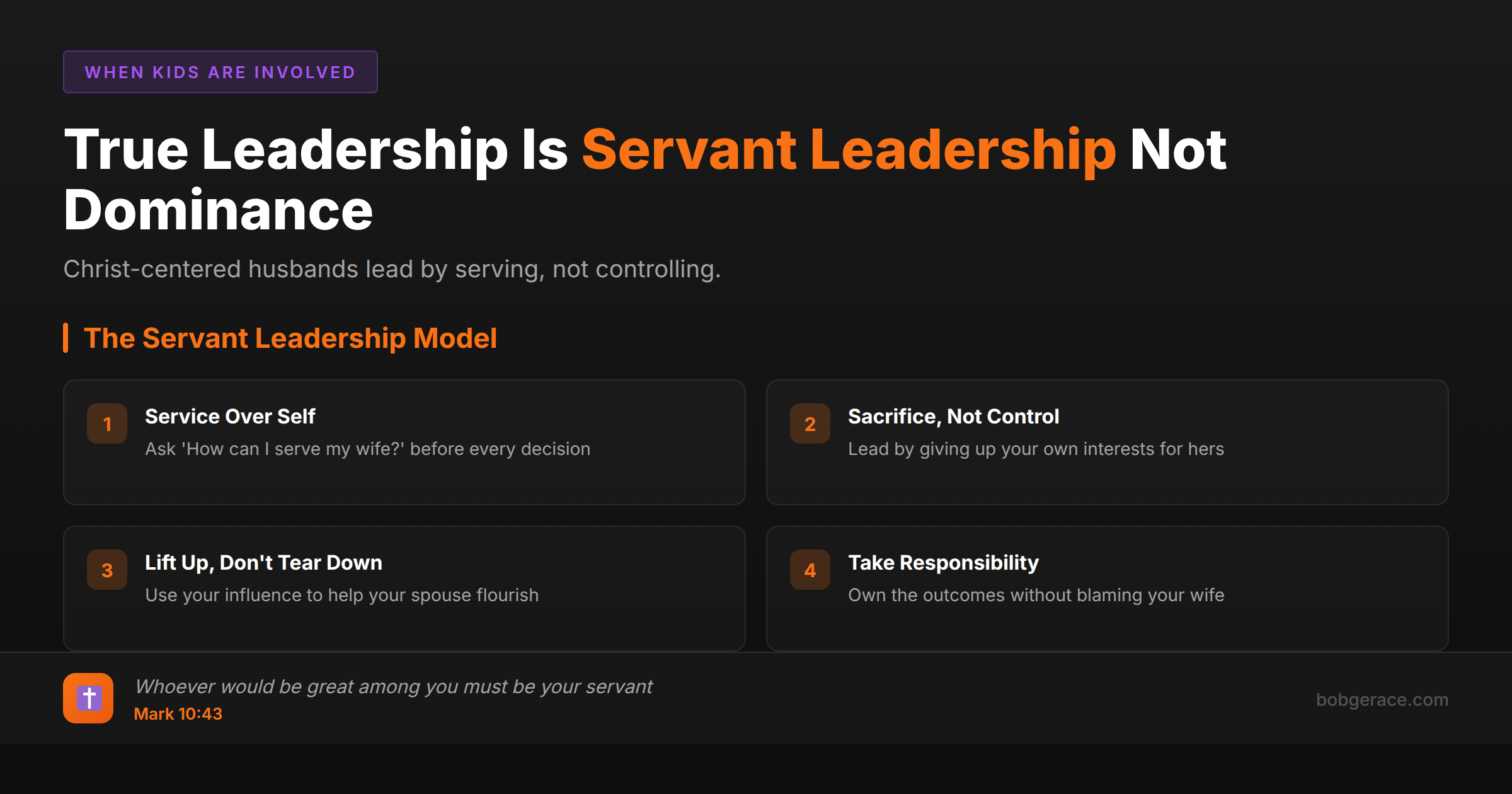
Servant leadership is leading through service, sacrifice, and love rather than dominance or control. It's modeled after Christ, who 'came not to be served, but to serve' (Mark 10:45). In marriage, this means using whatever authority or influence you have to lift up, protect, and serve your spouse's best interests. This isn't about being a doormat or avoiding difficult decisions. Servant leaders make hard choices when necessary, but always with their spouse's wellbeing in mind. They lead by example, take responsibility for outcomes, and create safety for their spouse to flourish. It's leadership that empowers rather than diminishes, that builds up rather than tears down.
The Full Picture
Servant leadership turns traditional power dynamics upside down. Instead of using position or authority to benefit yourself, you use it to benefit others. In marriage, this means leading in a way that serves your spouse's growth, security, and flourishing.
This concept has been completely distorted in our culture. Many people hear 'servant leadership' and think it means being weak, passive, or letting others walk all over you. That's not what this is. Servant leaders are often the strongest people in the room - they just use their strength differently.
Think about Jesus washing the disciples' feet. He wasn't being weak - He was demonstrating what real authority looks like. He had the power to command angels, yet He chose to serve. That's strength, not weakness.
In marriage, servant leadership means making decisions with your spouse's best interests at heart. It means taking initiative to solve problems, create security, and remove obstacles from your spouse's path. You're still leading, but you're leading like Christ led.
This doesn't mean avoiding tough conversations or difficult decisions. Sometimes servant leaders have to make unpopular choices. But the motivation is always love and service, not self-interest or control. The question isn't 'What do I want?' but 'What's best for us and how can I help make that happen?'
Servant leadership creates an environment where both spouses can thrive because neither is focused on protecting themselves from the other.
What's Really Happening
From a therapeutic perspective, servant leadership addresses one of the core issues I see in struggling marriages: the misuse of power and influence. When couples come to me in crisis, there's often an underlying dynamic where one or both partners are using whatever leverage they have - emotional, financial, or relational - to serve their own needs rather than the marriage.
Servant leadership fundamentally rewires this dynamic. Research in organizational psychology shows that servant leaders create environments of psychological safety, increased trust, and higher performance. The same principles apply in marriage. When one spouse consistently demonstrates that they'll use their influence to serve rather than to control, it creates space for genuine intimacy and partnership.
I've observed that spouses married to servant leaders report feeling more valued, more secure, and more willing to be vulnerable. This isn't about gender roles - it's about how we use whatever power or influence we have in the relationship. The spouse who handles the finances can serve by creating transparency and security. The spouse who makes more money can serve by ensuring both partners feel valued regardless of income.
What's particularly powerful about servant leadership is how it breaks negative cycles. When one partner consistently chooses service over self-protection, it often inspires reciprocal behavior. The relationship moves from competition to collaboration, from defensiveness to trust. This creates the foundation for the deep, lasting intimacy that every couple is really seeking.
What Scripture Says
Scripture gives us the perfect model of servant leadership in Jesus Christ. Mark 10:43-44 says, *'But it shall not be so among you. But whoever would be great among you must be your servant, and whoever would be first among you must be slave of all.'* This completely inverts worldly ideas about leadership and authority.
Ephesians 5:25 specifically applies this to marriage: *'Husbands, love your wives, as Christ loved the church and gave himself up for her.'* Notice it doesn't say 'rule your wives' or 'control your wives.' It says love them the way Christ loved - through sacrificial service.
Philippians 2:3-4 gives us the heart attitude: *'Do nothing from selfish ambition or conceit, but in humility count others more significant than yourselves. Let each of you look not only to his own interests, but also to the interests of others.'* In marriage, this means consistently considering your spouse's needs alongside your own.
1 Peter 5:2-3 shows what godly authority looks like: *'Shepherd the flock of God that is among you, exercising oversight, not under compulsion, but willingly, as God would have you; not for shameful gain, but eagerly; not domineering over those in your charge, but being examples to the flock.'*
The pattern is consistent throughout Scripture: true leadership serves others. This doesn't eliminate authority or decision-making, but it transforms the motivation behind them. Every choice is filtered through 'How does this serve my spouse and our marriage?'
What To Do Right Now
-
1
Examine your motivations - For the next week, before making any decision that affects your spouse, ask 'Am I doing this to serve them or to serve myself?'
-
2
Identify one area where you can serve - Look for something your spouse finds difficult or stressful, and take initiative to handle it without being asked
-
3
Practice the foot-washing principle - Find one small, humble way to serve your spouse each day, especially tasks they normally handle
-
4
Take responsibility without blame - When problems arise, focus on 'How can I help solve this?' rather than 'Whose fault is this?'
-
5
Ask better questions - Instead of 'What do I want?', start asking 'What does our marriage need?' and 'How can I help my spouse succeed?'
-
6
Lead difficult conversations with service - When you need to address problems, start with 'I want what's best for us' and mean it
Related Questions
- What does 'love your wife as Christ loves the church' mean?
- What is biblical headship?
- What does Christ's leadership model for husbands?
- What does 'dying for your wife' mean practically?
- What is 'sacrificial headship'?
- How do I lead without demanding submission?
- What does masculine leadership look like?
- How do I lead without controlling?
- What does humble leadership look like?
- What's the difference between leading and dominating?
Also find Bob on
Subscribe for weekly videos on Christian marriage.
You Don't Have to Figure This Out Alone
Servant leadership looks different in every marriage. A coach who knows your specific situation can help you lead in ways that actually land with your wife.
Talk to Bob →