What are the main views on complementarian vs. egalitarian?
6 min read
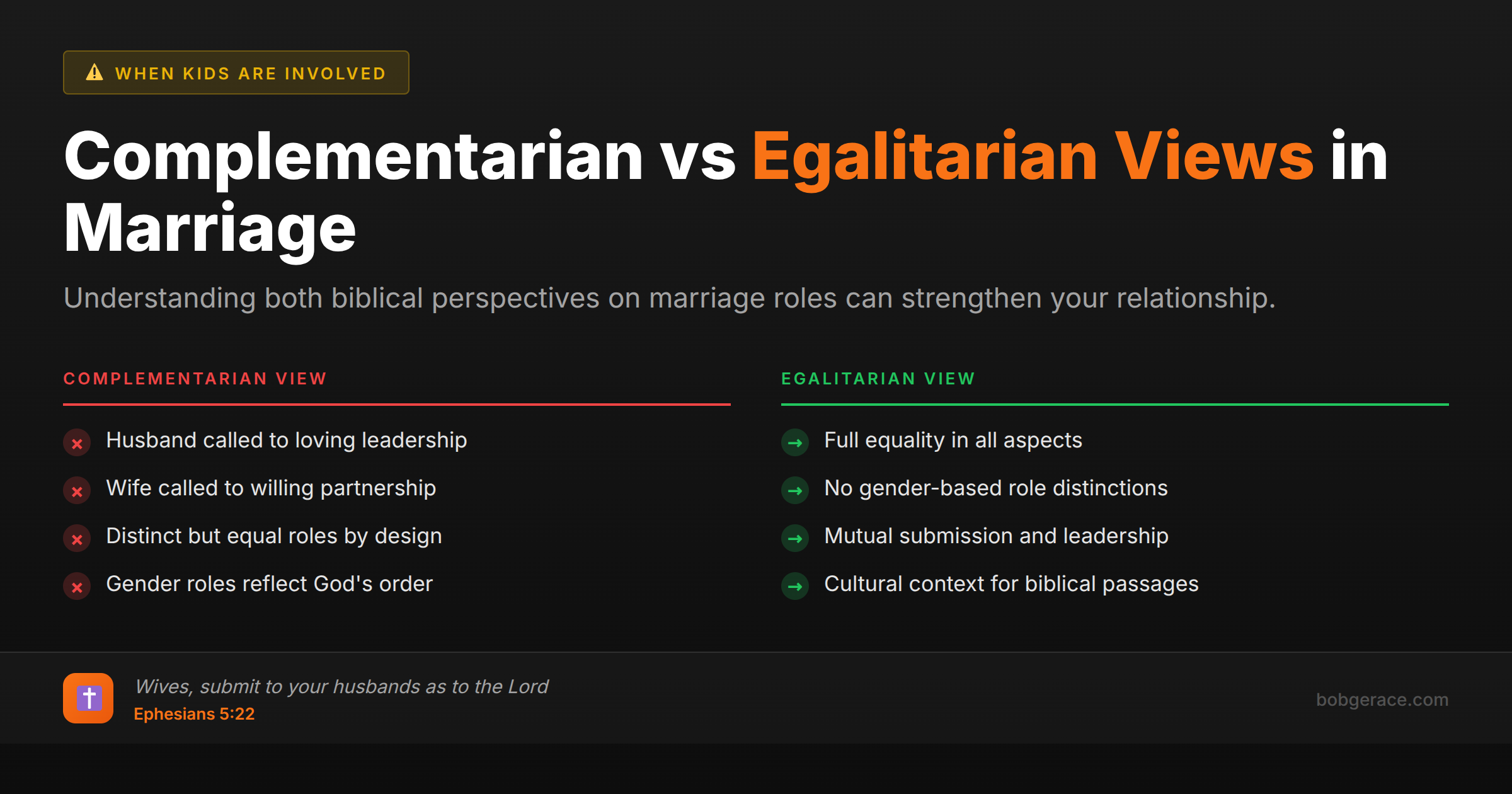
The complementarian view holds that God designed men and women with distinct but equal roles, with husbands called to loving leadership and wives to willing partnership. This perspective sees gender roles as part of God's created order, reflected in marriage through loving authority and joyful submission. The egalitarian view maintains that men and women are fully equal in all aspects of marriage and ministry, with no gender-based role distinctions beyond biological differences. Egalitarians interpret biblical passages about submission and headship as cultural or mutual rather than establishing permanent gender hierarchies. Both views affirm the equal worth and dignity of men and women while differing on functional roles in marriage.
The Full Picture
This theological debate has shaped Christian marriages for generations, and it's not going away anytime soon. But here's what I've learned after decades of marriage coaching: your theology matters, but your heart matters more.
Complementarians believe God created men and women with distinct roles that complement each other perfectly. They see male headship and female submission as beautiful expressions of God's design, not oppressive structures. In this view, a husband's leadership should mirror Christ's sacrificial love, while a wife's submission reflects the church's joyful response to Christ.
Egalitarians argue that gender shouldn't determine who leads or follows in marriage. They believe the gospel eliminates hierarchical gender roles, pointing to passages like Galatians 3:28. For egalitarians, mutual submission and shared leadership honor both partners' gifts and calling.
Here's the reality both sides often miss: Most healthy marriages operate somewhere in the middle. I've seen complementarian couples where the wife naturally leads in many areas, and I've seen egalitarian couples where traditional patterns emerge organically.
The danger isn't in holding either view—it's in using your theology to justify selfishness, control, or neglect of your spouse's needs. Whether you believe in headship or mutual leadership, love requires sacrifice, wisdom, and putting your spouse's flourishing above your own preferences.
Your marriage will be strengthened by understanding these perspectives, but it will be transformed by choosing love over being right.
What's Really Happening
From a therapeutic standpoint, I see couples struggling less with theological positions and more with power dynamics and emotional safety. The complementarian-egalitarian debate often becomes a smokescreen for deeper relational issues.
Couples who rigidly enforce either model without considering their unique personalities, strengths, and circumstances often experience increased conflict. Research shows that marriages thrive when both partners feel heard, valued, and empowered to contribute their gifts—regardless of theological framework.
What I find fascinating is that the healthiest complementarian marriages often look quite egalitarian in practice, and the strongest egalitarian marriages naturally develop specialized roles that can appear complementarian. This suggests that successful marriages adapt their structure to serve love, not ideology.
The clinical red flags I watch for aren't theological—they're relational. When either partner uses their interpretation of Scripture to shut down conversation, dismiss their spouse's concerns, or avoid personal growth, the marriage suffers regardless of their stated beliefs about gender roles.
Healthy couples in both camps share common traits: they communicate openly, make decisions together, respect each other's perspectives, and prioritize their spouse's wellbeing. They use their theology as a foundation for love, not a weapon for control. The goal isn't winning theological debates—it's building marriages that reflect God's heart for human flourishing.
What Scripture Says
Scripture presents marriage as a profound mystery that reflects Christ's relationship with the church. Let's examine key passages both perspectives cite:
Complementarian Foundation: Ephesians 5:22-25 states, "Wives, submit yourselves to your own husbands as you do to the Lord... Husbands, love your wives, just as Christ loved the church and gave himself up for her." This passage is central to complementarian theology, emphasizing distinct roles within equal worth.
1 Corinthians 11:3 declares, "But I want you to realize that the head of every man is Christ, and the head of the woman is man, and the head of Christ is God," which complementarians see as establishing divine order in relationships.
Egalitarian Emphasis: Galatians 3:28 proclaims, "There is neither Jew nor Gentile, neither slave nor free, nor is there male and female, for you are all one in Christ Jesus." Egalitarians view this as eliminating gender-based hierarchies in the new covenant.
Ephesians 5:21 instructs, "Submit to one another out of reverence for Christ," which egalitarians emphasize as the context for all marriage relationships—mutual submission rather than one-directional hierarchy.
Common Ground: Both views affirm Genesis 1:27: "So God created mankind in his own image, in the image of God he created them; male and female he created them." This establishes the equal dignity and worth of both genders.
The truth is that Scripture calls all marriages to sacrificial love, mutual service, and Christ-centered unity—principles both perspectives can embrace.
What To Do Right Now
-
1
Study both perspectives together with your spouse, reading books and resources from each viewpoint with open hearts
-
2
Discuss your individual backgrounds and how your upbringing shaped your views on marriage roles and leadership
-
3
Identify your unique strengths as individuals and explore how they can best serve your marriage regardless of gender
-
4
Establish decision-making processes that honor both your theological convictions and your spouse's input and wisdom
-
5
Focus on loving actions rather than winning theological arguments—ask how you can better serve your spouse today
-
6
Seek counsel from mature couples who model healthy marriages within your theological framework
Related Questions
- What does 'love your wife as Christ loves the church' mean?
- What is biblical headship?
- What does submission mean?
- What does 'mutual submission' mean?
- Is patriarchy biblical or cultural?
- What is the Ephesians 5 framework?
- What does masculine leadership look like?
- How do I lead without controlling?
- What's the difference between leading and dominating?
- What does humble leadership look like?
Also find Bob on
Subscribe for weekly videos on Christian marriage.
Ready to apply this to your marriage?
Theology matters, but so does your specific situation. A coach helps you translate these principles into decisions that fit your marriage, not someone else's.
Talk to Bob →