How do I become safer without becoming soft or passive?
5 min read
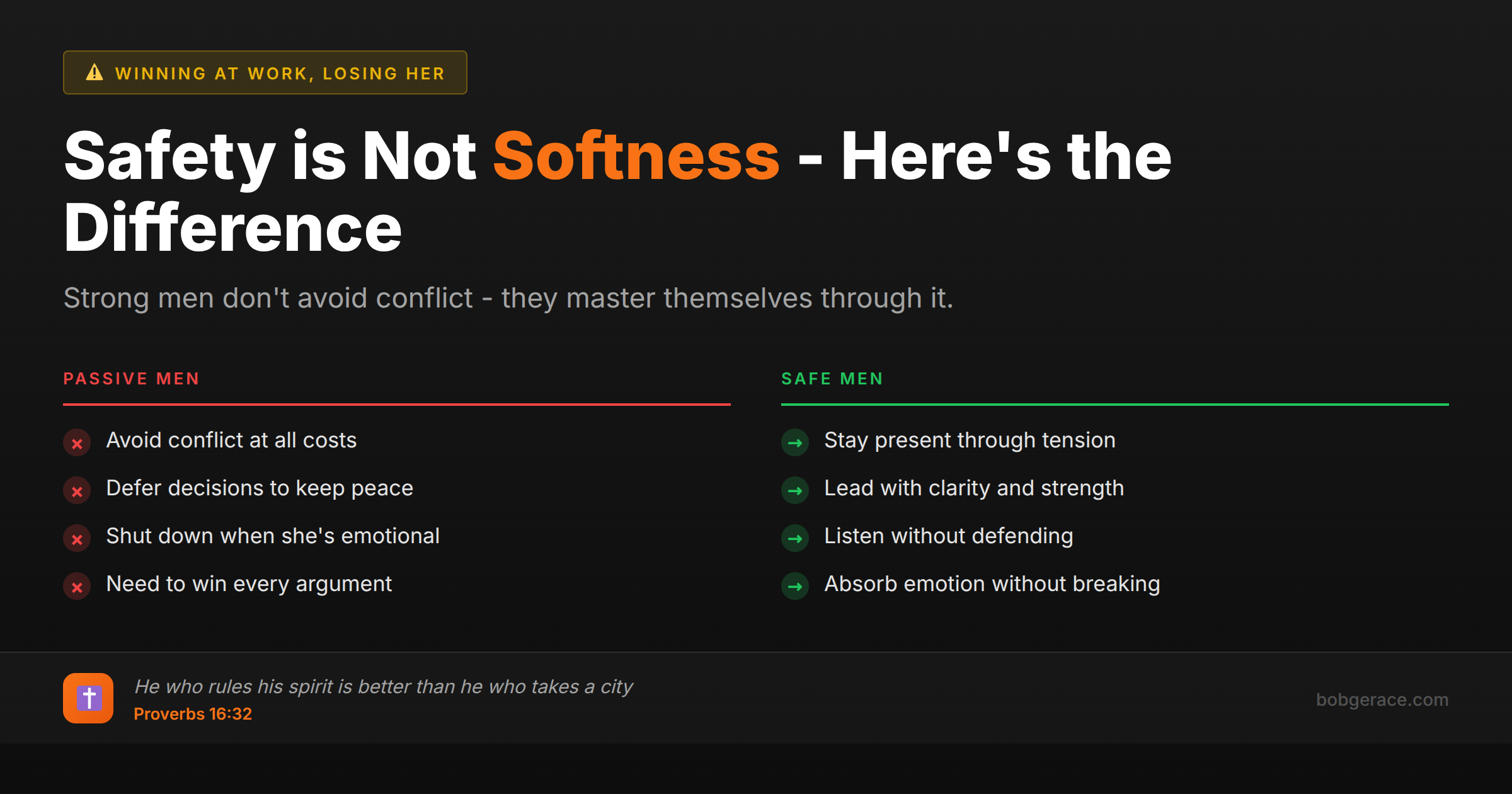
Safety is not softness. Safety is the capacity to stay present when your wife is upset, hurt, or scared without defending, fixing, or shutting down. It means she can bring you her heart and you will not punish her for it. Passive men avoid conflict and defer decisions. Safe men can hold tension, lead with clarity, and remain emotionally connected even when it is uncomfortable. You become safer by regulating your own nervous system first, then staying engaged. That means you notice when her emotion triggers your fight-or-flight response, you breathe through it, and you stay in the room. You listen without needing to win. You validate without needing to agree. You lead without needing to dominate. Strength and safety are not opposites. They are the same man, fully integrated.
What Safety Actually Looks Like in a Marriage
Your wife does not need you to be less of a man. She needs you to be more of one. The confusion comes because most men equate emotional availability with weakness. You have been trained to see feelings as feminine, vulnerability as failure, and any request for connection as criticism of your competence. So when she says she needs you to be safer, you hear it as an attack on your masculinity. You think she wants you to become passive, agreeable, or emotionally neutered. She does not.
What she wants is for you to be strong enough to stay present when she is not okay. She wants to know that her sadness will not send you into problem-solving mode. That her anger will not make you stonewall. That her fear will not trigger your defensiveness. She wants to feel like she can bring you the full range of her emotional experience without you collapsing, withdrawing, or counterattacking. That is safety. It is not about being nice. It is about being grounded.
Most high-performing men are excellent at managing external threats but terrible at managing internal discomfort. You can handle a difficult client, a financial crisis, or a business failure with composure. But when your wife cries or raises her voice, your nervous system interprets it as danger. You go into shutdown or combat mode. You stop listening. You start defending. You leave the room or you escalate. She experiences that as abandonment or aggression, and over time she stops bringing you her heart. She learns that you are not safe. And she is right.
Why Her Emotion Feels Like a Threat
When your wife expresses strong emotion, your brain often interprets it as an attack. This is not a character flaw. It is a nervous system response shaped by attachment history, family patterns, and years of conditioning. If you grew up in a home where emotion was punished, ignored, or weaponized, your system learned to treat vulnerability as danger. If you were rewarded for performance and criticized for feeling, you developed a threat response to emotional intimacy.
This shows up as defensiveness, intellectualizing, or withdrawal. She says she feels alone. You hear, 'You are failing.' She says she is hurt. You hear, 'You are bad.' Your amygdala fires. Your cortisol spikes. You go into fight, flight, or freeze. You argue the facts. You list what you have done for her. You shut down and walk away. None of this is conscious. It is automatic. And it makes you unsafe.
Becoming safer requires you to interrupt that pattern. You must learn to notice the physiological response before it controls your behavior. You feel the tightness in your chest, the heat in your face, the urge to defend or dismiss. And instead of reacting, you pause. You breathe. You remind yourself that her emotion is not an indictment of your worth. It is an invitation to connection. You stay in the room. You stay in your body. You stay curious instead of defensive. That is the work. It is not soft. It is the hardest thing you will ever do.
Strength Under Control
Proverbs 16:32 says, 'Whoever is slow to anger is better than the mighty, and he who rules his spirit than he who takes a city.' This is the biblical definition of strength. It is not the absence of power. It is power under control. A safe man is not a weak man. He is a man who has mastered himself. He does not need to dominate his wife to feel strong. He does not need to win every argument to feel secure. He can absorb her emotion without being destroyed by it.
Jesus modeled this perfectly. He was not passive. He overturned tables. He called out hypocrisy. He led with authority. But He was also safe. Women, children, and broken people ran to Him, not away from Him. He could hold the tension of truth and grace. He could be strong and tender at the same time. That is the model. Not the modern caricature of masculinity that equates strength with emotional detachment.
Ephesians 5 tells husbands to love their wives as Christ loved the church. That means sacrificial, present, engaged love. It means laying down your need to be right. It means staying connected even when it costs you something. It means leading her toward wholeness, not demanding her submission to your comfort. Safety is not weakness. It is Christlikeness. And it is the foundation of a marriage where she can trust you with her heart.
Action Steps
-
1
Notice your physical response when she expresses emotion. Name it: 'I feel defensive. My chest is tight. I want to leave.' Do not act on it. Just notice.
-
2
Practice staying in the room for 60 seconds longer than feels comfortable when she is upset. Breathe. Do not fix. Do not defend. Just stay present.
-
3
Say out loud: 'I hear you. Tell me more.' Even if you disagree. Even if it feels unfair. Let her finish before you respond.
-
4
Identify one recurring conflict where you typically shut down or escalate. Write down what you feel in your body when it starts. Bring that awareness into the next conversation.
-
5
Ask her this week: 'When do I feel least safe to you?' Listen without explaining. Thank her for telling you. Then work on that one thing.
Related Questions
- How can my wife feel neglected when I work so hard for her?
- How do I know if I am an emotionally unavailable husband?
- Why does my success not make her feel secure?
- What is emotional neglect in marriage?
- Can I rebuild trust before she makes a final decision?
- How do I become trustworthy after years of not showing up?
Also find Bob on
Subscribe for weekly videos on Christian marriage.
You Do Not Have to Figure This Out Alone
Learning to be safe without losing yourself is not intuitive. Most men need a guide who has walked this road and can show them how to stay grounded under pressure. That is what I do in Wingman and in one-on-one coaching.
Talk to Bob →