Why does she remember small moments I forgot?
5 min read
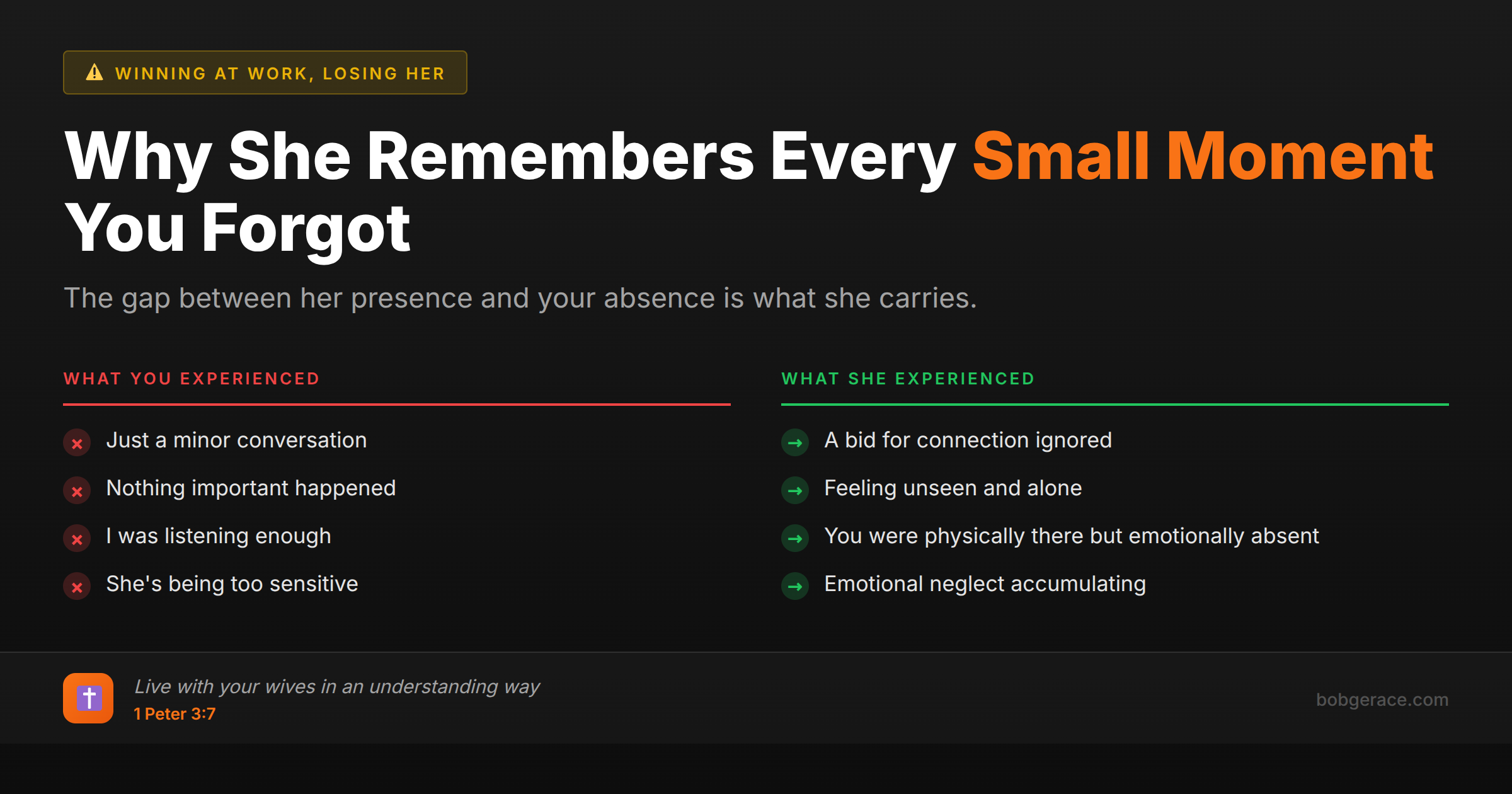
She remembers those small moments because they mattered to her and you were not present. To you, they were minor—a conversation you half-listened to, a moment she wanted to share that you dismissed, a time she reached for connection and you were distracted by your phone or your thoughts. To her, those moments were bids for connection. When you did not respond, she felt unseen. When it happened repeatedly, she felt alone. She remembers because emotional neglect is not usually one big failure. It is the accumulation of small moments where you were physically there but emotionally absent. You do not remember because you were not engaged. Your attention was elsewhere—on work, on a problem you were solving, on your own internal world. She remembers because she was present, hoping you would be too. That gap—between her presence and your absence—is what she carries. And it is why she brings those moments up now.
The Weight of Small Moments
Most men do not understand why their wives remember specific moments from years ago—moments that seem insignificant to them. A conversation in the kitchen where you were distracted. A time she tried to tell you about her day and you changed the subject. A moment she was excited about something and you responded with a half-hearted 'that's great' while looking at your phone. You do not remember these moments because, to you, they were not important. But to her, they were everything.
Those small moments were bids for connection. She was reaching for you—not for a grand gesture, not for a solution, just for your presence. She wanted you to see her, to be curious about her inner world, to stay engaged. When you did not, she felt dismissed. When it happened over and over, she stopped reaching. She learned that you are not emotionally available, that your attention is always somewhere else, that she is not a priority even when you are in the same room.
This is what emotional neglect looks like. It is not dramatic. It is not one catastrophic failure. It is the slow accumulation of moments where she felt alone while you were right there. She remembers because those moments shaped her experience of the marriage. They taught her that she cannot count on you to be present, that she has to manage her emotional life on her own, that you are a provider but not a partner. That is why she brings them up. She is not trying to punish you. She is trying to help you see the pattern you have been blind to.
Bids for Connection and the Cost of Missing Them
Research by John Gottman shows that healthy relationships are built on small, repeated bids for connection—moments where one partner reaches for the other's attention, affection, or engagement. When those bids are met with presence and responsiveness, trust and intimacy grow. When they are ignored or dismissed, resentment builds. Your wife has been making bids for connection for years. Most of them were small—'How was your day?' 'Look at this.' 'Can we talk?' When you responded with distraction, defensiveness, or disinterest, she felt rejected.
From a nervous system perspective, repeated missed bids teach her that you are not a safe person to reach for. Her nervous system adapts. She stops reaching. She builds walls. She begins to manage her emotional life independently because depending on you has proven painful. This is not a conscious decision. It is a protective adaptation. Her body learned that reaching for you results in disappointment, so it stopped reaching.
This is why she remembers those small moments and you do not. She was emotionally present and vulnerable. You were defended or distracted. The gap between her openness and your absence created pain, and pain is what the brain remembers. When she brings up those moments now, she is not being petty or holding a grudge. She is trying to show you the pattern that has been eroding the marriage. If you dismiss her again—'Why do you keep bringing up the past?'—you prove that the pattern has not changed. If you listen, own it, and stay present, you begin to rebuild what was lost.
The Call to See and Know Your Wife
First Peter 3:7 calls husbands to live with their wives 'in an understanding way, showing honor to the woman as the weaker vessel, since they are heirs with you of the grace of life.' The phrase 'in an understanding way' means you are called to know her—to pay attention, to be curious, to see her inner world. It is not enough to provide for her or be faithful to her. You are called to understand her, to honor her emotional reality, to be present with her in the small moments that make up a life together.
When you miss those small moments—when you are distracted, defended, or dismissive—you fail that calling. You treat her like a background character in your life rather than a co-heir of grace. You prioritize your own internal world, your work, your stress, your thoughts, and you miss the woman standing in front of you. That is not just a relational failure. It is a spiritual one. You are called to love your wife as Christ loved the church, and Christ was never distracted or dismissive. He saw people. He stayed present. He engaged.
The good news is that you can change. You can learn to be present. You can learn to notice her bids for connection and respond with curiosity and care. You can stop defending yourself when she brings up the past and start listening to what she is actually saying: 'I have been alone in this marriage, and I need you to see that.' If you can hear that without defensiveness, if you can own the pattern and commit to being present going forward, you give your marriage a chance to heal. But it starts with you being willing to see what you have been missing.
Action Steps
-
1
Ask her to tell you about one small moment she remembers that hurt her. Do not defend or explain. Just listen and say, 'I hear you. I am sorry I was not present.'
-
2
Identify your patterns of distraction. When do you check out? When you are stressed? When she is emotional? When you are thinking about work? Name the pattern so you can interrupt it.
-
3
Practice presence daily. Put your phone down when she talks to you. Make eye contact. Ask a follow-up question. Show her that you are engaged, not just physically there.
-
4
Respond to her bids for connection. When she shares something, asks a question, or reaches for you emotionally, turn toward her instead of away. Even a small response matters.
-
5
Work with a coach to learn emotional availability. If you have spent years being defended or distracted, you need help learning how to stay present and engaged under pressure.
Related Questions
- How can my wife feel neglected when I work so hard for her?
- How do I know if I am an emotionally unavailable husband?
- Why does my success not make her feel secure?
- What is emotional neglect in marriage?
- What does real repair look like from a husband?
- Can I rebuild trust before she makes a final decision?
Also find Bob on
Subscribe for weekly videos on Christian marriage.
Learn to Be Present Before It's Too Late
If your wife remembers moments you forgot and you are realizing you have been emotionally absent, you need help learning how to be present and engaged. I help high-performing men become emotionally available before their wives give up.
Talk to Bob →