Should I gather more evidence first?
6 min read
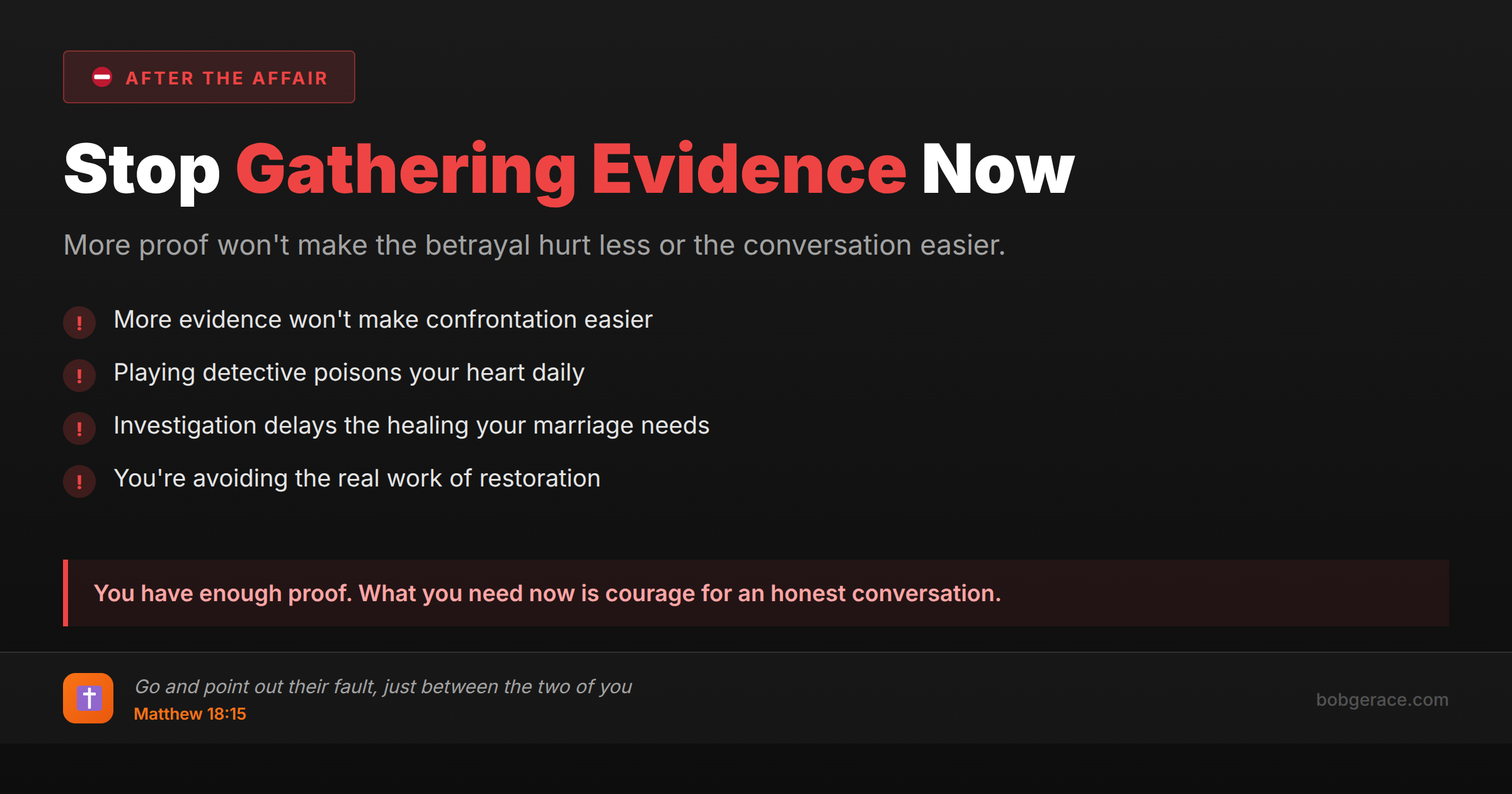
Stop right there. I know the urge to dig deeper feels overwhelming, but gathering more evidence usually does more harm than good. If you've already discovered clear signs of another relationship, you have enough. More evidence won't make the confrontation easier or the betrayal less painful - it will only poison you further and delay the healing process your marriage desperately needs. The real question isn't whether you have enough proof. It's whether you're ready to face this crisis head-on with courage and wisdom. Every day you spend playing detective is another day your marriage deteriorates in silence. Your energy is better spent preparing for an honest conversation and deciding what boundaries you need to establish moving forward.
The Full Picture
When you discover signs of another man in your wife's life, your mind immediately shifts into investigative mode. It's natural - you want certainty, concrete proof, the full story. But here's what I've learned after coaching hundreds of couples through this exact situation: the evidence-gathering phase often becomes a form of self-torture that prevents actual healing.
Think about what you're really asking when you wonder if you need more evidence. Are you hoping to find something that makes this situation *less* painful? Are you looking for ammunition for a future confrontation? Or are you simply avoiding the terrifying conversation that needs to happen?
The brutal truth is that most people who go down the evidence-gathering rabbit hole aren't looking for proof - they're looking for *certainty about what to do next*. But evidence won't give you that certainty. Only courage will.
Consider what you already know. If you've seen texts, calls, changes in behavior, or other clear indicators, you have what you need. The specific details of their relationship won't change the fundamental reality: your marriage is in crisis, and it needs immediate attention.
Every day you spend gathering more evidence is a day you're living in deception alongside your spouse. This secrecy creates distance, builds resentment, and often leads to behaviors that damage your own integrity. I've seen people become consumed with checking phones, following cars, and creating elaborate schemes to 'catch' their spouse. This isn't healing - it's poison.
More evidence also rarely provides the satisfaction people expect. Instead of clarity, it often brings more questions, more pain, and deeper wounds that take longer to heal. The goal isn't to have an airtight case - it's to save your marriage.
What's Really Happening
From a therapeutic perspective, the compulsion to gather more evidence represents what we call 'hypervigilance' - a trauma response where the betrayed spouse attempts to regain control through information gathering. While this feels productive, it actually prolongs the acute stress response and delays emotional processing.
Research shows that couples who address infidelity directly and quickly have better recovery outcomes than those who allow the discovery phase to drag on. The extended investigation period creates what I call 'compound trauma' - the original betrayal plus the ongoing deception and detective work.
Neurologically, your brain is already flooded with stress hormones from the initial discovery. Continuing to expose yourself to evidence of the affair keeps your nervous system in constant activation, making clear thinking and healthy decision-making nearly impossible. This is why many clients report feeling 'addicted' to checking phones or social media - the stress response creates a cycle that's difficult to //blog.bobgerace.com/mama-boy-christian-marriage-break-mother-loyalty-trap/:break.
The most crucial therapeutic intervention at this stage is moving from investigation to communication. The goal shifts from gathering information to creating safety for honest dialogue. This doesn't mean ignoring red flags, but it means recognizing that you likely have enough information to begin the real work of addressing the crisis.
Psychologically, the urge for more evidence often masks deeper fears about confrontation, conflict, or potential loss of the relationship. Working through these underlying anxieties is far more productive than accumulating more proof of something you already know to be true.
What Scripture Says
Scripture provides clear guidance about how to handle situations when someone we love is walking in deception. The principle isn't about gathering evidence - it's about restoration through truth and love.
Jesus outlined the process in Matthew 18:15: *'If your brother or sister sins, go and point out their fault, just between the two of you. If they listen to you, you have won them over.'* Notice there's no instruction to gather more evidence first. The emphasis is on direct, loving confrontation.
Ephesians 4:15 calls us to speak *'the truth in love.'* This means addressing what you know to be true with a heart oriented toward healing, not harm. The truth you already possess is sufficient for this conversation.
Proverbs 27:5-6 reminds us that *'Better is open rebuke than hidden love. Wounds from a friend can be trusted, but an enemy multiplies kisses.'* Sometimes the most loving thing we can do is have the difficult conversation, even when it's painful.
The biblical model prioritizes relationship restoration over being 'right' or having overwhelming proof. Galatians 6:1 instructs us to *'restore gently'* those caught in sin, which requires moving toward them in love, not building a case against them.
Proverbs 25:2 says *'It is the glory of God to conceal a matter; to search out a matter is the glory of kings.'* While God may reveal truth in His timing, our role as spouses is to address what's already been revealed with wisdom and grace.
Ultimately, Scripture emphasizes truth-telling, forgiveness, and restoration - none of which require more evidence than what God has already brought to light.
What To Do Right Now
-
1
Stop investigating immediately - Put down the phone, step away from social media, and commit to ending the detective work today
-
2
Process your emotions first - Spend time in prayer, journaling, or with a trusted friend to work through the anger, fear, and hurt before confronting
-
3
Prepare for the conversation - Plan what you'll say, when you'll say it, and what outcome you're hoping for (focus on restoration, not punishment)
-
4
Set clear boundaries - Decide what you need from your spouse moving forward and be prepared to communicate these expectations clearly
-
5
Choose the right time and place - Plan a private, uninterrupted conversation when you're both calm and can focus on the discussion
-
6
Seek professional help - Contact a marriage counselor or coach immediately to guide you through this process and provide accountability for both spouses
Related Questions
- I found texts — do I confront her?
- How do I confirm she's actually cheating?
- What evidence should I secure?
- Should I screenshot everything?
- Should I confront immediately or wait?
- What are the risks of confronting too soon?
- What do I say when she asks for divorce?
- How do I protect myself legally without being adversarial?
- What should I know before agreeing to anything?
- How do I not lose my mind right now?
Also find Bob on
Subscribe for weekly videos on Christian marriage.
Bring Your Situation to Bob
You're in crisis mode right now. A coach who knows your specific marriage can help you handle the next 30 days without making it worse.
Talk to Bob →