What's the process of forgiveness?
6 min read
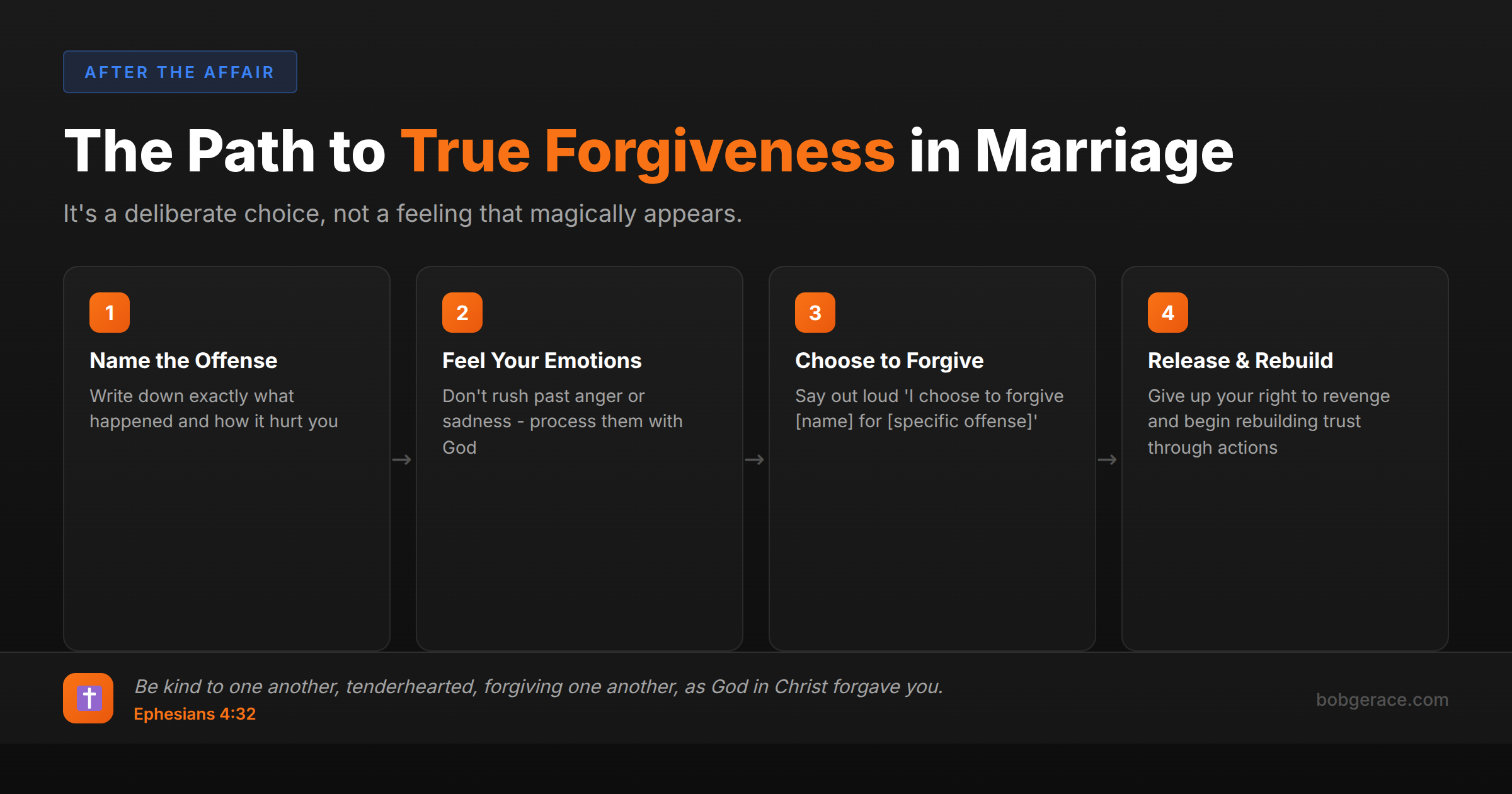
Forgiveness is a deliberate process, not a feeling that magically appears. It begins with acknowledging the hurt and making a conscious choice to release your right to revenge. This involves grieving what was lost, understanding what forgiveness actually means (releasing debt, not excusing behavior), and then actively choosing to bless rather than curse your spouse. The process includes practical steps: naming the offense clearly, feeling your emotions fully, choosing forgiveness as an act of obedience to God, and then rebuilding trust through consistent actions over time. True forgiveness doesn't mean forgetting or pretending it didn't happen – it means choosing to move forward without holding the offense against your spouse.
The Full Picture
Forgiveness in marriage isn't a one-time event – it's a process that unfolds over time. Too many couples get stuck because they think forgiveness should happen instantly, or that it automatically means everything goes back to normal. That's not how it works.
The reality is forgiveness has layers. There's the initial choice to forgive, which you can make immediately. Then there's the ongoing work of living out that forgiveness, which takes time. And finally, there's the separate process of rebuilding trust, which requires consistent action from the offending spouse.
Many people confuse forgiveness with reconciliation. Forgiveness is what you do – it's your choice to release the debt. Reconciliation is what you both do together – it's the rebuilding of relationship. You can forgive unilaterally, but reconciliation requires both people.
Here's what forgiveness actually means: You're choosing to cancel the debt your spouse owes you for their offense. You're releasing your right to punish them or make them pay. You're choosing to see them as God sees them – loved, valuable, and worth fighting for.
Here's what forgiveness doesn't mean: It doesn't mean pretending it didn't happen. It doesn't mean there are no consequences. It doesn't mean you immediately trust them with everything. And it definitely doesn't mean you become a doormat.
The forgiveness process requires both your heart and your will. Your heart needs time to heal, but your will can choose forgiveness today. That's where the process begins – with a deliberate choice to obey God and love your spouse, regardless of how you feel.
What's Really Happening
From a therapeutic perspective, forgiveness activates multiple psychological processes simultaneously. When we've been hurt, our brain's threat detection system remains hypervigilant, constantly scanning for danger. The forgiveness process helps rewire these neural pathways from threat-focused to healing-focused.
Research shows that forgiveness is strongly correlated with improved mental health, reduced anxiety, and better relationship satisfaction. However, the process must be genuine – forced or premature forgiveness often leads to suppressed emotions that resurface later with greater intensity.
The most successful forgiveness process involves what we call '//blog.bobgerace.com/emotional-overwhelm-christian-marriage-science-solutions/:emotional validation' first. You must acknowledge and feel the full weight of your hurt before you can genuinely release it. Couples who skip this step often find themselves stuck in cycles of surface-level forgiveness followed by recurring resentment.
Neurologically, forgiveness engages the prefrontal cortex – the part of your brain responsible for executive decisions – to override the limbic system's emotional reactions. This is why forgiveness feels so difficult initially; you're literally fighting against your brain's natural protective responses.
The timeline varies significantly between individuals. Some can work through minor offenses in days, while major betrayals may require months or years of processing. The key is maintaining forward momentum while allowing adequate time for emotional healing. Rushing the process often backfires, while refusing to engage in the process leads to bitterness and relationship deterioration.
What Scripture Says
God's design for forgiveness is both clear and comprehensive. Scripture doesn't minimize the difficulty of forgiveness, but it makes the command unmistakable.
Ephesians 4:32 gives us the foundation: *"Be kind to one another, tenderhearted, forgiving one another, as God in Christ forgave you."* Notice the standard – we forgive as God forgave us. That means completely, willingly, and without keeping score.
Matthew 18:21-22 addresses the scope: *"Then Peter came up and said to him, 'Lord, how often will my brother sin against me, and I forgive him? As many as seven times?' Jesus said to him, 'I do not say to you seven times, but seventy-seven times.'"* Jesus isn't giving us a mathematical limit – He's saying forgiveness should be our default response.
Colossians 3:13 shows us the method: *"Bearing with one another and, if one has a complaint against another, forgiving each other; as the Lord has forgiven you, so you also must forgive."* The phrase 'bearing with' suggests an ongoing process, not a one-time event.
Mark 11:25 connects forgiveness to our relationship with God: *"And whenever you stand praying, forgive, if you have anything against anyone, so that your Father also who is in heaven may forgive you your trespasses."* Our willingness to forgive directly impacts our relationship with God.
Scripture presents forgiveness as both a command and a gift – a command because it's required, and a gift because it frees us from the poison of bitterness. God knows that unforgiveness hurts us more than it hurts the person who wronged us.
What To Do Right Now
-
1
Name the offense specifically - write down exactly what your spouse did and how it hurt you
-
2
Feel your emotions fully - don't rush past anger, sadness, or disappointment; process them with God
-
3
Make the choice to forgive - say out loud 'I choose to forgive [spouse's name] for [specific offense]'
-
4
Release your right to revenge - pray for God to bless your spouse instead of cursing them
-
5
Communicate your forgiveness clearly - tell your spouse you've chosen to forgive them
-
6
Begin rebuilding through consistent actions - create new patterns of trust through daily choices
Related Questions
- What does biblical forgiveness require of me?
- Can I forgive without trusting?
- What's the difference between forgiveness and reconciliation?
- How do I forgive when she hasn't fully repented?
- What does real forgiveness look like?
- How do I know if I've actually forgiven?
- How do I not lose my mind right now?
- How do I deal with intrusive images?
- What does trauma recovery look like?
- How long do I wait before giving up?
Also find Bob on
Subscribe for weekly videos on Christian marriage.
Forgiveness in Your Actual Marriage
The process looks different when it's your spouse, your history, your specific hurt. A coach who knows your story can help you work through this without getting stuck or faking it.
Talk to Bob →