How do I know if I've actually forgiven?
6 min read
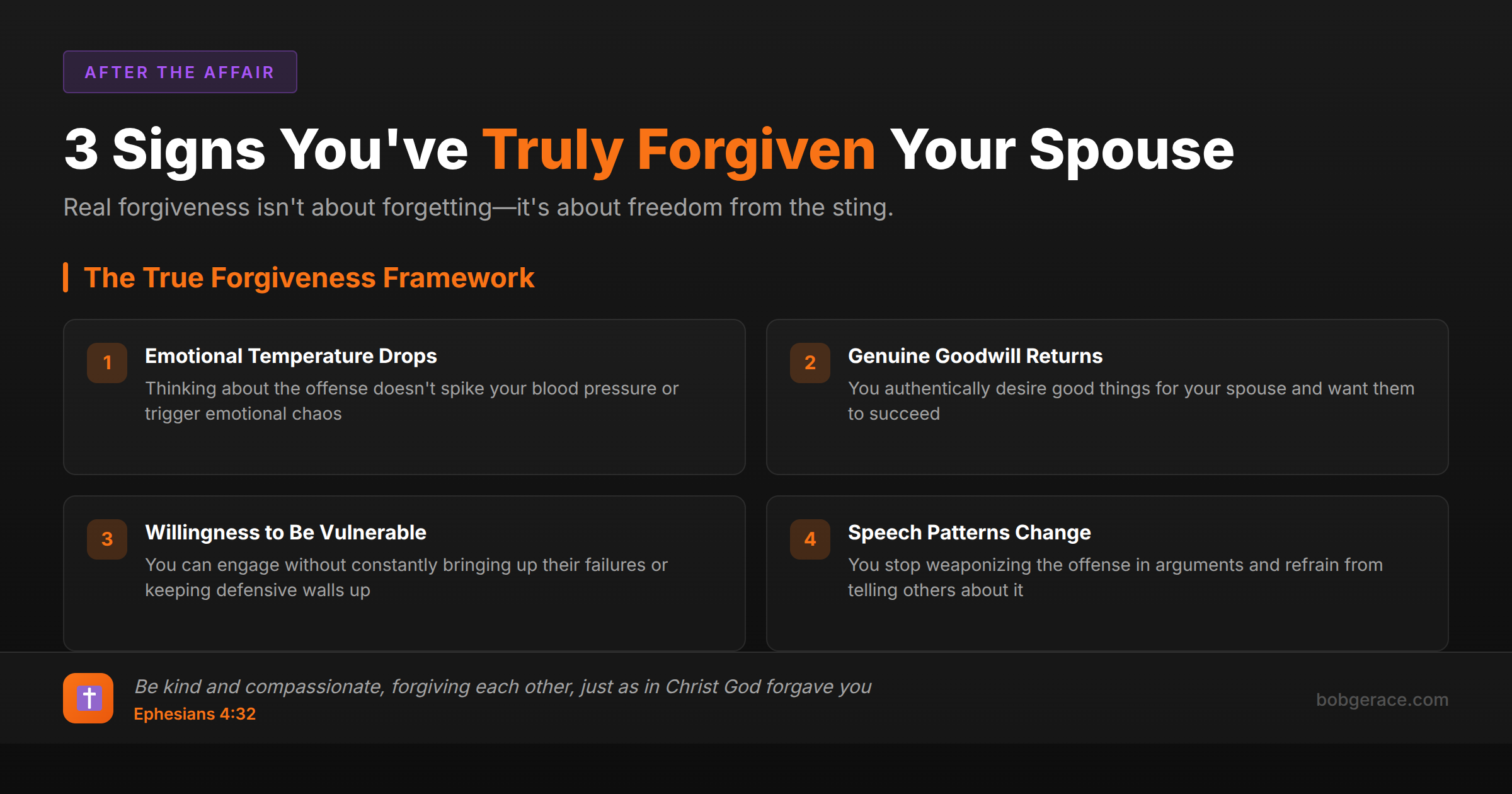
True forgiveness reveals itself through three key indicators: your emotional temperature drops when you think about the offense, you genuinely desire good things for your spouse, and you're willing to be vulnerable with them again. It's not about forgetting what happened or pretending it didn't hurt - that's denial, not forgiveness. Real forgiveness means the sting is gone, the desire for revenge has disappeared, and you can engage with your spouse without constantly bringing up their failures. You'll know you've forgiven when thinking about the offense doesn't spike your blood pressure or send you into an emotional tailspin. Instead, you feel a sense of release and freedom.
The Full Picture
Forgiveness isn't a feeling - it's a decision that eventually transforms your feelings. Too many couples get stuck thinking they haven't truly forgiven because they still feel hurt when they remember the offense. That's not how forgiveness works.
The clearest sign you've forgiven is emotional neutrality. When you can think about what your spouse did without your heart racing, without anger flooding your system, without immediately wanting to bring up their failure - that's forgiveness at work. You're not pretending it didn't happen. You're not saying it was okay. You're simply releasing your right to make them pay for it.
True forgiveness shows up in your behavior. You stop bringing up past offenses in current arguments. You don't keep a mental scorecard of their failures. You're not constantly looking for evidence that they'll hurt you again. Instead, you're willing to be present, engaged, and even vulnerable with them.
Forgiveness also reveals itself in your desires for your spouse. When you've truly forgiven, you want good things for them. You're not secretly hoping they'll get what's coming to them. You're not waiting for karma to catch up. You genuinely desire their wellbeing, their growth, and their success.
Here's what forgiveness is NOT: It's not trust (that's earned back over time), it's not forgetting (that's often impossible and not required), and it's not reconciliation (that requires repentance and change from both parties). Forgiveness is simply releasing your spouse from the debt they owe you for the pain they caused.
What's Really Happening
From a psychological perspective, forgiveness is measurable through both physiological and behavioral indicators. When we haven't forgiven, our nervous system remains hypervigilant around the topic of the offense. Heart rate increases, cortisol spikes, and we experience what we call 'emotional hijacking' - where past pain overwhelms present reality.
Genuine forgiveness rewires your brain's response. The amygdala - your brain's alarm system - stops firing danger signals when you think about the offense. This neurological shift is why true forgiveness brings such profound peace. Your //blog.bobgerace.com/physical-fitness-christian-marriage-body-temple/:body literally stops treating your spouse as a threat related to that specific hurt.
Behaviorally, forgiveness shows up in decreased rumination. You stop mentally rehearsing the offense, stop telling the story to others for validation, and stop using it as ammunition in conflicts. This isn't suppression - it's genuine release. The event loses its emotional charge.
There's also a shift in attribution patterns. When you've forgiven, you stop attributing malicious intent to neutral behaviors. You're not reading hidden meanings into their actions or assuming the worst about their motivations. You can see them as a flawed human being rather than an enemy.
The process isn't linear. You might forgive and then find yourself needing to forgive again as new layers of hurt surface. This is normal and doesn't mean your initial forgiveness wasn't real. Forgiveness is often more like peeling an onion than flipping a switch - it happens in layers as you're able to process deeper levels of pain.
What Scripture Says
Scripture gives us clear markers for recognizing true forgiveness. Ephesians 4:31-32 commands us to "Get rid of all bitterness, rage and anger, brawling and slander, along with every form of malice. Be kind and compassionate to one another, forgiving each other, just as in Christ God forgave you." When you've forgiven, bitterness is replaced by kindness, anger by compassion.
1 Corinthians 13:5 tells us love "keeps no record of wrongs." This doesn't mean you forget what happened, but rather that you stop keeping a ledger of offenses to use against your spouse. True forgiveness stops the scorekeeping.
Matthew 6:14-15 reveals the connection between our forgiveness and God's: "For if you forgive other people when they sin against you, your heavenly Father will also forgive you. But if you do not forgive others their sins, your Father will not forgive your sins." When you truly grasp how much God has forgiven you, forgiving your spouse becomes possible.
Colossians 3:13 instructs us to "Bear with each other and forgive one another if any of you has a grievance against someone. Forgive as the Lord forgave you." God's forgiveness is complete, immediate, and doesn't depend on our feelings - and that's our model.
Romans 12:19 says "Do not take revenge, my dear friends, but leave room for God's wrath." When you've forgiven, you've released your desire for revenge and trusted God with justice.
Luke 17:3-4 shows forgiveness can be immediate and repeated: "If your brother or sister sins against you, rebuke them; and if they repent, forgive them. Even if they sin against you seven times in a day and seven times come back to you saying 'I repent,' you must forgive them."
What To Do Right Now
-
1
Check your emotional temperature - Think about the offense and notice your physical response. True forgiveness brings emotional calm, not emotional numbness.
-
2
Examine your speech patterns - Have you stopped bringing up this offense in arguments? Do you refrain from telling others about it? Forgiveness changes how we talk.
-
3
Assess your desires for your spouse - Can you genuinely wish good things for them? Do you want them to succeed and be blessed? This reveals the heart of forgiveness.
-
4
Test your vulnerability - Are you willing to be open with your spouse again, or are you still completely guarded? Forgiveness doesn't require foolishness, but it does enable appropriate vulnerability.
-
5
Notice your assumptions - Do you still assume the worst about their motives, or can you give them the benefit of the doubt? Forgiveness changes how we interpret their actions.
-
6
Pray for confirmation - Ask God to show you areas where forgiveness is incomplete and to give you grace to forgive fully. He's faithful to reveal and heal.
Related Questions
Need Help Working Through Forgiveness?
Forgiveness is often harder than it sounds. If you're struggling to truly forgive or aren't sure where you stand, let's work through it together.
Get Support →