What does healthy venting vs. rumination look like?
6 min read
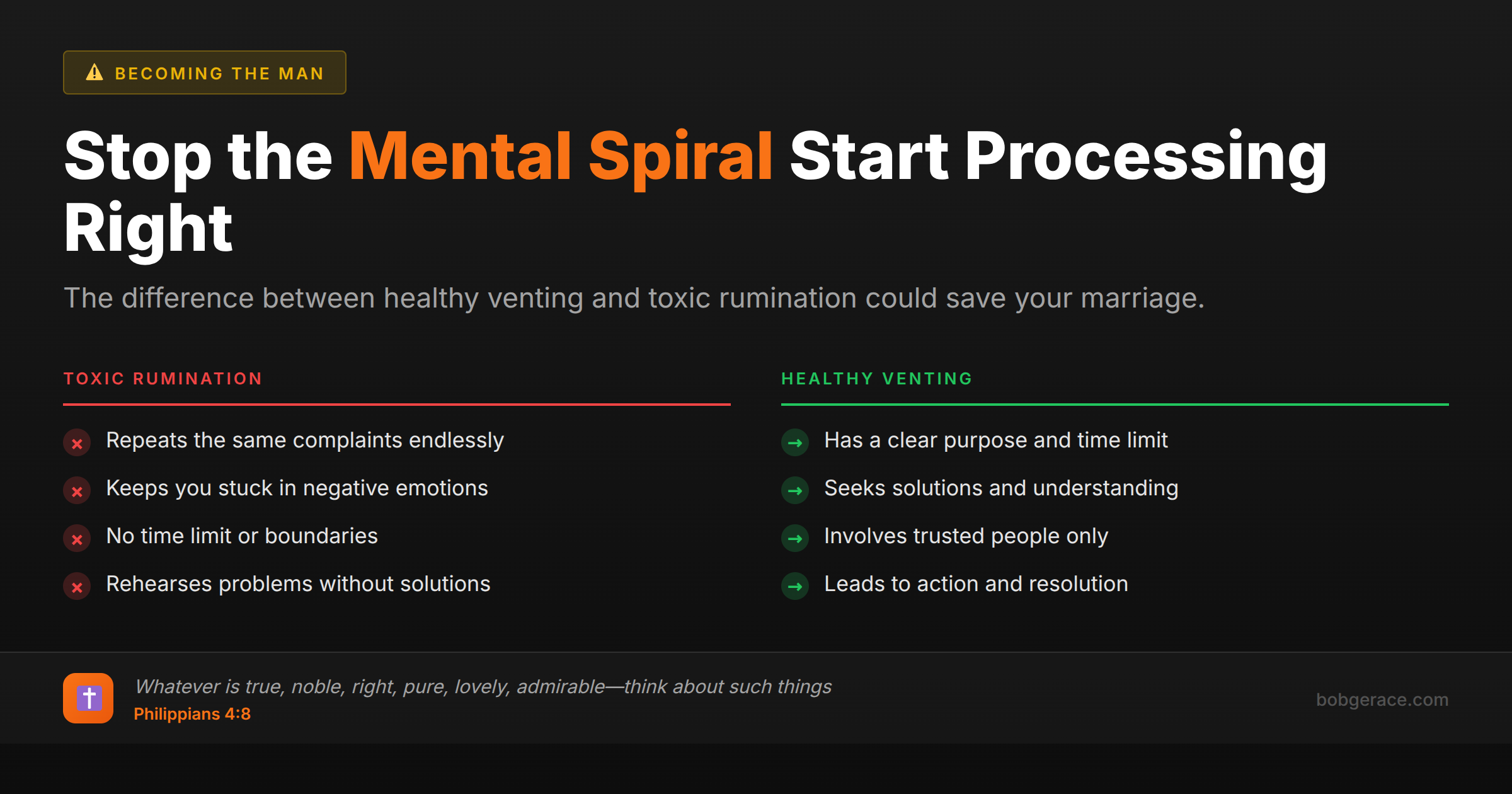
Healthy venting has a purpose, a time limit, and leads to action or resolution. You share specific concerns with trusted people, seek solutions, and move forward. Rumination, on the other hand, is repetitive, circular thinking that keeps you stuck in negative emotions without progress. Healthy venting might sound like: 'I'm frustrated about this situation. Can you help me think through it?' followed by problem-solving. Rumination sounds like: 'I can't stop thinking about how wrong this is' repeated endlessly without seeking change. The key difference? Healthy venting seeks understanding and moves toward resolution, while rumination rehearses problems without pursuing solutions.
The Full Picture
Every woman needs to process her emotions - that's not the problem. The problem comes when processing becomes a prison instead of a pathway to peace. I've watched countless wives get trapped in cycles that feel like venting but are actually rumination disguised as conversation.
Healthy venting looks like this: - You have a specific issue you want to understand or resolve - You choose your audience carefully - someone who can offer wisdom or support - You set boundaries on time and repetition - You're open to different perspectives - You move toward action or acceptance - You feel lighter and clearer afterward
Rumination masquerades as venting but actually: - Rehearses the same complaints repeatedly - Seeks agreement more than solutions - Increases anxiety and frustration over time - Involves multiple people hearing the same story - Resists alternative viewpoints - Leaves you feeling more agitated, not less
The difference isn't in the initial emotion - both start with legitimate concerns. The difference is in the direction. Healthy venting is a bridge to somewhere better. Rumination is a hamster wheel that goes nowhere but exhausts everyone involved, including you.
Your marriage needs you to process well, not just process much. When you learn to vent healthily, you become a woman who handles life's challenges with grace and wisdom, rather than getting stuck in emotional quicksand.
What's Really Happening
From a clinical perspective, the difference between healthy venting and rumination lies in neural pathways and emotional regulation. When we engage in healthy venting, we're using our prefrontal cortex - the part of the brain responsible for problem-solving and emotional regulation. This creates new neural connections and helps us process emotions effectively.
Rumination, however, activates the amygdala and keeps us in a fight-or-flight state. Research shows that rumination actually strengthens negative thought patterns, making them more automatic over time. It's like wearing a path in the grass - the more you walk the same route, the deeper the groove becomes.
Healthy venting engages what we call 'emotional granularity' - the ability to distinguish between different emotional states and identify specific triggers. When you say, 'I feel dismissed when conversations get cut short,' you're being emotionally granular. When you say, 'He never listens to me,' you're generalizing in ways that promote rumination.
The biochemistry is different too. Healthy processing releases tension and can actually trigger the parasympathetic nervous system, promoting calm. Rumination keeps cortisol levels elevated, which impacts sleep, digestion, and overall health. Your body literally knows the difference between productive emotional work and spinning your wheels. Trust what your body tells you after these conversations - energized or depleted, clearer or more confused, peaceful or more agitated.
What Scripture Says
Scripture gives us a clear framework for how to handle our thoughts and emotions. God doesn't tell us to suppress our feelings, but He does give us guidance on processing them wisely.
Philippians 4:8 teaches us where to direct our mental energy: 'Finally, brothers and sisters, whatever is true, whatever is noble, whatever is right, whatever is pure, whatever is lovely, whatever is admirable—if anything is excellent or praiseworthy—think about such things.' This doesn't mean ignoring problems, but it means not camping out in negativity.
Proverbs 27:5-6 shows us the value of honest conversation: 'Better is open rebuke than hidden love. Wounds from a friend can be trusted, but an enemy multiplies kisses.' Healthy venting involves trusted friends who will speak truth, not just validate complaints.
Ecclesiastes 3:7 reminds us there is 'a time to be silent and a time to speak.' Wisdom knows when to process and when to rest from processing. Rumination refuses to honor the 'time to be silent.'
Psalm 139:23-24 gives us the right heart posture: 'Search me, God, and know my heart; test me and know my anxious thoughts. See if there is any offensive way in me, and lead me in the way everlasting.' This is processing with purpose - seeking God's perspective and transformation.
Matthew 6:26 reminds us of God's care: 'Look at the birds of the air; they do not sow or reap or store away in barns, and yet your heavenly Father feeds them. Are you not much more valuable than they?' When we ruminate, we're often trying to control outcomes through worry. Faith calls us to process, then trust.
What To Do Right Now
-
1
Set a timer for 15 minutes when you need to process something - this creates healthy boundaries around venting time
-
2
Ask yourself: 'Am I seeking solutions, understanding, or just rehearsing complaints?' before sharing with others
-
3
Choose 1-2 trusted people for processing big issues rather than telling everyone the same story multiple times
-
4
Write down the specific outcome you want from venting - clarity, advice, prayer support, or just being heard
-
5
Practice the 24-hour rule: wait one day before re-discussing the same issue to see if you still need to process it
-
6
End venting sessions with prayer or a specific action step, even if it's just 'I'm going to sleep on this and revisit tomorrow'
Related Questions
- What is self-care in crisis?
- What support do I need?
- What does healthy coping look like?
- What numbing behaviors should I watch for?
- How do I process without a toxic support system?
- How do I regulate my own system?
- Why do I keep replaying the discovery?
- What is the 'trauma loop' and how do I interrupt it?
- Why can't I stop obsessing over details?
Also find Bob on
Subscribe for weekly videos on Christian marriage.
Stop Spinning. Get a Coach.
If you're stuck in the same loop in your marriage, a coach who knows your specific situation can see what you can't see from inside it.
Talk to Bob →