What if I say I've forgiven but still bring it up?
6 min read
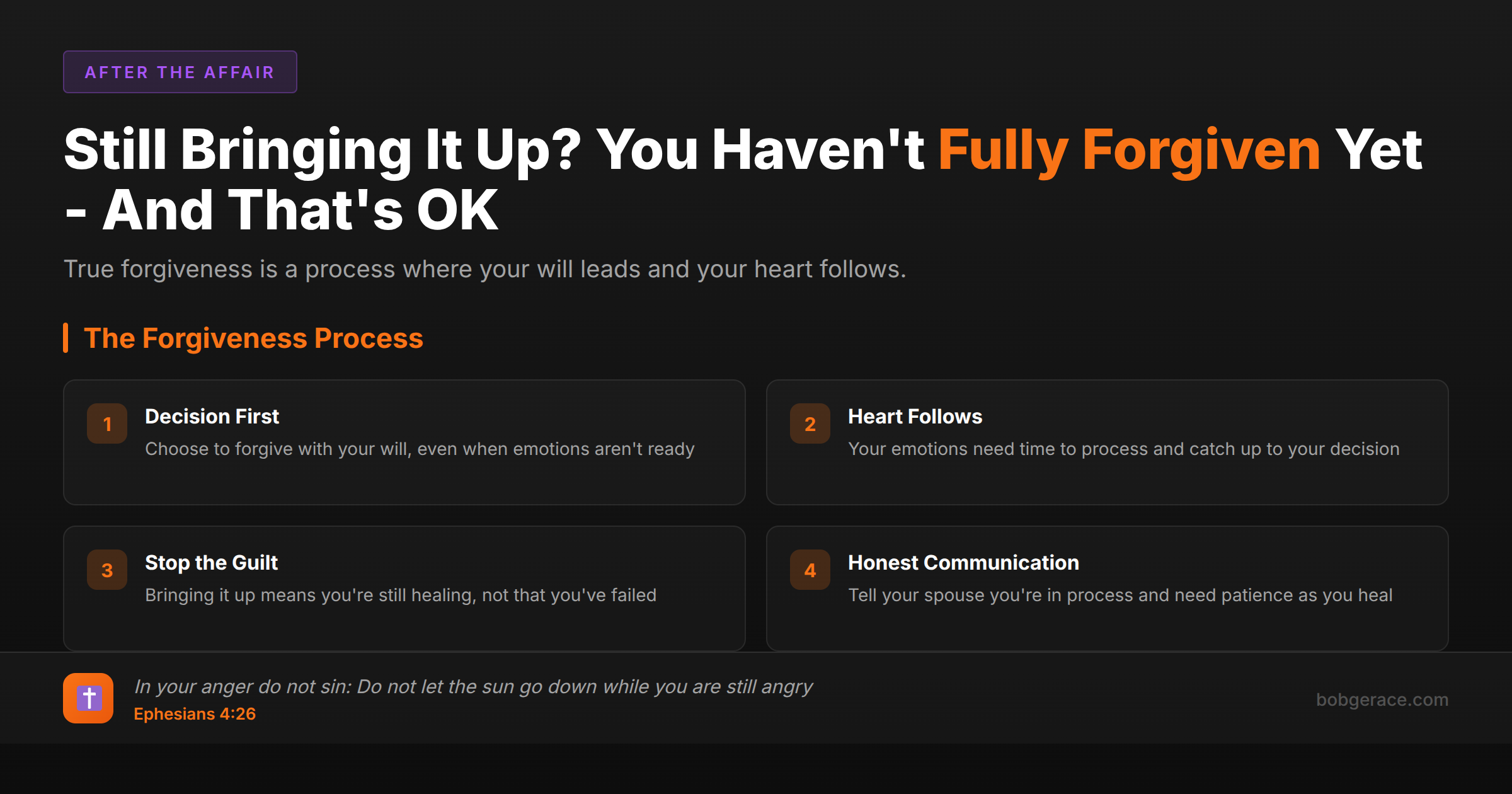
If you're still bringing up past hurts, you haven't fully forgiven yet - and that's okay. True forgiveness is a process, not a one-time declaration. What you're experiencing is normal and shows you're being honest about where you really are emotionally. The key is recognizing that forgiveness involves both your will and your emotions working together over time. You may have made the decision to forgive (which is crucial), but your heart is still processing the pain. This creates an internal conflict that manifests as repeatedly bringing up the offense. Instead of feeling guilty about this, use it as information about what still needs healing in your heart.
The Full Picture
Here's what's really happening when you say you've forgiven but keep bringing up the hurt: you're caught between your head and your heart. Your mind knows forgiveness is right and necessary, but your emotions haven't caught up yet. This creates a frustrating cycle where you genuinely want to move forward but find yourself pulled back into the pain.
This doesn't make you a failure or a fake. It makes you human. Forgiveness, especially for deep wounds in marriage, rarely happens instantly. What you've done by choosing to forgive is the crucial first step - you've set the direction. Now your emotions need time to align with that decision.
The problem comes when we pretend we're "over it" when we're not. This creates internal pressure and often leads to explosive moments where all that suppressed hurt comes rushing out. Your spouse feels confused and frustrated because they thought the issue was resolved, and you feel guilty for "failing" at forgiveness.
True forgiveness involves three elements: the decision to forgive (which you've made), the emotional release of the offense (which takes time), and the rebuilding of trust (which requires consistent action from both spouses). You're not stuck - you're simply in process. The fact that you keep bringing it up is actually your heart's way of saying "this still needs attention and healing." Instead of fighting this reality, lean into it and do the deeper work of processing the pain completely.
What's Really Happening
From a therapeutic standpoint, what you're experiencing is called cognitive-emotional dissonance - your rational mind and emotional system are operating on different timelines. This is completely normal when processing betrayal or deep hurt in relationships.
Your brain is trying to protect you. When we experience relational trauma, our nervous system creates what we call "emotional bookmarks" - neurological reminders of the pain designed to help us avoid similar hurts. These bookmarks don't disappear just because we make a conscious decision to forgive. They require intentional processing and often trigger the urge to "bring it up again."
The repetitive nature of bringing up past hurts often indicates unfinished emotional business. Perhaps you haven't fully expressed how the offense affected you, or maybe you don't feel truly heard and understood by your spouse. Sometimes it's because the underlying issue that led to the hurt hasn't been adequately addressed.
Here's the key insight: Sustainable forgiveness requires emotional completion, not just cognitive decision-making. This means creating space to fully process the hurt - feeling it, expressing it appropriately, and allowing your nervous system to release the charge around the event. When couples try to "forgive and forget" too quickly, they often find themselves stuck in this exact cycle. The goal isn't to forget or suppress the hurt, but to metabolize it completely so it no longer has an emotional charge that compels you to keep revisiting it.
What Scripture Says
Scripture gives us a realistic picture of forgiveness that acknowledges both the command to forgive and the process it often requires. Ephesians 4:26-27 tells us: *"In your anger do not sin: Do not let the sun go down while you are still angry, and do not give the devil a foothold."* This shows us that even righteous anger needs to be processed, not buried.
Matthew 18:21-22 records Peter asking Jesus: *"Lord, how many times shall I forgive my brother or sister who sins against me? Up to seven times?" Jesus answered, "I tell you, not seven times, but seventy-seven times."* This isn't about keeping score - it's acknowledging that forgiveness is often an ongoing choice, especially in close relationships.
Psalm 51:6 reveals God's heart: *"Yet you desired faithfulness even in the womb; you taught me wisdom in that //blog.bobgerace.com/christian-marriage-confession-psychology-her-secret/:secret place."* God values truth and authenticity over religious performance. He'd rather you be honest about your struggle than pretend you're somewhere you're not.
1 John 1:9 promises: *"If we confess our sins, he is faithful and just and will forgive us our sins and purify us from all unrighteousness."* Notice the process - confession leads to forgiveness and then to purification. Similarly, in marriage, acknowledgment of hurt can lead to forgiveness and then to healing.
Colossians 3:13 instructs: *"Bear with each other and forgive one another if any of you has a grievance against someone. Forgive as the Lord forgave you."* The phrase "bear with" implies patience with the process. Even Jesus, in His perfect forgiveness, took time to work through the disciples' failures and restoration.
What To Do Right Now
-
1
Stop feeling guilty about where you are. Acknowledge that you're in process, not in failure. Thank God that you've chosen to forgive even while your emotions are still catching up.
-
2
Have an honest conversation with your spouse. Explain that you've chosen to forgive but you're still processing the hurt emotionally. Ask for patience and understanding as you work through this together.
-
3
Identify what's still unresolved. Write down specifically what aspects of the hurt still feel raw or unfinished. Is it lack of understanding from your spouse? Unaddressed underlying issues? Need for different boundaries?
-
4
Create a plan for processing the pain. This might include counseling, prayer, journaling, or structured conversations with your spouse. Don't just hope it goes away - actively work toward emotional completion.
-
5
Establish boundaries around "bringing it up." Agree with your spouse on appropriate times and ways to discuss the issue while you're healing, rather than letting it come up randomly in arguments.
-
6
Celebrate progress, not just perfection. Notice when you go longer periods without bringing it up, when the emotional intensity decreases, or when you can discuss it without losing control. These are signs that healing is happening.
Related Questions
- How do I know if I've actually forgiven?
- What does forgiveness feel like when it's real?
- What if the pain keeps coming back?
- Can I forgive before I'm ready?
- What does forgiveness look like day to day?
- What's the difference between forgiveness and trust?
- Why do I repeat patterns I hate?
- I know what to do but can't do it
- How do I deal with intrusive images?
- What does healthy coping look like?
Also find Bob on
Subscribe for weekly videos on Christian marriage.
Your Marriage Needs More Than a Framework
You know what forgiveness should look like. But your specific story—what was done, how it lands in your body, why it keeps surfacing—needs a human who can calibrate to where you actually are.
Talk to Bob →