What does 'forgive and forget' actually mean?
6 min read
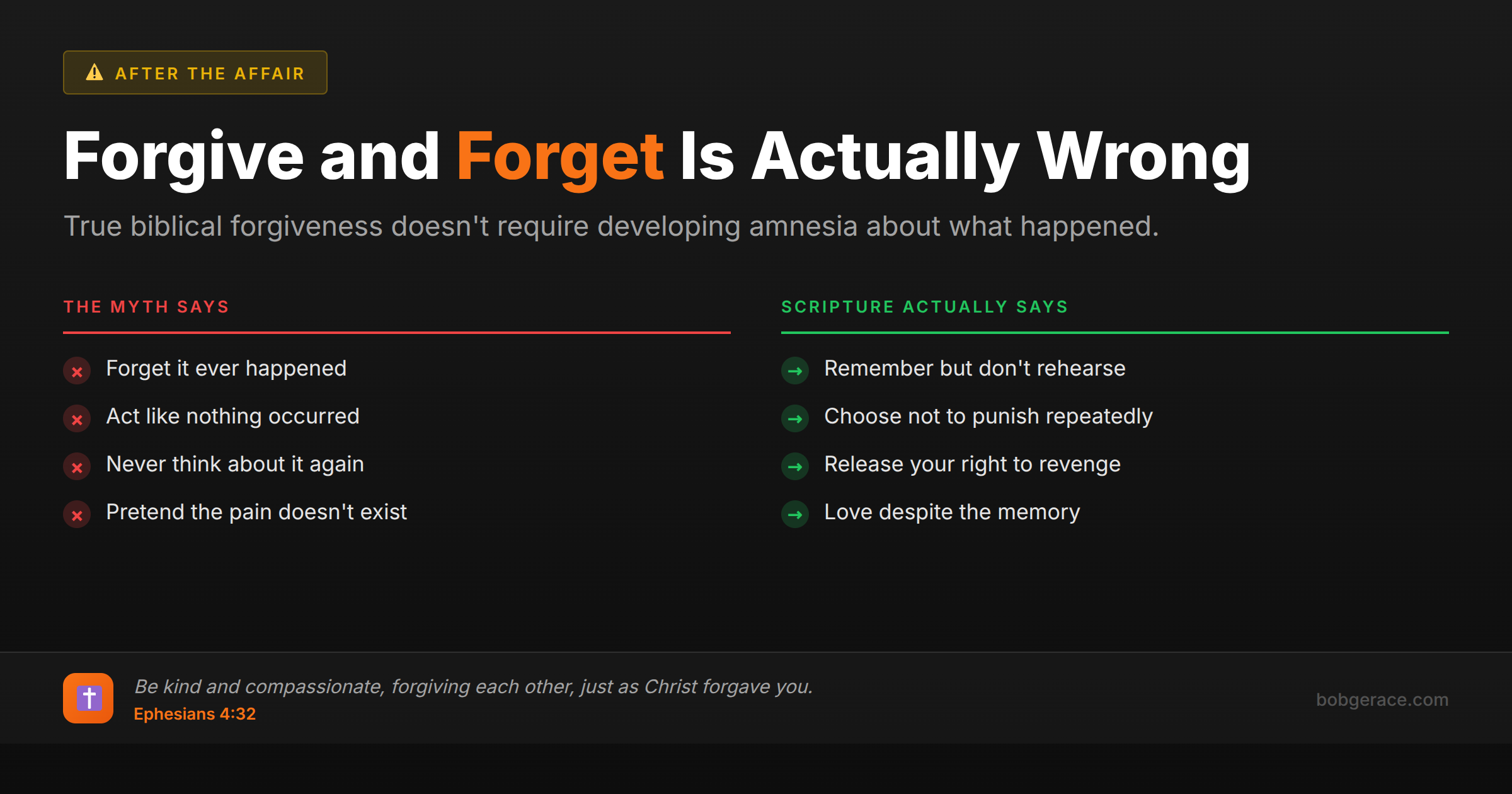
The phrase 'forgive and forget' isn't actually found in Scripture, and it's often misunderstood. Biblical forgiveness doesn't mean developing amnesia about what happened. Instead, it means choosing not to hold the offense against someone and not bringing it up to punish them repeatedly. True forgiveness is a decision to release your right to revenge and to stop rehearsing the hurt. It's choosing to treat your spouse as if the offense didn't happen, even though you remember it occurred. This doesn't mean ignoring patterns of harm or avoiding necessary boundaries - it means freeing yourself from the burden of carrying that hurt and choosing love despite the pain.
The Full Picture
Here's what most people get wrong about 'forgive and forget': they think it means pretending the hurt never happened. That's not biblical, and it's not healthy. God designed our brains to remember experiences because memory protects us and helps us make wise decisions.
What forgiveness actually means is choosing not to use past offenses as weapons against your spouse. It's deciding not to bring up old hurts every time you have a disagreement. It's releasing your demand for payback and choosing to love despite the pain.
The 'forget' part doesn't mean literal amnesia. It means choosing not to dwell on the offense, not rehearsing it in your mind, and not allowing it to poison your present interactions. Think of it like a scar - you can see where the wound was, but it's healed and no longer bleeding.
This protects both of you. When you truly forgive, you free yourself from the exhausting burden of carrying resentment. You also free your spouse from walking on eggshells, wondering when their past mistakes will be thrown back at them. This creates space for genuine healing and rebuilding trust.
But here's the key: forgiveness doesn't mean there are no consequences or that trust is automatically restored. You can forgive your spouse for lying while still requiring transparency moving forward. You can forgive financial betrayal while implementing new accountability measures. Forgiveness opens the door to reconciliation, but rebuilding happens through consistent, trustworthy actions over time.
What's Really Happening
From a clinical perspective, the confusion around 'forgive and forget' creates significant problems in marriages. When couples think forgiveness requires forgetting, they either avoid forgiving (because they can't forget) or they engage in premature forgiveness that doesn't address the underlying issues.
Neurologically, we can't simply delete memories. Traumatic or hurtful experiences create neural pathways that remain accessible. Trying to force forgetfulness often leads to suppression, which typically increases intrusive thoughts and emotional reactivity. Instead, healthy forgiveness involves changing our relationship with the memory - moving from active rumination to acknowledgment without emotional charge.
I see three common patterns when couples misunderstand this concept: First, the hurt spouse feels guilty for remembering painful events, thinking they haven't 'truly' forgiven. Second, the offending spouse uses 'you should forget' as a way to avoid accountability for their actions. Third, both partners avoid addressing systemic issues because they think forgiveness should make everything 'like new.'
Genuine forgiveness is actually a process that involves multiple components: acknowledging the hurt, choosing to release the right to revenge, developing empathy for your spouse's humanity, and committing to rebuild the relationship. This process takes time and often requires revisiting the decision to forgive multiple times as you //blog.bobgerace.com/trust-rebuilding-marriage-patient-work/:work through layers of pain and begin to establish new patterns of interaction.
What Scripture Says
Scripture gives us a clear picture of what forgiveness looks like, and it's more nuanced than simply forgetting.
Ephesians 4:32 tells us to 'be kind and compassionate to one another, forgiving each other, just as in Christ God forgave you.' Notice it doesn't say 'forgetting' - it says forgiving as Christ forgave us. God doesn't forget our sins in the sense of losing memory; He chooses not to count them against us.
Isaiah 43:25 says, 'I, even I, am he who blots out your transgressions, for my own sake, and remembers your sins no more.' The Hebrew word for 'remembers no more' means choosing not to bring something up or act upon it, not literal forgetting. God chooses not to hold our sins against us.
1 Corinthians 13:5 describes love as keeping 'no record of wrongs.' This doesn't mean having no memory, but rather not keeping a running tally to use against someone later. It's choosing not to rehearse and weaponize past hurts.
Matthew 18:21-22 shows Peter asking if forgiving seven times is enough, and Jesus responds 'seventy-seven times' (or seventy times seven). This suggests forgiveness is often a repeated choice, not a one-time event that erases all memory.
Luke 17:3-4 instructs us to forgive repeatedly when someone repents, but notice it assumes we remember the previous offenses - otherwise, how would we know it happened multiple times? The point is choosing forgiveness despite remembering.
Psalm 103:12 beautifully illustrates God's forgiveness: 'as far as the east is from the west, so far has he removed our transgressions from us.' This is about separation and release, not amnesia.
What To Do Right Now
-
1
Stop demanding that you or your spouse forget painful events - focus instead on choosing not to use them as weapons
-
2
Practice the 'acknowledge but don't rehearse' principle - when hurt memories surface, acknowledge them without dwelling or ruminating
-
3
Have an honest conversation about the difference between forgiving and rebuilding trust - they're separate processes
-
4
Create a 'no bringing up past offenses' rule for current disagreements - deal with present issues without dragging in old hurts
-
5
If you've been hurt, work on releasing your right to revenge while still maintaining appropriate boundaries for safety and rebuilding
-
6
If you've caused hurt, stop using 'you should forget' to avoid accountability and instead focus on consistent trustworthy actions moving forward
Related Questions
- What does biblical forgiveness require of me?
- Can I forgive without trusting?
- What's the difference between forgiveness and reconciliation?
- How do I forgive when she hasn't fully repented?
- What does forgiveness feel like when it's real?
- What if the pain keeps coming back?
- How do I stop the mental movies?
- She brings up things from years ago
- What does real forgiveness look like?
- How do I not lose my mind right now?
Also find Bob on
Subscribe for weekly videos on Christian marriage.
Forgiveness in Your Actual Marriage
The concept is one thing. Applying it to your specific hurt, your spouse, your history — that's where a coach helps you calibrate what forgiveness actually looks like for you.
Talk to Bob →