What's the difference between forgiveness and trust?
6 min read
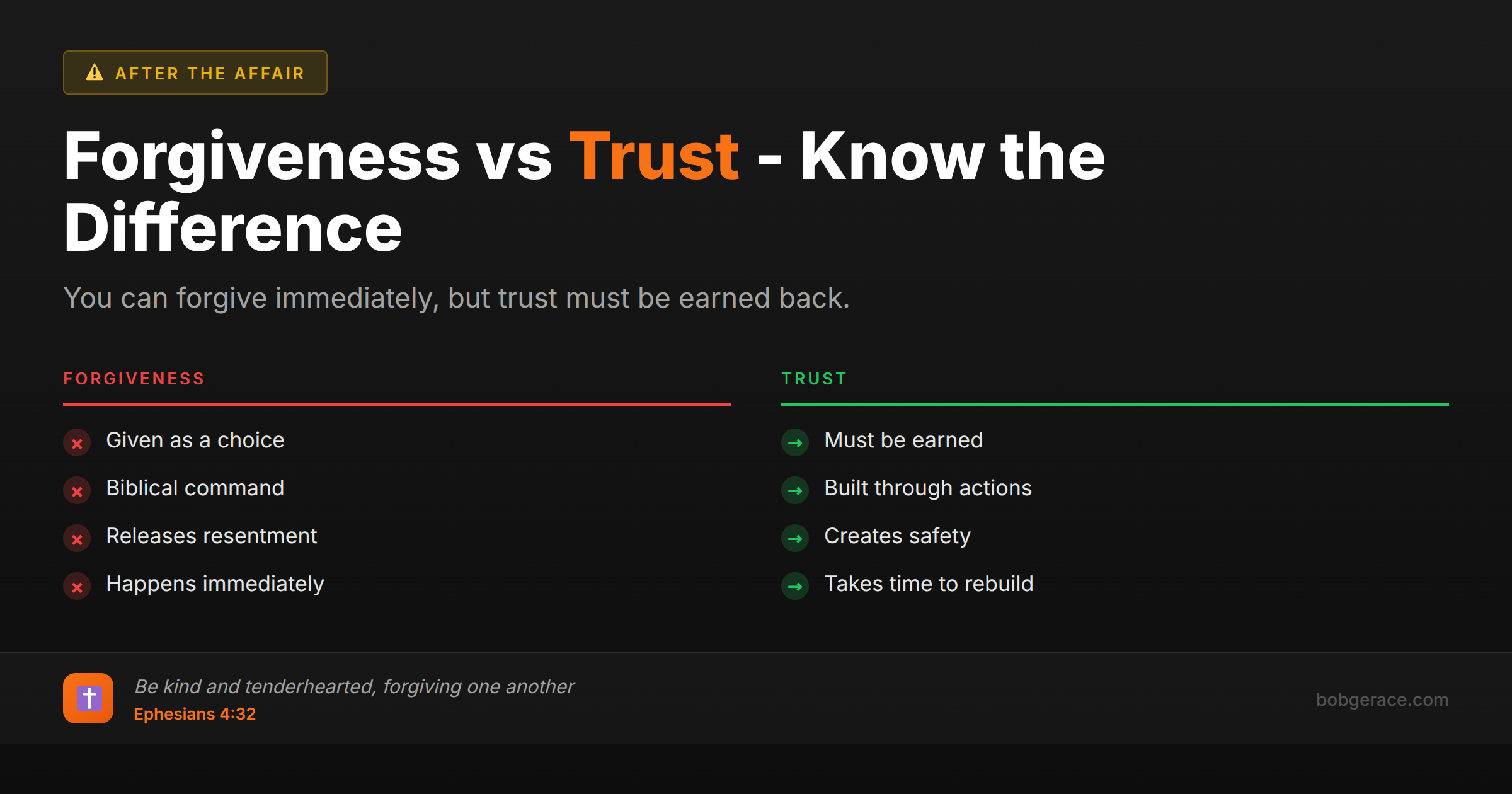
Forgiveness and trust are fundamentally different concepts that many couples confuse. Forgiveness is a biblical command that we choose to extend regardless of the other person's response - it's about releasing resentment and choosing love. Trust, however, is earned through consistent, trustworthy behavior over time. You can forgive someone immediately, but rebuilding trust requires proof of change. When your spouse hurts you, God calls you to forgive them completely. But that doesn't mean you automatically trust them with your heart again. Trust must be rebuilt through their actions, transparency, and time. Forgiveness frees you from bitterness; rebuilt trust creates safety for intimacy to flourish again.
The Full Picture
Here's where most couples get confused: they think forgiveness means everything goes back to normal immediately. That's not biblical, and it's not healthy.
Forgiveness is a choice you make about the past. It's saying, "I release you from the debt you owe me for this hurt." It's canceling the IOU. When Jesus tells us to forgive "seventy times seven," He's commanding us to release resentment and choose love regardless of whether our spouse "deserves" it.
Trust is an assessment you make about the future. It's asking, "Based on your current behavior, can I count on you to protect my heart?" Trust looks at patterns, consistency, and evidence of real change.
Think of it this way: If someone borrowed your car and wrecked it, you could forgive them completely. But would you immediately hand them your keys again? Probably not until they showed responsibility, got insurance, and proved they'd changed their driving habits.
The same principle applies in marriage. You can forgive an affair, forgive harsh words, forgive broken promises - and you should. But rebuilding trust requires your spouse to do the hard work of proving they're safe with your heart again.
This isn't punishment - it's wisdom. Proverbs 27:14 warns us about being naive. True reconciliation requires both forgiveness AND rebuilt trust. Without both, you either become bitter (no forgiveness) or repeatedly wounded (forgiveness without wisdom).
The beautiful truth? When both happen together - when forgiveness meets earned trust - marriages become stronger than they were before the hurt occurred.
What's Really Happening
From a therapeutic standpoint, confusing forgiveness with trust creates significant emotional and relational problems. When couples collapse these concepts, they often end up in one of two destructive patterns.
First, the hurt spouse feels guilty for not "trusting enough" after they've chosen to forgive. They think something is wrong with their faith or their heart when they still feel guarded. This self-condemnation prevents healthy boundary-setting and prolongs the healing process.
Second, the offending spouse often pressures for immediate trust restoration, using forgiveness as leverage. "You said you forgave me, so why don't you trust me?" This misunderstands both concepts and usually indicates they haven't done the internal //blog.bobgerace.com/trust-rebuilding-marriage-patient-work/:work necessary for genuine change.
Neurologically, forgiveness and trust activate different brain networks. Forgiveness engages our prefrontal cortex - our decision-making center. We can literally choose to forgive regardless of how we feel. Trust, however, involves our limbic system and requires our threat-detection system to calm down through repeated positive experiences.
Healthy couples understand that forgiveness can happen in a moment, but trust rebuilding is a process. The timeline depends on the severity of the breach, the offender's response, and the consistency of new behaviors. Rushing this process often leads to repeated violations because the underlying issues weren't properly addressed.
This is why therapeutic work often focuses on helping couples navigate both simultaneously - extending genuine forgiveness while establishing appropriate boundaries that allow trust to be rebuilt safely.
What Scripture Says
Scripture provides clear guidance on both forgiveness and trust, treating them as distinct yet complementary concepts.
On Forgiveness - It's Commanded and Immediate: Ephesians 4:32 tells us, "Be kind to one another, tenderhearted, forgiving one another, as God in Christ forgave you." This isn't conditional on the other person's response. Colossians 3:13 reinforces this: "Bearing with one another and, if one has a complaint against another, forgiving each other; as the Lord has forgiven you, so you also must forgive."
On Trust - It's Earned and Gradual: Proverbs 27:14 warns against naive trust: "The simple believe anything, but the prudent give thought to their steps." Jesus Himself demonstrates this principle in John 2:24-25: "Jesus would not entrust himself to them, for he knew all people. He did not need any testimony about mankind, for he knew what was in each person."
Wisdom in Relationships: Matthew 10:16 calls us to be "wise as serpents and innocent as doves." This perfectly captures the balance - we maintain innocent hearts through forgiveness while exercising serpent-like wisdom in rebuilding trust.
The Process of Restoration: Galatians 6:1 outlines restoration: "Brothers and sisters, if someone is caught in a sin, you who live by the Spirit should restore that person gently." Note that restoration is a process, not an instant return to previous status.
Scripture never suggests that forgiveness equals immediate trust restoration. Instead, it shows us that love forgives quickly while wisdom rebuilds trust carefully.
What To Do Right Now
-
1
Choose to forgive completely - release resentment and the desire for revenge, regardless of your spouse's response
-
2
Communicate the difference - explain to your spouse that forgiveness is given but trust must be rebuilt through consistent actions
-
3
Establish clear boundaries - define what behaviors and transparency are needed for trust rebuilding to begin
-
4
Create accountability measures - implement systems that allow your spouse to demonstrate trustworthiness over time
-
5
Celebrate small steps - acknowledge and appreciate every genuine effort your spouse makes toward rebuilding trust
-
6
Seek counseling support - work with a professional to navigate this process healthily and avoid common pitfalls
Related Questions
Need Help Rebuilding Trust?
Navigating forgiveness and trust rebuilding requires wisdom and support. Let's work together to restore your marriage properly.
Get Support →