Can I forgive before I'm ready?
5 min read
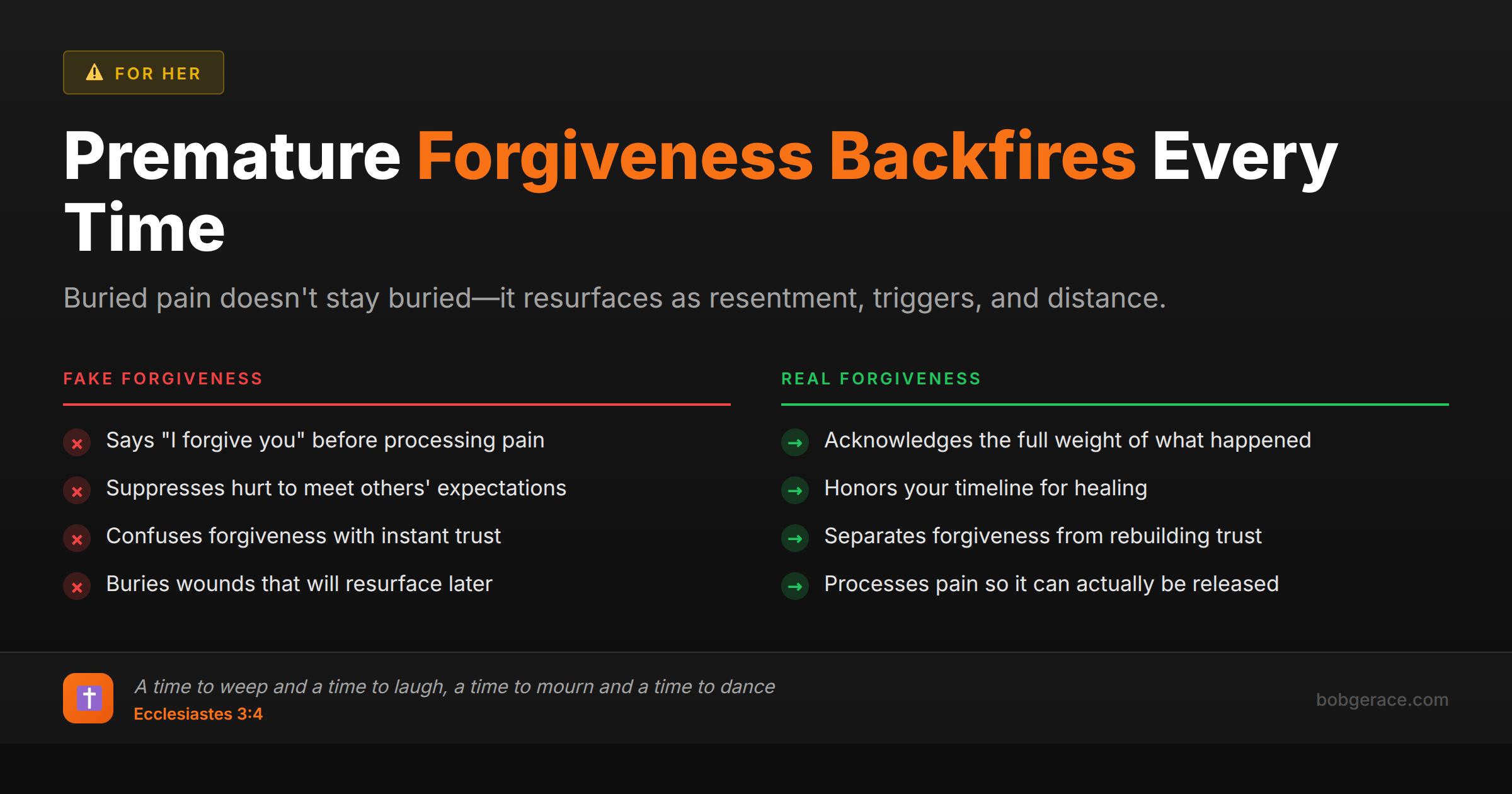
The short answer is no—and trying to will likely backfire. Premature forgiveness isn't forgiveness at all; it's suppression dressed in spiritual language. When you say the words "I forgive you" before your heart has actually processed the wound, you're not releasing the pain—you're burying it. And buried pain doesn't stay buried. It resurfaces as resentment, triggers, emotional distance, or physical symptoms. You may feel pressure to forgive quickly—from him, from well-meaning friends, from religious teachings that emphasize forgiveness. But genuine forgiveness is a process, not a single decision. It requires acknowledging the full weight of what happened, grieving what was lost, and reaching a place where release becomes possible because you've truly processed the pain—not because you've avoided it. God doesn't ask you to pretend wounds don't hurt. He asks you to eventually release bitterness so it doesn't poison you. Those are different timelines. Honor yours.
Why Premature Forgiveness Fails
There's enormous pressure on wounded spouses—especially wives, especially Christian wives—to forgive quickly. The message comes from multiple directions: forgive as God forgave you, don't let bitterness take root, move forward for the sake of the marriage. These messages contain truth, but when applied prematurely, they cause real harm.
Here's what happens when you forgive before you're ready: You say the words, but your nervous system doesn't believe them. You've intellectually decided to release the offense, but your body is still in protection mode. Your heart hasn't caught up to your declaration. This creates an internal split—your conscious mind says "forgiven" while your unconscious mind says "still dangerous." That split doesn't resolve over time; it widens.
The buried unforgiveness surfaces in unexpected ways. You might find yourself triggered by small things that shouldn't matter. You might feel a coldness you can't explain when he's being genuinely kind. You might notice resentment leaking out in sarcasm, emotional distance, or an inability to receive his efforts. This isn't failure to forgive; it's evidence that the premature declaration didn't accomplish what genuine forgiveness accomplishes.
Authentic forgiveness requires feeling the full weight of what happened. Not intellectually acknowledging it—actually feeling it. The anger, the grief, the betrayal, the loss. These emotions need to move through you before they can be released. When you skip that process and jump to forgiveness, you're essentially telling your wounded heart that its pain doesn't matter enough to be acknowledged. Your heart doesn't forget that dismissal.
Forgiveness is also not the same as reconciliation or trust. You can forgive someone and still maintain boundaries. You can release bitterness and still require demonstrated change before rebuilding trust. Forgiveness doesn't obligate you to pretend everything is fine or to give access to someone who hasn't earned it. Confusing forgiveness with reconciliation creates pressure to restore what shouldn't yet be restored.
The process of genuine forgiveness often looks like this: First, you acknowledge the full reality of what happened without minimizing or spiritualizing it. Then you allow yourself to feel the emotions that reality evokes. You grieve what was lost. You may need to express that grief and anger in safe spaces—to God, to a counselor, to trusted friends. Gradually, you reach a point where the pain no longer has the same grip on you, where you can think about what happened without being flooded. And from that place—a place of genuine processing rather than avoidance—release becomes possible.
This process takes time. More time than you'll be comfortable with. More time than others will be patient with. But there are no shortcuts that actually work.
The Psychology of Genuine Forgiveness
Research psychologist Robert Enright, who has studied forgiveness for decades, identifies a clear process that genuine forgiveness follows. Importantly, he distinguishes between pseudo-forgiveness—saying the words without the internal shift—and authentic forgiveness that actually releases both the offended and the offender.
Enright's research shows that forgiveness involves four phases: uncovering the impact of the offense (feeling the full weight), deciding to pursue forgiveness (as a goal, not an immediate achievement), working toward understanding (cognitive reframing of the offender), and finally, discovery of meaning and release of negative emotions. Notably, the feeling phase comes first. Trying to skip to release without doing the emotional work doesn't produce genuine forgiveness.
Neuroscience supports this phased approach. Emotional memories are stored differently than factual memories; they're processed through the limbic system and require emotional engagement to update. Simply deciding intellectually to forgive doesn't change the emotional memory. The body still responds to triggers as if the wound is still fresh because, neurologically, it is.
Trauma-informed therapists often note that premature forgiveness can actually retraumatize. When a wounded person is pressured to forgive before processing, the message received is: your pain doesn't matter, your experience isn't valid, your timeline isn't respected. This compounds the original wound with a new one—the invalidation of your legitimate response to being hurt.
The timeline for genuine forgiveness varies based on the severity of the wound, the individual's history, the availability of support, and whether the offender demonstrates genuine change. Research suggests that more significant betrayals require longer processing times, and that forgiveness often proceeds in waves rather than as a single event.
What Scripture Actually Teaches About Forgiveness
The biblical call to forgiveness is real and important, but it's often misapplied in ways that cause harm. Let's look at what Scripture actually teaches versus how it's sometimes weaponized against wounded spouses.
Jesus' teaching on forgiveness in Matthew 18 comes in response to Peter's question: "How many times shall I forgive?" Jesus' answer—seventy times seven—emphasizes unlimited willingness to forgive. But notice: He doesn't say forgiveness must be instantaneous. The parable that follows involves a process—a reckoning, a plea, a decision. Forgiveness in Scripture is directional, not immediate.
The often-quoted Ephesians 4:32—"forgiving one another, as God in Christ forgave you"—is preceded by verse 26: "Be angry and do not sin; do not let the sun go down on your anger." Notice that anger is acknowledged as legitimate. The instruction isn't "don't feel angry" but "don't let anger harden into sin." There's room for the emotion before the release.
God Himself models a forgiveness process, not instant amnesia. Throughout Scripture, genuine restoration involves acknowledgment of wrong, demonstrated repentance, and a rebuilding of trust over time. When Israel turned from God, restoration wasn't immediate; it involved a process. Even the father in the prodigal son parable watched and waited—forgiveness was extended when the son returned, not forced while he was still in the far country.
The goal of biblical forgiveness is freedom from bitterness that poisons your own soul, not pretending wounds don't exist or trust hasn't been broken. You're called to release the desire for revenge, to refuse to let hatred define you. But you're not called to lie about your pain or pretend healing has occurred before it has. God, who knows your heart, isn't fooled by premature declarations. He's patient with the process.
Honoring Your Forgiveness Timeline
-
1
Resist pressure—internal or external—to declare forgiveness before you've processed the pain it's meant to release.
-
2
Give yourself permission to feel anger, grief, and betrayal fully; these emotions need acknowledgment before they can be released.
-
3
Distinguish between forgiveness (releasing bitterness) and trust (requiring demonstrated change); they're not the same thing.
-
4
Find safe spaces to express the full weight of your pain—counseling, support groups, honest prayer, trusted friends.
-
5
View forgiveness as a direction you're traveling, not a switch you flip; progress matters more than arrival.
-
6
Remember that God sees your heart's movement toward release, not just the words you speak; honor the process He's walking you through.
Related Questions
Also find Bob on
Subscribe for weekly videos on Christian marriage.
Think This Could Help Your Husband?
If you believe your husband could benefit from the structured transformation process we offer, share this with him. Real change is possible when men commit to the work.
Learn About the Program →