How do I take care of myself through this?
5 min read
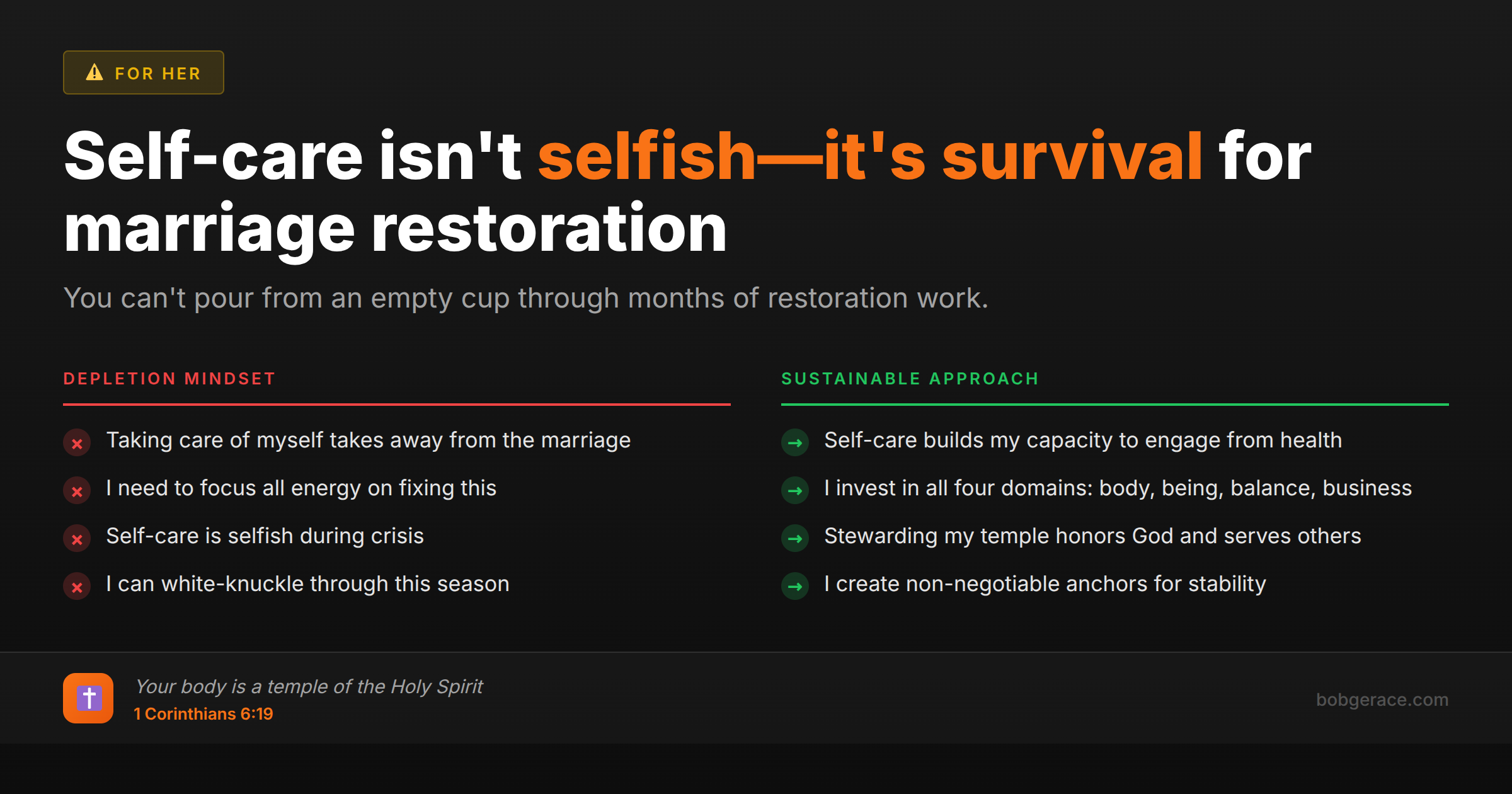
Taking care of yourself through this season isn't selfish—it's essential for sustainable engagement with an inherently challenging process. Marriage restoration, when it happens, often takes months of consistent work. You cannot white-knuckle your way through that duration on depleted reserves. Self-care during crisis differs from normal self-care. It's not primarily about bubble baths and relaxation (though rest matters). It's about building sustainable practices that maintain your physical health, emotional stability, spiritual nourishment, and relational connection through an extended stressful season. The transformation process your husband is engaged in emphasizes what we call the 'Core 4' domains—Body, Being, Balance, and Business. These represent areas of personal development that create holistic health. You have your own version of these domains that deserve attention. When you invest in your own wellbeing, you're not taking resources away from the marriage—you're building capacity to engage the marriage from health rather than depletion. Many wives discover that attending to their own growth during this season produces unexpected benefits: clarity about their needs, development of new strengths, deeper faith, and a sense of identity that doesn't depend entirely on the marriage's outcome.
The Full Picture
The instinct to neglect yourself during marriage crisis is understandable but ultimately counterproductive. Your attention is consumed by the relationship. Your emotional energy goes to processing his behavior, monitoring his progress, and managing your reactions. Self-care feels like a luxury you can't afford when everything seems to be falling apart.
But here's the reality: this process typically unfolds over months, not days. The transformation your husband is working toward involves identity-level change that doesn't happen quickly. Even the most motivated men require sustained time to build new patterns, and the Four Theater framework acknowledges that progression through crisis, chaos, correction, and mastery happens gradually. If you deplete yourself in the first weeks, you won't have reserves for the longer journey.
Sustainable self-care during crisis has four dimensions that parallel the Core 4 framework your husband is learning:
Physical care becomes even more important during stress. Your body bears the burden of emotional difficulty through cortisol production, sleep disruption, appetite changes, and tension. Attending to sleep, nutrition, movement, and physical health isn't vanity—it's maintaining the biological system that enables everything else. Many women find that non-negotiable physical routines (morning walks, consistent sleep times, regular meals) provide stability when everything else feels chaotic.
Emotional care means creating space for processing without being consumed by processing. This includes appropriate support relationships, possible counseling, and emotional regulation strategies. It also means giving yourself permission to experience moments of normalcy—watching a show, enjoying a coffee, reading a book—without guilt. These aren't escapes from reality; they're necessary respites that enable sustained engagement.
Spiritual care often intensifies during crisis but sometimes gets distorted. Some women punish themselves with relentless prayer and Bible reading as if earning God's intervention. Others abandon spiritual practice because they're angry or confused. Healthy spiritual care during this season involves honest engagement with God, including the hard questions and messy emotions, while receiving rather than only performing faith practices.
Relational care means maintaining connections beyond the marriage. Friends, family, support groups, and community provide necessary perspective and encouragement. Isolation amplifies crisis; connection provides resilience. Your relationships outside the marriage aren't competing with the marriage—they're supporting your capacity to engage it well.
Clinical Insight
The concept of allostatic load—the cumulative physiological burden of chronic stress—explains why self-care during marriage crisis is medically necessary, not merely pleasant. Extended periods of elevated cortisol, disrupted sleep, and emotional dysregulation create measurable impacts on physical and mental health. These impacts compound over time, eventually affecting cognitive function, immune response, and emotional regulation capacity.
Research on caregiver health provides relevant insight. Studies consistently show that individuals caring for others through extended difficult periods (illness, recovery, crisis) often experience significant health declines themselves—not because caring is wrong, but because caring without self-replenishment is unsustainable. You are in a caregiver-adjacent role, engaged with someone in a transformation process that requires extended attention.
The clinical principle of 'putting on your own oxygen mask first' applies directly. Your capacity to engage constructively with your husband's process depends on your own maintained health. Depleted individuals tend toward reactivity rather than responsiveness, catastrophizing rather than realistic //blog.bobgerace.com/marriage-readiness-assessment-christian-husband-leadership/:assessment, and rigid thinking rather than adaptive problem-solving. All of these patterns can interfere with the restoration process.
Effective self-care during crisis follows certain principles: it should be sustainable rather than intermittent, proactive rather than only reactive (scheduled before you're desperate), and comprehensive rather than singular (addressing multiple domains rather than just one). Researchers in stress management also emphasize the importance of 'micro-recoveries'—small daily practices that interrupt stress accumulation—in addition to larger periodic recovery experiences.
One particularly important finding: self-care that involves social connection produces stronger benefits than isolated self-care. Exercise with a friend, coffee with a confidant, or participation in a support group generates both the inherent benefit of the activity and the additional benefit of relational connection. Where possible, integrating social elements into self-care practices amplifies their impact.
Biblical Framework
Scripture presents self-care not as selfishness but as stewardship. Your body, mind, and spirit are described as temples of the Holy Spirit (1 Corinthians 6:19), entrusted to your care. Neglecting this temple isn't spiritual—it's poor stewardship of what God has given.
Jesus modeled rhythms of engagement and withdrawal throughout His ministry. Despite constant demands, He regularly withdrew to lonely places to pray (Luke 5:16). He slept in the boat during a storm (Mark 4:38). He took His disciples away from the crowds to rest (Mark 6:31: 'Come with me by yourselves to a quiet place and get some rest'). If Jesus—with unlimited spiritual resources—built restoration into His rhythms, your need for the same is not weakness but wisdom.
The principle of Sabbath extends beyond one day per week to a pattern of work and rest woven throughout life. God could have created continuously but instead modeled rest on the seventh day. This wasn't divine fatigue—it was divine example. Your season of crisis still needs embedded rest, not as escape but as obedience to the pattern God established.
Elijah's experience after Mount Carmel offers direct relevance. After a massive spiritual victory, he collapsed in exhaustion and depression. God's response wasn't rebuke but care: God provided food, water, rest, and only then conversation (1 Kings 19). Sometimes the most spiritual thing you can do is sleep, eat, and rest. God may be waiting to speak until you're resourced enough to hear.
The 'least of these' language in Matthew 25 is typically applied to serving others, but consider: you are also one of God's children in need of care. Extending the compassion you would show others to yourself is not selfishness—it's treating yourself as God's beloved, which you are.
Action Steps
-
1
Audit your current self-care across all four domains (physical, emotional, spiritual, relational)—identify which are most depleted and prioritize those first.
-
2
Establish 2-3 non-negotiable daily practices that happen regardless of his progress or the relationship's status—these anchors provide stability when everything else fluctuates.
-
3
Schedule larger restoration experiences periodically—a lunch with a friend, a morning at a favorite place, an evening doing something you enjoy—and protect these from cancellation.
-
4
Create boundaries around rumination—designated times to think about the situation and times when you consciously redirect your attention to give your mind rest.
-
5
Build a personal support system separate from support about the marriage—friends and activities that aren't focused on this crisis but remind you of your broader identity.
-
6
Ask your husband about the Core 4 framework he's learning—understanding his approach to holistic health may inspire parallel investment in your own domains.
Related Questions
- How do I heal from what's happened?
- What should I expect during this process?
- Do I need my own support?
- Is it okay to still love him and be hurt?
- What if I can't get past it?
- How long does real change actually take?
- What is self-care in crisis?
- What does trauma recovery look like?
- How do I protect myself emotionally?
- What support do I need?
Also find Bob on
Subscribe for weekly videos on Christian marriage.
Think This Could Help Your Husband?
If you believe your husband could benefit from the structured transformation process we offer, share this with him. Real change is possible when men commit to the work.
Learn About the Program →