How do I heal from what's happened?
5 min read
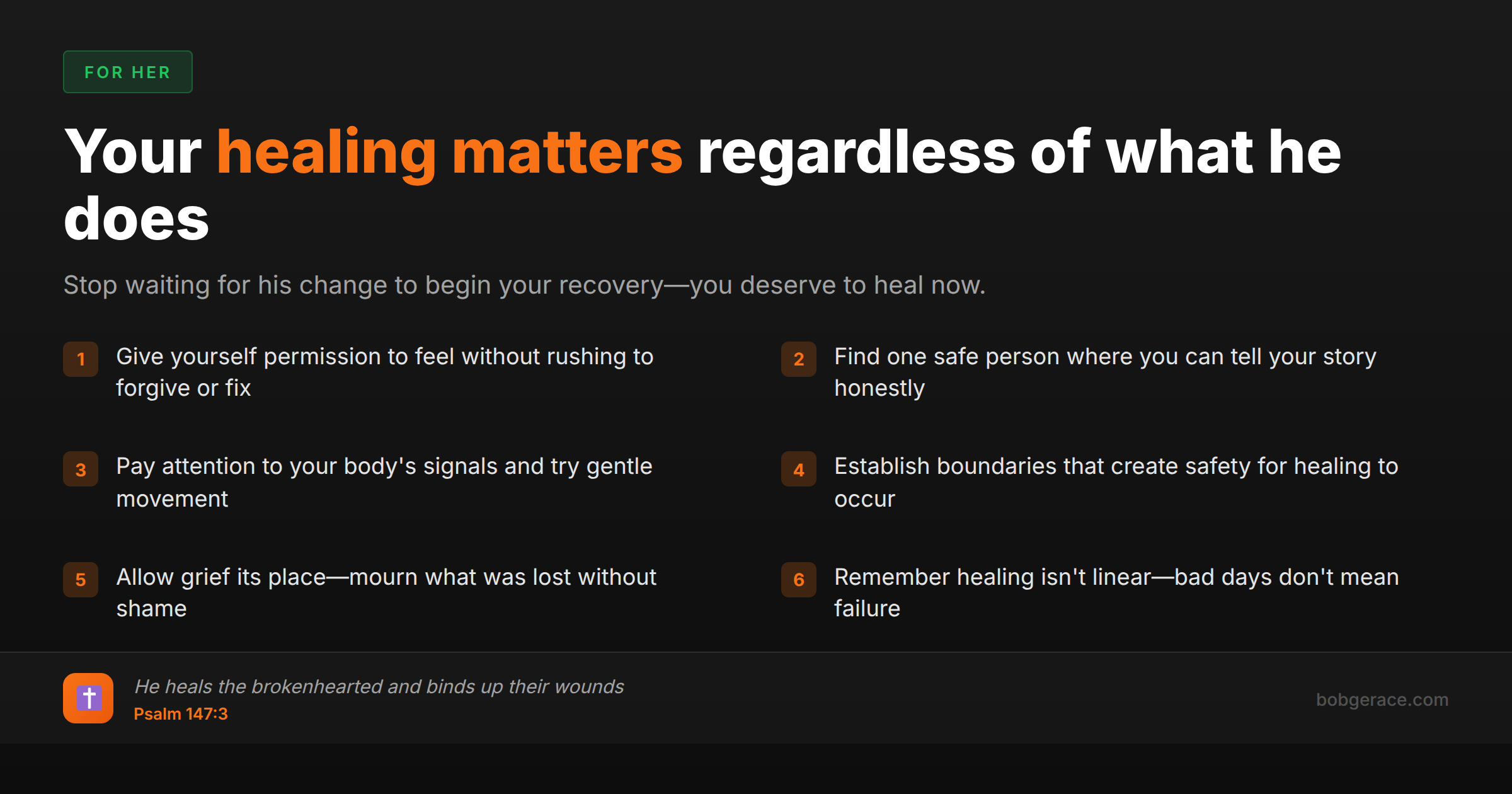
Your healing isn't a luxury or something that can wait until after he changes. It's essential—for you, for your children if you have them, and ultimately for your marriage if it survives. The wounds you're carrying are real. Betrayal, neglect, broken promises, the exhaustion of carrying a marriage alone—these create genuine trauma that lives in your body and shapes your daily experience. Healing doesn't mean pretending those things didn't happen or that they didn't matter. It means processing them so they no longer control your present and future. Healing is rarely linear. You'll have days that feel like progress and days that feel like starting over. This isn't failure; it's how trauma recovery actually works. The waves of pain become less frequent and less intense over time, but they don't follow a predictable schedule. Your healing journey is yours. It runs alongside his transformation but isn't dependent on it. You deserve to heal regardless of what he does or doesn't do.
Understanding Your Healing Journey
When you've been wounded in your marriage—whether through betrayal, neglect, broken promises, or the slow erosion of trust—healing can feel like an impossible mountain. Where do you even start? And how do you heal when the source of the wound is still present in your daily life?
First, let's acknowledge what you're actually dealing with. Marriage wounds aren't simple hurts that a good night's sleep can cure. They're complex injuries that affect your sense of self, your ability to trust, your emotional regulation, and even your physical health. The hypervigilance you feel, the way your stomach tightens when his phone buzzes, the exhaustion that sleep doesn't touch—these aren't character flaws. They're normal responses to abnormal circumstances.
Healing begins with permission. Permission to feel what you feel without rushing to forgive before you're ready. Permission to grieve what you've lost—the marriage you thought you had, the husband you thought he was, the future you planned together. That grief is legitimate, and it needs space.
Many women try to skip the feeling part and jump straight to fixing or forgiving. But emotions that aren't processed don't disappear; they go underground and emerge as anxiety, depression, physical symptoms, or relational triggers. Your feelings need to be acknowledged before they can be released.
Healing also requires safety. If your husband is actively in transformation, the environment may be shifting. But you can't heal in an environment that continues to wound you. This might mean establishing boundaries, creating emotional space, or finding places outside the marriage where you feel safe enough to process what's happened.
The journey typically involves telling your story—to yourself, to safe people, perhaps to a counselor. When you put words to what happened and how it affected you, you begin to integrate the experience rather than being controlled by it. This isn't dwelling in the past; it's metabolizing it so you can move forward.
You may find that healing reveals layers you didn't know were there. Wounds from your marriage sometimes connect to earlier wounds from childhood or previous relationships. This isn't a setback; it's an opportunity for deeper restoration than you knew you needed.
Healing doesn't mean the pain never happened or that it was okay. It means the pain no longer has the power to define your present and dictate your future. That kind of freedom is possible—not overnight, but through a process that respects your pace and honors your experience.
The Neuroscience of Relational Trauma
Relational trauma—the kind that occurs when we're wounded by someone we trusted intimately—affects the brain differently than other types of trauma. The attachment system, designed to keep us connected to those who should protect us, becomes confused when the source of danger is also the source of attachment. This creates a neurological state of simultaneous approach and avoidance that's genuinely disorienting.
Your nervous system may be operating in a chronic state of threat detection. The amygdala, responsible for sensing danger, becomes hyperactive after relational betrayal. This is why small things can trigger big reactions—your brain is trying to protect you from future harm by staying on high alert.
Healing involves what researchers call "neural reconsolidation"—the process by which traumatic memories are updated with new information and emotional context. This happens most effectively when you can revisit the painful experience from a place of safety, allowing the brain to recategorize the memory from "ongoing threat" to "past event that no longer controls me."
The body keeps score, as trauma expert Bessel van der Kolk famously noted. You may carry tension, experience disrupted sleep, or have physical symptoms that medical tests can't explain. Body-based approaches to healing—movement, breathwork, practices that restore a sense of safety in your own skin—are often essential complements to talk-based processing.
Neuroplasticity research offers genuine hope: the brain can change throughout life. The neural pathways reinforced by trauma can be gradually replaced by new pathways formed through safe experiences, consistent care, and intentional healing practices. This isn't wishful thinking; it's documented science.
God's Heart for Your Restoration
Scripture reveals a God who is intimately acquainted with betrayal, abandonment, and broken covenants. The prophets repeatedly use marriage imagery to describe God's relationship with His people—including their unfaithfulness and His wounded heart. "I have been hurt by their adulterous hearts which turned away from Me" (Ezekiel 6:9). Your pain is not foreign to God; He understands betrayal from the inside.
But the biblical story doesn't end with wounds. It moves toward restoration. "He heals the brokenhearted and binds up their wounds" (Psalm 147:3). This isn't a promise of instant repair but of ongoing tender care. The language suggests a process—binding, treating, attending to injuries over time.
Isaiah 61 describes God's mission as bringing "good news to the afflicted... to bind up the brokenhearted... to comfort all who mourn... giving them a garland instead of ashes, the oil of gladness instead of mourning." Notice the exchange: beauty for ashes, joy for mourning. This suggests your pain isn't wasted but can become the raw material for something new.
The Psalms model honest processing of pain before God. David's laments don't skip from wound to praise; they move through anger, grief, confusion, and questions before arriving at trust. This emotional honesty is not a lack of faith—it's the path faith travels through suffering. You have permission to bring your unfiltered pain to God. He can handle it.
Peter's restoration after betraying Jesus offers a powerful picture. Jesus didn't pretend the betrayal didn't happen; He addressed it directly. But He also didn't leave Peter defined by his failure. Restoration was possible—real, costly, and complete.
Beginning Your Healing Journey
-
1
Give yourself permission to feel whatever you feel without rushing to forgive or fix before you're ready.
-
2
Find at least one safe person—a counselor, trusted friend, or support group—where you can tell your story honestly.
-
3
Pay attention to your body's signals and consider body-based healing practices like walking, gentle movement, or breathwork.
-
4
Establish boundaries that create enough safety for healing to occur, even while living in the same space.
-
5
Allow grief its place—mourning what was lost is part of healing, not an obstacle to it.
-
6
Remember that your healing doesn't depend on his transformation; it's yours regardless of what he does or doesn't do.
Related Questions
- What should I expect during this process?
- How do I take care of myself through this?
- Do I need my own support?
- What if I can't get past it?
- Is it okay to still love him and be hurt?
- How long does real change actually take?
- What is 'betrayal trauma' and do I have it?
- What does trauma recovery look like?
- What is 'post-traumatic growth'?
- How do I regulate my own system?
Also find Bob on
Subscribe for weekly videos on Christian marriage.
Think This Could Help Your Husband?
If you believe your husband could benefit from the structured transformation process we offer, share this with him. Real change is possible when men commit to the work.
Learn About the Program →