What does her body remember that her mind forgot?
6 min read
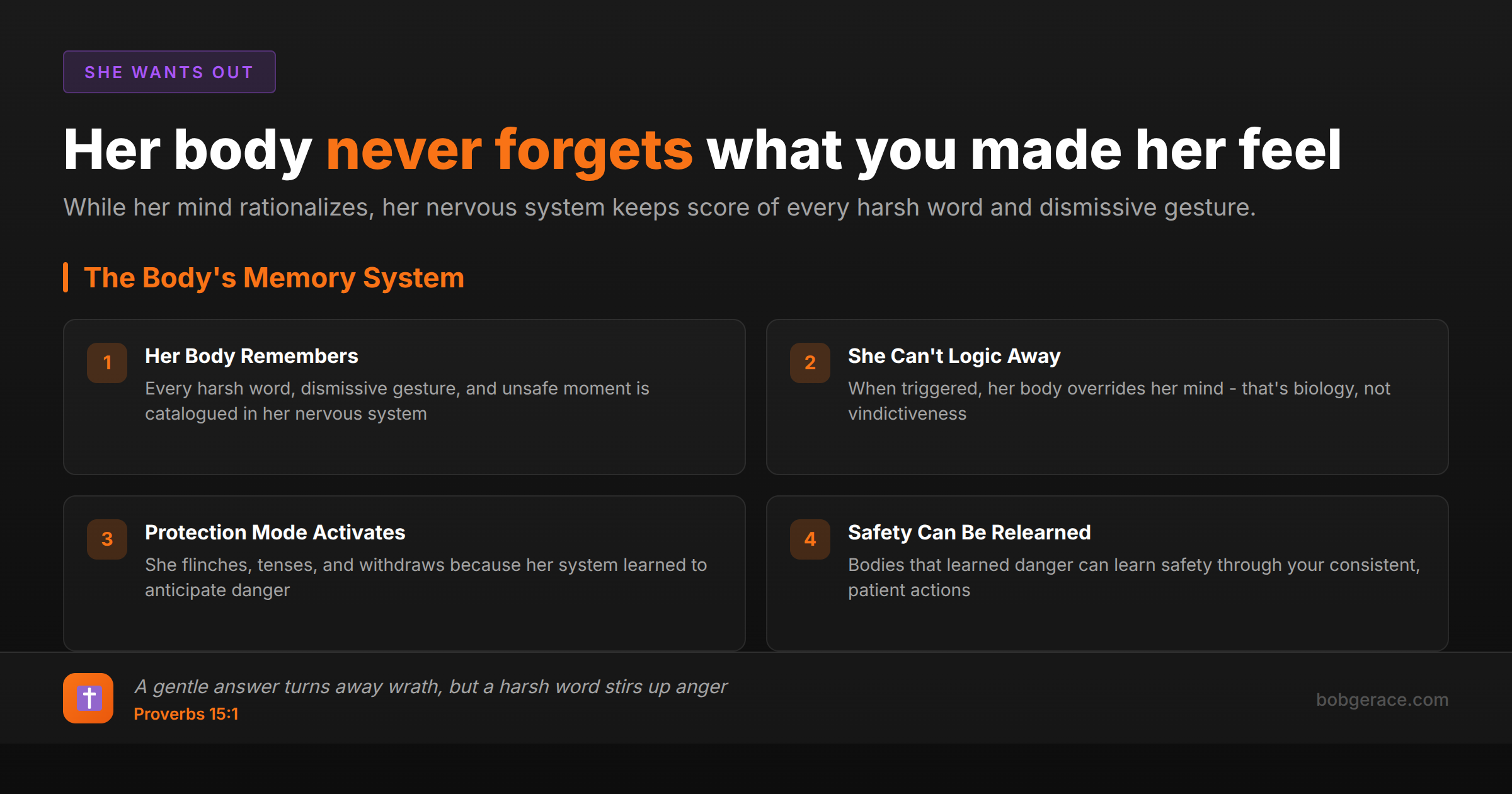
Her body remembers every harsh word, every dismissive gesture, every moment she felt unsafe with you. While her conscious mind may rationalize or forget specific incidents, her nervous system has catalogued them all. This is why she flinches when you raise your voice, even slightly. Why she tenses when you approach during conflict. Why logic doesn't reach her when she's triggered. Your wife's body is operating from a place of learned protection. It's not personal vindictiveness - it's biology. Her system learned to anticipate danger based on patterns you may not even remember creating. The good news? Bodies can learn safety just as surely as they learned danger, but it requires consistent, patient action from you.
The Full Picture
The body keeps the score - and your wife's body has been keeping a very detailed scorecard of your marriage. Every time you've raised your voice in frustration, dismissed her concerns, or responded defensively instead of listening, her nervous system filed it away as data about her safety with you.
This isn't about her being "too sensitive" or "holding grudges." This is about how human beings are wired for survival. Her body learned patterns:
• When he gets frustrated, his voice changes and I'm not safe to speak • When I bring up problems, he gets defensive and I end up feeling worse • When he's stressed, I need to manage his emotions or there will be consequences • My needs and feelings cause problems, so I should minimize them
These aren't conscious thoughts - they're somatic memories stored in her nervous system. Her body learned to go into protective mode before her mind even processes what's happening. This is why she might seem "unreasonable" during conflict, or why she shuts down when you think you're just having a normal conversation.
Men often ask me, "But I've apologized for those things. Why can't she just forgive and move on?" Because her body hasn't received the consistent evidence it needs to update its safety assessment. One apology doesn't override months or years of stored data about danger.
The most damaging pattern I see is when men dismiss their wife's trauma responses as "drama" or "overreaction." This compounds the original injury because now she's not only unsafe, she's also invalidated for having a normal biological response to feeling unsafe.
What's Really Happening
From a clinical perspective, what we're seeing is the manifestation of relational trauma and its impact on the autonomic nervous system. Dr. Bessel van der Kolk's groundbreaking research shows us that "the body keeps the score" of traumatic experiences, and this absolutely applies to marriage relationships.
When a woman experiences repeated incidents of feeling emotionally unsafe - whether through criticism, dismissiveness, anger outbursts, or emotional neglect - her nervous system adapts by developing hypervigilance toward potential threats. This creates what we call neural pathways of protection that become automatic responses.
The polyvagal theory explains three states her nervous system might default to: social engagement (when she feels safe), fight-or-flight (when she becomes reactive or withdraws with high energy), or freeze/fawn (when she shuts down or becomes overly compliant). These aren't choices - they're automatic nervous system responses based on stored data about safety.
What's particularly relevant in marriage is the concept of neuroception - her body's unconscious ability to detect danger before her conscious mind processes it. This means she might react to your tone, body language, or facial expression before you've even said anything problematic, because her system recognizes the precursors to previous unsafe experiences.
Trauma-informed therapy shows us that healing requires consistent experiences of safety over time. Her nervous system needs to collect new data that contradicts the old patterns. This process, called re-regulation, happens through repeated positive interactions that demonstrate genuine safety and attunement.
The good news is that neuroplasticity means her nervous system can learn new patterns of safety, but it requires patience and consistency from both partners.
What Scripture Says
Scripture acknowledges the deep connection between our physical and emotional experiences. Proverbs 14:30 tells us that "A heart at peace gives life to the body, but envy rots the bones." Our emotional state directly impacts our physical well-being, and this includes how our bodies respond to relational stress.
Proverbs 15:1 reminds us that "A gentle answer turns away wrath, but a harsh word stirs up anger." God's design recognizes that our words have physical impact on others. When we speak harshly, we're not just communicating information - we're affecting another person's sense of safety and well-being.
The call to "be quick to listen, slow to speak and slow to become angry" (James 1:19) isn't just about better communication - it's about creating the conditions where another person's nervous system can remain calm and regulated. When we're quick to anger, we're training our spouse's body to expect danger.
1 Peter 3:7 specifically instructs husbands to live with their wives "in an understanding way" and to "show her honor as a fellow heir of the grace of life." This understanding includes recognizing how your actions affect her not just mentally and emotionally, but physically and neurologically.
Ephesians 4:29 calls us to speak only what "builds others up according to their needs, that it may benefit those who listen." This means considering not just what we say, but how our words and tone impact our spouse's ability to feel safe and regulated.
Finally, 1 Corinthians 13:4-5 reminds us that love "is not easily angered, it keeps no record of wrongs." While we're called not to keep records of wrongs, we must understand that our spouse's body may need time and consistent safety to release the protective patterns it developed.
What To Do Right Now
-
1
Lower your voice deliberately during any tense conversation - her body will notice before her mind does
-
2
Ask 'What do you need to feel safe right now?' when she seems triggered, instead of defending yourself
-
3
Practice the 24-hour rule - wait a full day before addressing any conflict to ensure you approach with calm energy
-
4
Notice your body language during difficult conversations - uncross arms, soften facial expressions, maintain appropriate distance
-
5
Validate her experience by saying 'Your body learned to protect you, and I want to help it learn safety with me'
-
6
Create consistent daily moments of non-sexual physical affection to help her nervous system associate your touch with safety
Related Questions
- What does 'neuroception of danger' mean?
- What happens neurologically when she sees my number pop up?
- How does chronic stress affect her capacity for connection?
- Is she triggered or is this a rational decision?
- What does 'survival brain' look like in her right now?
- Did I retraumatize her without knowing?
- What is 'betrayal trauma' and do I have it?
- What does 'body keeps the score' mean for our sex life?
- What does chronic anger do to my nervous system?
- What is 'complex trauma' and do I have it?
Also find Bob on
Subscribe for weekly videos on Christian marriage.
Your Marriage Needs More Than Understanding
You know what her body remembers. A coach who knows your specific history can show you how to rebuild safety in ways a tool can't calibrate.
Talk to Bob →