Do I need my own support?
5 min read
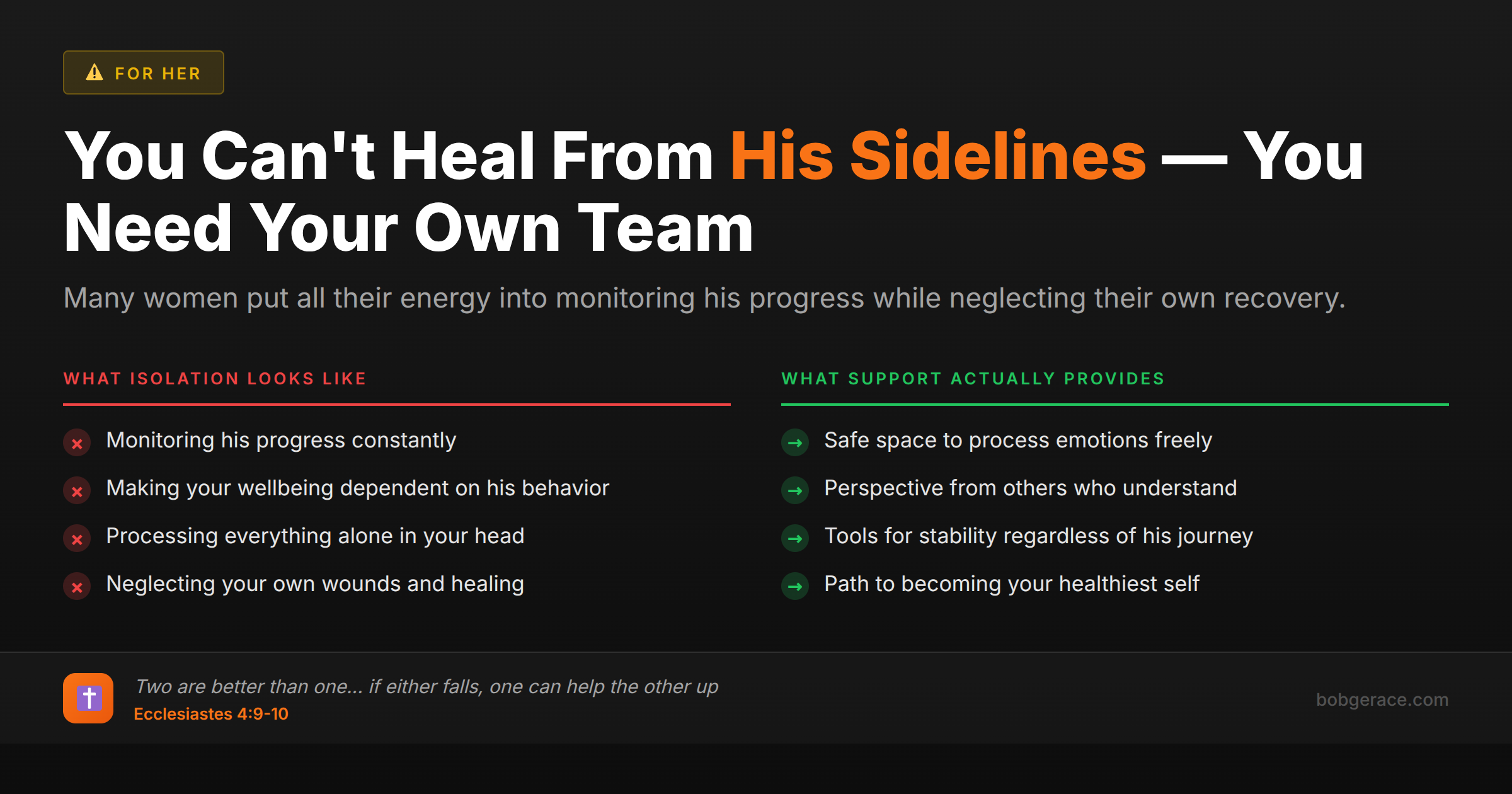
Yes—and this isn't optional. Your husband's transformation addresses his patterns, his wounds, his identity reconstruction. But you have your own wounds, your own processing, your own healing that needs attention. Many women make the mistake of putting all their energy into monitoring his progress while neglecting their own recovery. This creates an unhealthy dynamic where your wellbeing becomes entirely dependent on his behavior. Effective support for you serves multiple purposes. It provides a safe space to process emotions that might be counterproductive to share with him right now. It offers perspective from others who understand what you're experiencing. It helps you develop tools for your own stability regardless of how his journey unfolds. And it ensures you're becoming the healthiest version of yourself—which ultimately benefits any possible reconciliation. The transformation process he's in recognizes that both partners typically need support. His brotherhood provides accountability and guidance; you need your own equivalent. This parallel healing process is actually one of the factors that distinguishes successful restorations from failed attempts. When both partners are actively growing, reconciliation has a foundation to build on.
The Full Picture
There's a common pattern among wives in your situation: pouring all available energy into tracking his progress, analyzing his behavior, and waiting to see if he'll change—while completely neglecting their own healing. This is understandable. The crisis feels like his crisis. The program is his program. The transformation is supposed to be his transformation. Where do you fit in?
The answer is that you're not a bystander in this process—you're a participant with your own parallel journey. His patterns may have caused the immediate crisis, but you've been affected by years of relational dynamics that left marks requiring their own attention. His recovery doesn't heal your wounds any more than his eating would nourish your body.
Women who secure their own support during this season consistently report better outcomes in multiple dimensions. They develop emotional stability that doesn't rise and fall with his daily progress. They gain clarity about their own needs, values, and boundaries. They process grief, anger, and fear in appropriate settings rather than accumulating emotional pressure. They often discover personal growth opportunities they would have missed if focused exclusively on him.
This support can take various forms. Individual counseling provides personalized attention to your specific situation and history. Support groups connect you with women who genuinely understand the particular challenges of this journey. Trusted friends who can listen without judgment or agenda offer informal but valuable support. Spiritual direction or pastoral counseling addresses the faith dimensions of your experience.
Importantly, the support you secure should be for you, not primarily about him. While you'll naturally discuss his progress and your reactions to it, the focus should be your own healing, growth, and decision-making. You need space where you're the subject, not the supporting character.
The transformation framework your husband is learning emphasizes what we call the 'Core 4' domains—Body, Being, Balance, and Business. These represent areas of personal development that create holistic health. You have your own version of these domains that deserve attention. Your physical health matters during this stressful season. Your emotional and spiritual life needs nourishment. Your relationships and support system require cultivation. Your personal goals and identity beyond the marriage warrant investment.
This parallel development creates something powerful: two people who are both actively growing rather than one person changing while the other waits and watches. Successful restorations are built on this foundation of mutual development.
Clinical Insight
Research consistently demonstrates that partners of individuals in recovery or transformation processes benefit significantly from their own concurrent support. This isn't merely helpful—it's often predictive of better outcomes for both individuals and the relationship.
The clinical term for what you may be experiencing is 'secondary trauma' or 'partner trauma.' Living in relationship with someone whose behavior has caused harm creates its own traumatic impact. Symptoms can include hypervigilance, anxiety, depression, difficulty concentrating, sleep disturbances, and intrusive thoughts—all of which require their own attention and care.
Studies of couples navigating recovery from various crises show that when the partner secures independent support, several positive outcomes increase: the partner's mental health improves independently of the other's progress, enabling greater stability; the relationship is protected from becoming the sole venue for the partner's processing; the partner develops clearer boundaries and more realistic expectations; long-term relationship satisfaction is higher regardless of outcome.
The concept of 'differentiation'—maintaining a clear sense of self while in relationship—is particularly relevant here. When your //blog.bobgerace.com/emotional-overwhelm-christian-marriage-science-solutions/:emotional state is entirely dependent on his behavior, you've lost differentiation. This creates an unstable dynamic where his bad day devastates you and his good day becomes necessary for your wellbeing. Effective support helps you rebuild appropriate differentiation so that you can be connected to him without being fused to his outcomes.
Clinicians who work with couples in restoration processes typically recommend that both partners have their own support resources. This might seem counterintuitive—shouldn't the focus be on the relationship?—but evidence shows that individual health provides the necessary foundation for relational health. You cannot give to the relationship from an empty well.
Biblical Framework
Scripture presents community support as a fundamental aspect of navigating difficulty, not an optional addition. The biblical model is not the isolated individual managing hardship alone, but the connected person surrounded by supporting others.
Ecclesiastes captures this principle clearly: 'Two are better than one... If either of them falls down, one can help the other up. But pity anyone who falls and has no one to help them up' (4:9-10). This wisdom applies directly to your situation. You've experienced a fall—not through your own fault, but through the collapse of relational trust. You need others to help you up.
The early church modeled mutual support as essential rather than optional. Believers were instructed to 'carry each other's burdens' (Galatians 6:2) and to 'encourage one another and build each other up' (1 Thessalonians 5:11). This wasn't weakness—it was the designed way of experiencing Christian community. The lone Christian trying to navigate hardship without support is an unbiblical aberration.
Consider also that Jesus Himself, facing the agony of Gethsemane, sought the company of His closest friends. He asked Peter, James, and John to stay near and keep watch with Him. If the Son of God sought human support during His darkest hour, seeking support for your own dark season is not a lack of faith but an imitation of Christ.
The Psalms repeatedly portray God working through community. 'God sets the lonely in families' (Psalm 68:6). Your need for support may itself be the means through which God provides comfort, wisdom, and strength. Isolating yourself during this season cuts you off from the channels God most commonly uses.
Your healing matters to God. You are not simply a supporting character in your husband's transformation story—you are a beloved daughter with your own story that deserves attention, support, and care.
Action Steps
-
1
Identify at least one form of professional support—whether individual counseling, a support group, or pastoral counseling—and take concrete steps to engage it this week.
-
2
Evaluate your current friend network for trustworthy confidants who can listen without advising, fixing, or judging—invest in those relationships.
-
3
Set boundaries around support conversations—designated times and people—rather than processing constantly with everyone, which creates exhaustion.
-
4
Create a self-care baseline that doesn't depend on his progress—routines for physical health, spiritual nourishment, and emotional regulation that belong to you.
-
5
Consider whether any relationships are unhelpful during this season—those who pressure you toward specific decisions or can't hold space for complexity may need temporary boundaries.
-
6
Ask your husband what he's learning about community and accountability—understanding the brotherhood model may help you recognize the parallel value of your own support network.
Related Questions
- How do I take care of myself through this?
- How do I heal from what's happened?
- What should I expect during this process?
- Is it okay to still love him and be hurt?
- What if I can't get past it?
- What's my role in his transformation?
- What support do I need?
- What is self-care in crisis?
- How do I process without a toxic support system?
- What does healthy coping look like?
Also find Bob on
Subscribe for weekly videos on Christian marriage.
Think This Could Help Your Husband?
If you believe your husband could benefit from the structured transformation process we offer, share this with him. Real change is possible when men commit to the work.
Learn About the Program →