How do I forgive when she's still sinning?
6 min read
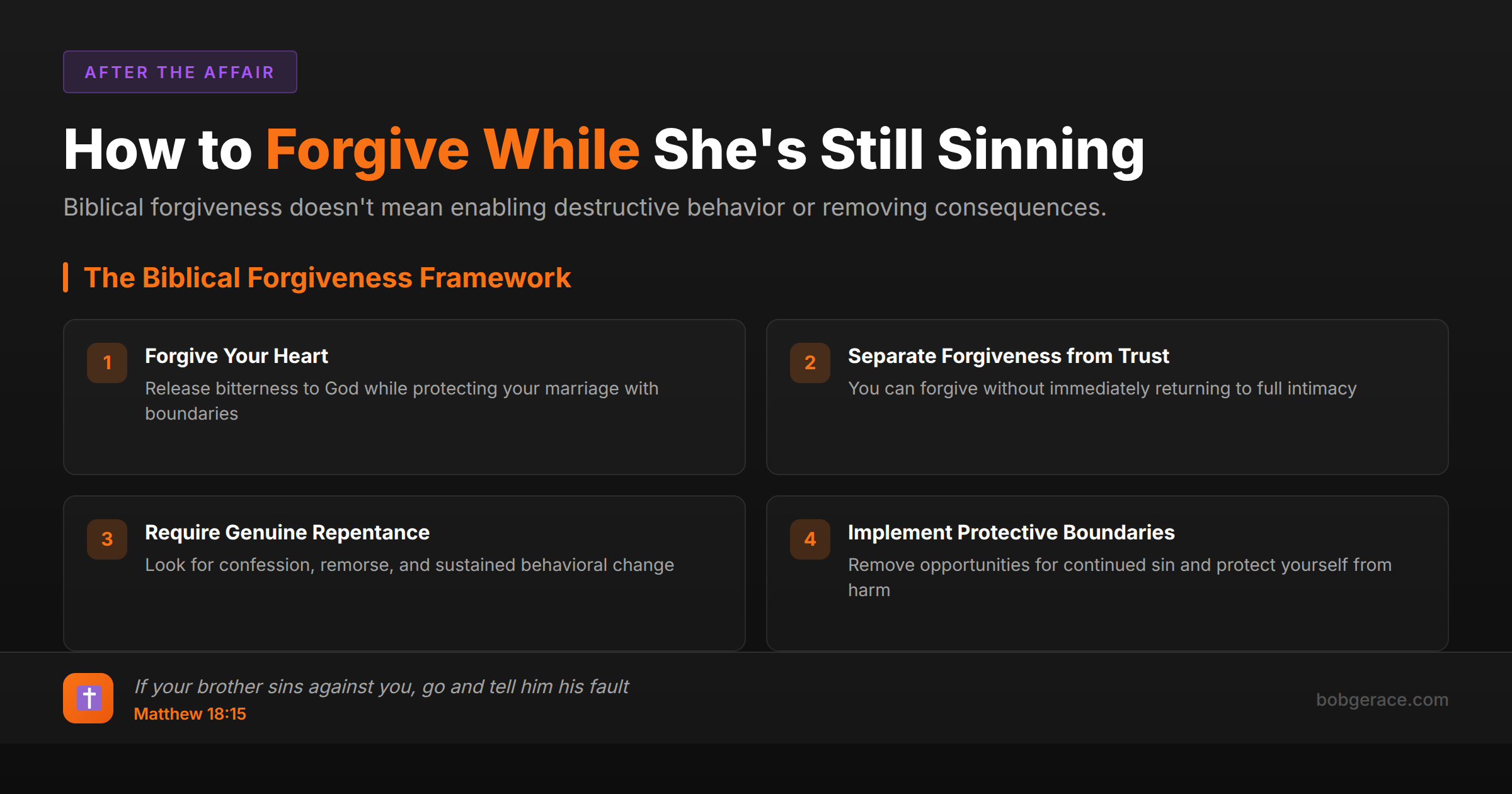
Forgiveness doesn't mean enabling ongoing sin or removing all consequences. You can release your right to revenge and bitterness while still protecting yourself and requiring change. Biblical forgiveness is a command, but it doesn't eliminate the need for repentance, accountability, or boundaries. The key is understanding that forgiveness is primarily about your heart's posture toward God and your spouse, not about pretending the sin doesn't matter or won't happen again. You forgive to free yourself from bitterness and to obey Christ, but you also implement wise boundaries to protect your marriage and encourage genuine repentance.
The Full Picture
Here's the brutal truth: forgiveness becomes exponentially harder when the sin continues. Your wife's ongoing sin creates a cycle where you're constantly being re-wounded while trying to heal from previous wounds. This isn't just difficult—it's one of the most challenging situations a Christian spouse can face.
Many Christian husbands get trapped in false guilt, thinking that if they truly forgave, they wouldn't feel angry about continued betrayal. That's not biblical. Even God's forgiveness comes with conditions and consequences. When Israel continued in sin, God forgave but also implemented discipline.
The confusion comes from misunderstanding what forgiveness actually requires. Forgiveness doesn't mean: - Pretending the sin doesn't hurt - Removing all consequences - Trusting immediately - Enabling continued destructive behavior - Becoming a doormat for ongoing abuse
What forgiveness does mean: - Releasing your right to revenge - Refusing to let bitterness take root - Hoping for her repentance and restoration - Treating her with basic human dignity - Praying for God to change her heart
The practical reality is that you may need to forgive the same sin multiple times—not because your previous forgiveness was inadequate, but because ongoing sin creates ongoing wounds. This is why Jesus told Peter to forgive "seventy times seven times."
Here's what makes this sustainable: You're not forgiving to fix your marriage or change your wife. You're forgiving in obedience to Christ and for your own spiritual health. The outcomes belong to God.
What's Really Happening
From a clinical perspective, trying to forgive ongoing betrayal creates a psychological phenomenon called "re-traumatization." Each repeated offense reopens the wound before it can properly heal, creating layers of trauma that compound over time.
Your brain is designed to protect you from harm, so when someone continues hurting you, your nervous system remains in a state of hypervigilance. This makes genuine forgiveness neurologically challenging—your body is literally fighting against vulnerability with someone who keeps proving themselves unsafe.
The most important clinical insight: boundaries actually facilitate forgiveness. When you implement appropriate consequences and protection measures, you create the psychological safety needed to process forgiveness without constantly defending yourself from new attacks.
Many men struggle with what I call "premature forgiveness"—rushing to forgive before they've properly processed the betrayal or implemented necessary changes. This often leads to suppressed anger, resentment, and eventual emotional explosion.
Healthy forgiveness in ongoing sin situations requires: - Acknowledging the full impact of the betrayal - Implementing protective boundaries - Requiring genuine repentance and change - Processing your emotions with //blog.bobgerace.com/christian-marriage-trust-rebuilding-evidence-recovery/:safe support - Separating forgiveness from reconciliation
Remember: forgiveness is a process, not a one-time event. In cases of ongoing sin, you may need to forgive repeatedly while maintaining firm boundaries until you see sustainable change.
What Scripture Says
Scripture provides clear guidance for handling ongoing sin in relationships, and it never requires us to enable destructive behavior in the name of forgiveness.
Matthew 18:15-17 gives us the biblical process: "If your brother sins against you, go and tell him his fault, between you and him alone. If he listens to you, you have gained your brother. But if he does not listen, take one or two others along with you... If he refuses to listen even to the church, treat him as a gentile and a tax collector." Notice that continued sin results in increased consequences, not unlimited tolerance.
Luke 17:3-4 says, "If your brother sins, rebuke him, and if he repents, forgive him, and if he sins against you seven times in the day, and turns to you seven times, saying, 'I repent,' you must forgive him." The key phrase is "if he repents"—forgiveness is linked to repentance.
Ephesians 4:32 commands us to forgive "as God in Christ forgave you." But how does God forgive? 1 John 1:9 shows us: "If we confess our sins, he is faithful and just to forgive us." God's forgiveness requires confession and repentance.
Galatians 6:1 instructs us to restore those caught in sin "in a spirit of gentleness," but restoration implies change. Matthew 7:6 warns us not to "give dogs what is holy" or "throw pearls before pigs"—sometimes we must protect what's sacred.
The biblical pattern is clear: Forgive to free your own heart, but require repentance for full reconciliation. God himself maintains this standard—so can you.
What To Do Right Now
-
1
Forgive your heart, protect your marriage - Release bitterness to God while implementing boundaries that discourage continued sin
-
2
Distinguish forgiveness from reconciliation - You can forgive without immediately returning to full trust and intimacy
-
3
Require genuine repentance - Look for confession, remorse, accountability measures, and sustained behavioral change
-
4
Implement protective boundaries - Remove opportunities for continued sin and protect yourself from further harm
-
5
Get professional Christian support - Work with a counselor who understands both biblical principles and trauma recovery
-
6
Document patterns and progress - Keep track of promises made, boundaries crossed, and genuine changes to make informed decisions
Related Questions
Don't Navigate This Alone
Forgiving ongoing betrayal requires expert guidance to protect both your heart and your marriage. Get the biblical framework and practical tools you need.
Get Help Now →