When does wanting to know become obsessive?
6 min read
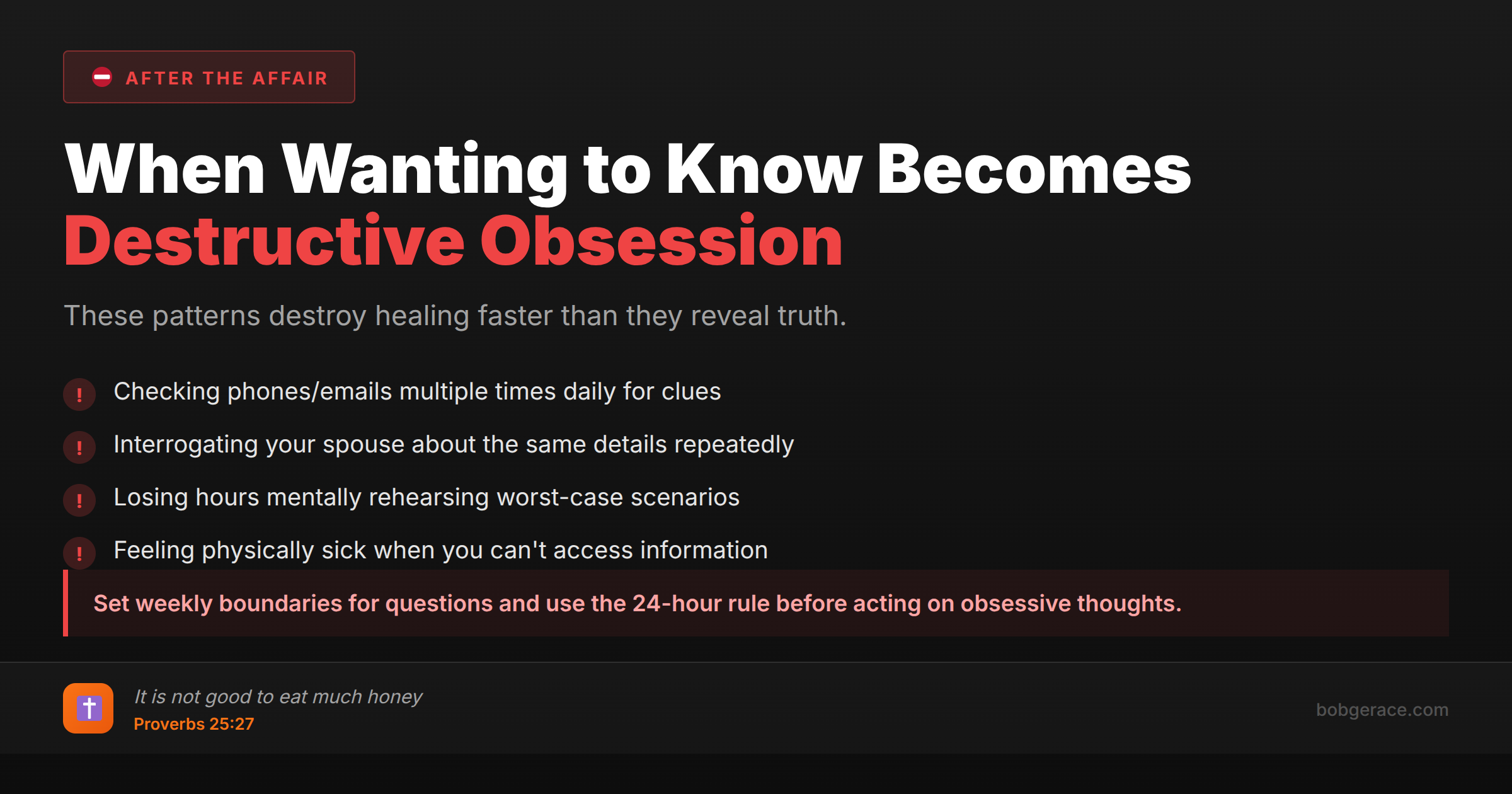
The line between healthy curiosity and obsession crosses when your need to know consumes your daily functioning, disrupts sleep, dominates conversations, or becomes compulsive checking behaviors. Healthy wanting to know serves healing and understanding, while obsession creates cycles of anxiety and prevents forward progress. Obsessive patterns include checking phones/emails multiple times daily, interrogating your spouse repeatedly about the same details, losing hours to mental rehearsal of scenarios, or feeling physically ill when you can't access information. When the pursuit of information becomes more important than your wellbeing or relationship restoration, you've crossed into unhealthy territory.
The Full Picture
The difference between healthy inquiry and obsession lies in purpose and impact. When you've been betrayed, wanting to understand what happened is completely normal. Your mind tries to make sense of the betrayal, fill in gaps, and assess safety for moving forward.
Healthy wanting to know serves specific purposes: understanding the scope of betrayal, assessing genuine remorse, determining safety in the relationship, and making informed decisions about your future. This kind of inquiry has boundaries, respects both parties' wellbeing, and ultimately serves healing.
Obsession, however, becomes self-feeding. It creates a cycle where each answer generates ten more questions, where no amount of information feels sufficient, and where the pursuit of details becomes more important than the relationship itself. You might find yourself checking the same emails repeatedly, asking identical questions hoping for different answers, or spending hours mentally rehearsing conversations.
Physical and emotional signs of obsession include: disrupted sleep patterns, inability to focus on work or family, constant anxiety or physical tension, social isolation, and feeling controlled by your need for information. When friends and family express concern about your preoccupation, when your other relationships suffer, or when you feel guilty about your own behavior, you've likely crossed the line.
The cruel irony is that obsession actually impedes healing. While healthy inquiry can lead to understanding and eventual peace, obsessive patterns keep you trapped in the trauma, preventing the emotional processing necessary for recovery.
What's Really Happening
From a clinical perspective, the transition from healthy curiosity to obsession represents your nervous system's attempt to regain //blog.bobgerace.com/romans-7-marriage-crisis-scripture-control/:control after trauma. Betrayal shatters our fundamental assumptions about safety and predictability, triggering what we call hypervigilance - an exhausting state of heightened alertness.
The obsessive patterns serve a psychological function: they create an illusion of control and safety. Your brain believes that if you can just gather enough information, you can prevent future harm. This is why simply telling someone to 'stop obsessing' rarely works - the behavior serves a protective purpose, even when it becomes destructive.
Neurologically, obsessive thinking creates neural pathways that become stronger with repetition. Each time you engage the obsessive cycle, you're literally rewiring your brain to default to this pattern. This explains why obsessive thoughts can feel involuntary and why breaking the cycle requires intentional intervention.
The key therapeutic insight is recognizing that true safety comes not from information hoarding, but from developing internal resources for managing uncertainty. This includes building distress tolerance, creating healthy boundaries, and learning to sit with uncomfortable emotions without immediately seeking relief through information-seeking behaviors.
Recovery involves gradually expanding your tolerance for not knowing while building confidence in your ability to handle whatever information might come. This shift from external control (gathering information) to internal regulation (managing your response) is essential for long-term healing.
What Scripture Says
Scripture acknowledges our human need for truth while warning against the bondage of obsessive patterns. Proverbs 25:27 reminds us, 'It is not good to eat much honey, nor is it glorious to seek one's own glory.' The pursuit of knowledge, even legitimate knowledge, can become excessive and ultimately harmful.
Jesus addresses our tendency toward anxious rumination in Matthew 6:34: 'Therefore do not worry about tomorrow, for tomorrow will worry about itself. Each day has enough trouble of its own.' While this specifically addresses worry, the principle applies to obsessive information-seeking that robs us of present peace.
The psalmist models healthy processing of betrayal in Psalm 55:12-14, acknowledging the pain while ultimately turning to God rather than becoming consumed with details: 'If an enemy were insulting me, I could endure it... But it is you, a man like myself, my companion, my close friend, with whom I once enjoyed sweet fellowship at the house of God.'
Philippians 4:8 provides a framework for mental discipline: 'Finally, brothers and sisters, whatever is true, whatever is noble, whatever is right, whatever is pure, whatever is lovely, whatever is admirable—if anything is excellent or praiseworthy—think about such things.' This doesn't mean ignoring reality, but it challenges us to consider whether our thought patterns align with what promotes healing and restoration.
Romans 12:2 calls us to mental transformation: 'Do not conform to the pattern of this world, but be transformed by the renewing of your mind.' Breaking obsessive cycles requires this kind of intentional mental renewal, replacing destructive thought patterns with those that serve healing and hope.
What To Do Right Now
-
1
Set specific boundaries around information-seeking: designate one conversation per week for questions rather than daily interrogations
-
2
Create a 'thought parking lot' - write down obsessive questions when they arise, then address them during designated times only
-
3
Implement the 24-hour rule: when you feel compelled to ask a question or check something, wait 24 hours first
-
4
Develop physical interrupt techniques: when obsessive thoughts start, immediately engage in vigorous exercise or another physical activity
-
5
Practice the 'good enough' principle: acknowledge that 80% certainty may be sufficient for moving forward rather than demanding 100%
-
6
Schedule regular check-ins with a counselor or trusted friend to assess whether your information-seeking remains healthy or has become compulsive
Related Questions
Ready to Break Free from Obsessive Patterns?
You don't have to stay trapped in cycles of obsessive thinking. Let's work together to develop healthy boundaries and internal strength.
Get Support →