Why can't I stop obsessing over details?
6 min read
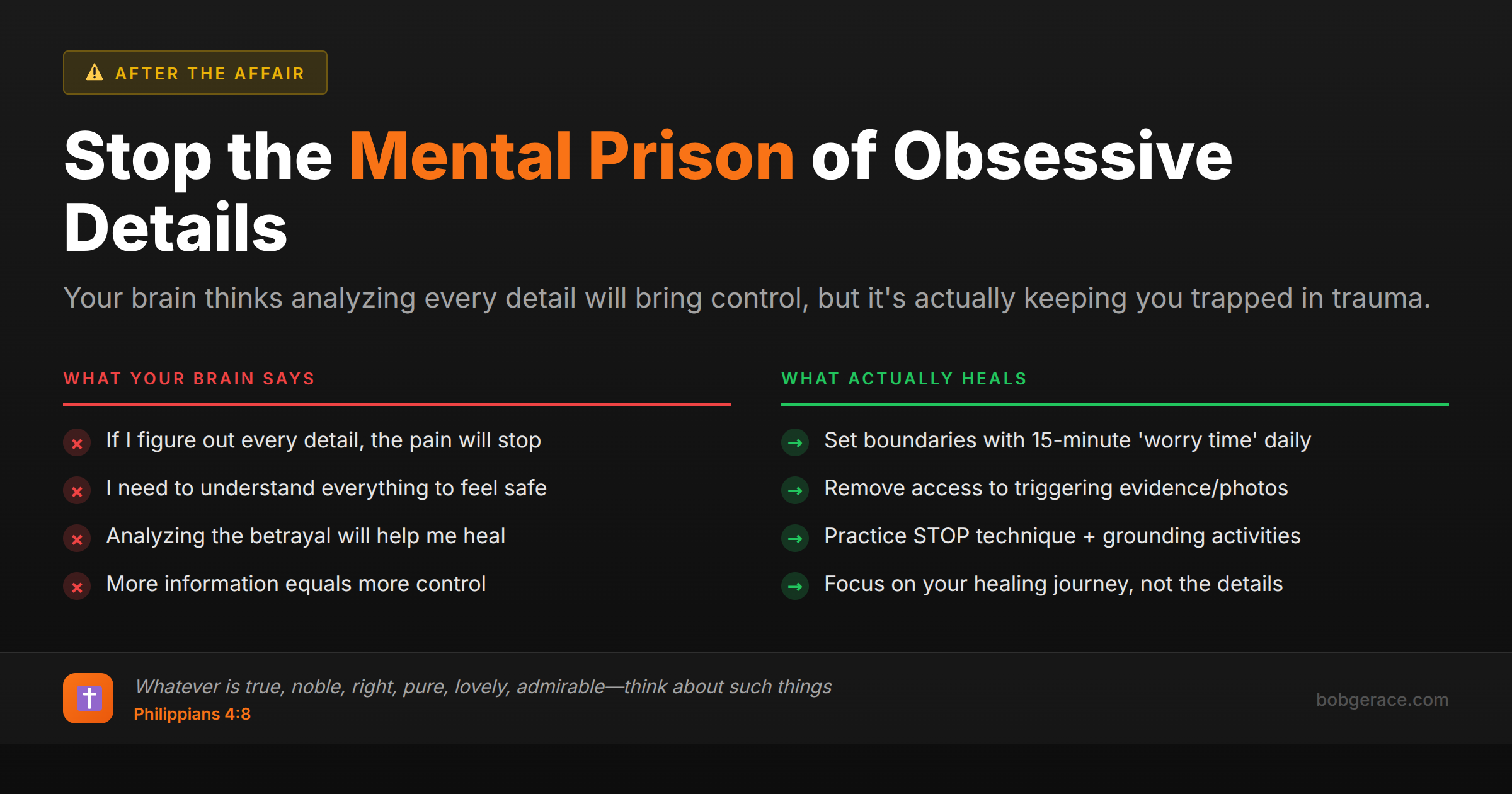
Your obsession with details is a normal trauma response - your brain is trying to make sense of something that shattered your reality. When betrayal happens, your mind goes into overdrive trying to piece together what was real and what wasn't. This isn't weakness; it's your brain's attempt to regain control and safety. The obsessive thoughts serve a purpose initially - they help you process the shock. But when they persist, they become a prison that keeps you stuck in the trauma instead of moving toward healing. Your mind believes that if it can just figure out every detail, somehow the pain will make sense or go away. Unfortunately, this mental loop actually reinforces the trauma rather than resolving it.
The Full Picture
Let me be straight with you - the obsessing isn't really about the details. It's about your brain trying to solve an unsolvable puzzle. When someone you trusted completely betrays that trust, your entire reality gets turned upside down. Everything you thought you knew becomes questionable.
Your brain is asking the wrong questions. Instead of "How do I heal from this?" it's asking "What exactly happened when?" and "How could I have missed the signs?" These questions feel important, but they're actually keeping you trapped.
The obsession creates an illusion of control. If you can just understand every detail, every lie, every moment of deception, then somehow you'll be safe from future betrayal. But here's the hard truth: knowing every detail won't heal the wound or guarantee it won't happen again.
This is trauma bonding at work. Your mind keeps returning to the source of pain, like touching a bruise to see if it still hurts. The repetitive thoughts create neural pathways that make the obsessing even stronger over time.
The details you're obsessing over aren't neutral information - they're loaded with emotional dynamite. Each time you replay them, you're re-traumatizing yourself. You're essentially forcing yourself to relive the betrayal over and over.
You're not crazy, and you're not weak. This is how betrayal trauma works. But staying stuck in the details keeps you from doing the real work of healing, rebuilding, and deciding what kind of future you want.
What's Really Happening
From a clinical perspective, what you're experiencing is called "hypervigilance" - a hallmark symptom of betrayal trauma. Your nervous system has been hijacked by the betrayal, and it's now operating from a place of perceived threat, even when you're physically safe.
The obsessive thoughts about details represent your brain's attempt to create what we call a "coherent narrative." Betrayal shatters your assumptive world - your basic beliefs about your partner, your relationship, and your ability to judge reality. Your mind desperately wants to restore order and predictability.
This creates what I call the "detective //blog.bobgerace.com/mama-boy-christian-marriage-break-mother-loyalty-trap/:trap." You become consumed with gathering evidence, timelines, and proof, believing this will provide closure. But betrayal trauma doesn't resolve through fact-finding - it heals through processing the emotional impact and rebuilding your sense of safety.
Neurologically, trauma creates changes in your brain's threat-detection system. The amygdala becomes hyperactive while the prefrontal cortex (responsible for rational thinking) goes offline. This is why you can't simply "think your way out" of the obsession.
The obsessing also serves as an avoidance mechanism. Focusing on details keeps you from feeling the full weight of emotions like grief, anger, and fear. It's easier to stay busy analyzing than to sit with the profound sadness of what you've lost.
Healing requires shifting from the "thinking brain" to the "feeling brain" - processing emotions rather than collecting information. This happens through trauma-informed therapy, somatic work, and gradually building new neural pathways of safety and trust.
What Scripture Says
Scripture speaks directly to our tendency to get trapped in cycles of anxious thinking. Philippians 4:8 gives us a roadmap: *"Finally, brothers and sisters, whatever is true, whatever is noble, whatever is right, whatever is pure, whatever is lovely, whatever is admirable—if anything is excellent or praiseworthy—think about such things."*
Notice it doesn't say to think about whatever is detailed, analyzed, or perfectly understood. God calls us to focus our minds on things that build us up, not tear us down.
Isaiah 26:3 promises: *"You will keep in perfect peace those whose minds are steadfast, because they trust in you."* The obsessive mind is the opposite of steadfast - it's scattered, anxious, and fixated on things that steal peace.
2 Corinthians 10:5 calls us to *"take captive every thought to make it obedient to Christ."* This doesn't mean suppressing thoughts, but rather bringing them under God's authority instead of letting them control you.
Jesus himself addressed our tendency toward anxious, repetitive thinking in Matthew 6:27: *"Can any one of you by worrying add a single hour to your life?"* The same principle applies to obsessing over betrayal details - it doesn't add healing, hope, or forward movement to your life.
Psalm 139:23-24 offers a better approach: *"Search me, God, and know my heart; test me and know my anxious thoughts. See if there is any offensive way in me, and lead me in the way everlasting."* Instead of searching for more details about the betrayal, invite God to search your heart and lead you toward healing.
God's design is for your mind to be renewed (Romans 12:2), not recycled through the same painful information repeatedly.
What To Do Right Now
-
1
Set a daily "worry time" - 15 minutes where you allow yourself to think about details, then consciously redirect your thoughts when time is up
-
2
Create physical boundaries - remove access to evidence, photos, or information that feeds the obsession
-
3
Practice the "STOP technique" - when obsessive thoughts start, say "STOP" out loud and immediately engage in a grounding activity
-
4
Start a healing journal focused on your emotions and progress rather than rehashing details
-
5
Engage your body through exercise, walking, or breathing exercises to interrupt the mental loops
-
6
Seek trauma-informed counseling to process the betrayal in a healthy, structured way
Related Questions
- How do I stop the mental movies?
- Why do I keep replaying the discovery?
- What is 'hypervigilance' and why am I doing it?
- Why am I having intrusive thoughts/images?
- Do I need to know all the details?
- How do I deal with intrusive images?
- Why do I feel like I'm going to die?
- I can't control my anger
- Why do I repeat patterns I hate?
Also find Bob on
Subscribe for weekly videos on Christian marriage.
You Don't Have to Loop Alone
A coach who knows your specific story can help you distinguish between useful processing and the mental trap. When the obsession won't let go, bring it to someone who's seen this pattern before.
Talk to Bob →