How do I pray for my wife when she's hurting me?
6 min read
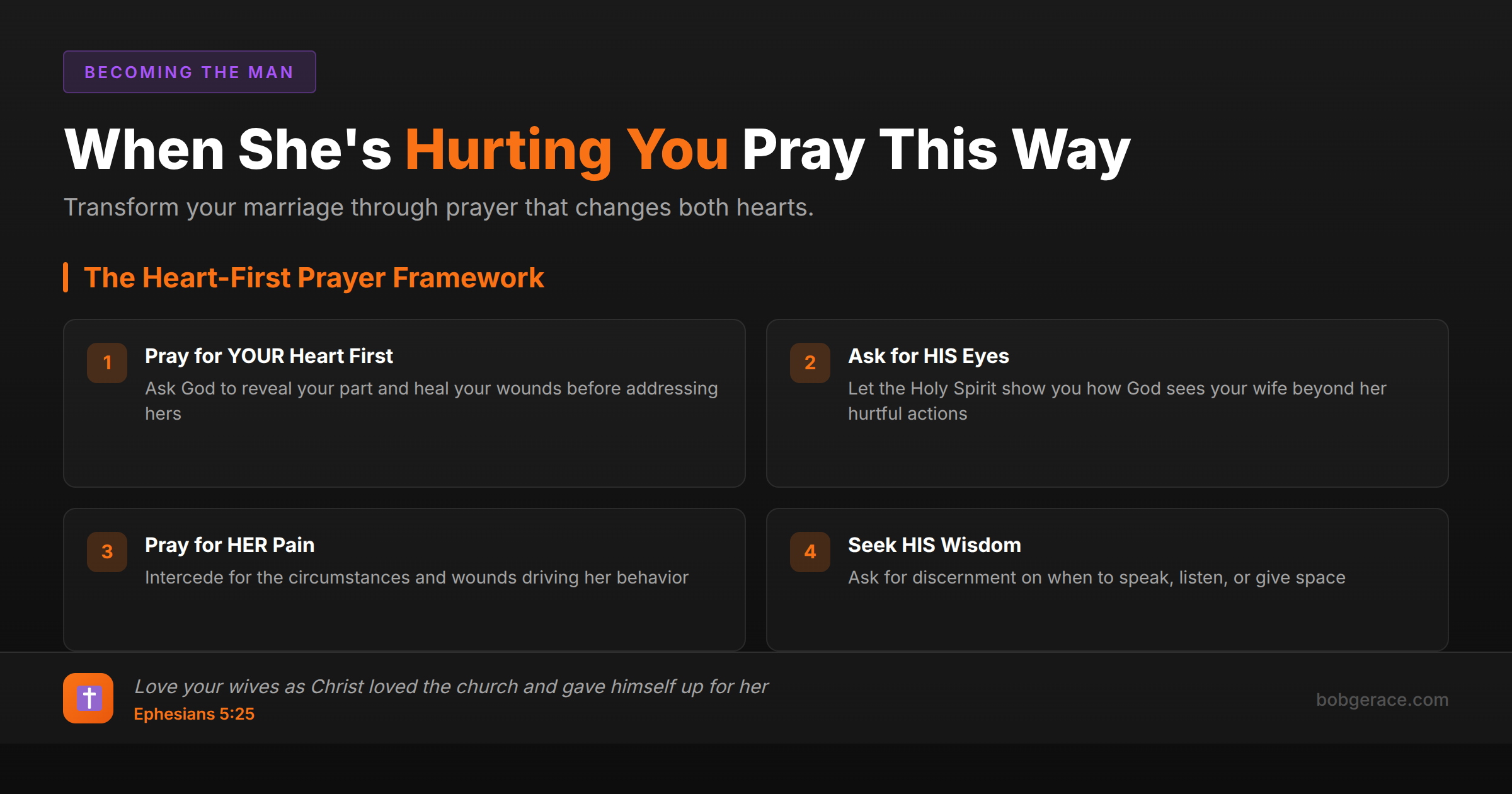
When your wife is hurting you, pray first for your own heart - asking God to reveal your part, heal your wounds, and give you His love for her. Ask the Holy Spirit to show you how to see her through God's eyes, understanding that hurt people often hurt people. Pray for her heart, her pain, and the circumstances driving her behavior, not just for your relief. This isn't about being a doormat or enabling destructive behavior. It's about positioning your heart before God so He can work in both of you. When we pray with genuine love and submission to God's will, we create space for the Holy Spirit to move in our marriage, even in the midst of conflict.
The Full Picture
Praying for your wife when she's causing you pain is one of the hardest things God asks of us as husbands. Every instinct wants to defend, retaliate, or withdraw. But God calls us to something radically different - to love as Christ loved the church.
This doesn't mean being passive. Biblical love isn't weak or enabling. It's strong enough to confront sin while covering it with grace. It's wise enough to set boundaries while maintaining an open heart. When your wife is hurting you, she's often hurting too - from something you did, something you didn't do, or pain from her past that has nothing to do with you.
Prayer changes everything about how we handle conflict. Instead of reacting from our wounds, we respond from God's heart. Instead of trying to control or manipulate outcomes, we trust the Holy Spirit to do what only He can do. Instead of seeing our wife as the enemy, we remember that our real battle is against spiritual forces that want to destroy our marriage.
The goal isn't just peace - it's transformation. God uses these painful seasons to shape us into the husbands He's called us to be. Every time we choose to pray instead of lash out, to bless instead of curse, to seek understanding instead of being understood, we become more like Jesus. And that kind of love has power to melt the hardest heart over time.
What's Really Happening
When couples are in conflict cycles, both partners often operate from their nervous system's threat response rather than their rational mind. Your wife's hurtful behavior may be her way of protecting herself from perceived danger - emotional abandonment, criticism, or feeling unheard.
Prayer serves as a powerful intervention that activates your parasympathetic nervous system, moving you out of fight-or-flight mode into a calmer state where you can respond rather than react. This neurological shift is crucial because when we're activated, we literally cannot access our capacity for empathy, creative problem-solving, or emotional regulation.
From a psychological perspective, praying for your wife when she's hurting you develops what we call 'emotional differentiation' - the ability to maintain your own emotional stability while staying connected to your spouse. This is one of the most important skills in marriage. When you can remain loving while she's dysregulated, you become a calming presence that helps her nervous system settle down.
Research consistently shows that couples who pray together and for each other report higher relationship satisfaction and lower divorce rates. Prayer creates what psychologists call 'benefit finding' - the ability to see growth opportunities in difficult circumstances. It also cultivates gratitude and empathy, two emotions that are incompatible with resentment and contempt.
What Scripture Says
Scripture gives us a clear framework for how to pray during marital conflict. Ephesians 5:25 commands us to "love your wives as Christ loved the church and gave himself up for her." This sacrificial love includes our prayer life - interceding for her even when it costs us emotionally.
Matthew 5:44 challenges us to "pray for those who persecute you." While your wife isn't your persecutor, this principle applies when we feel attacked or hurt. Jesus modeled this perfectly, praying "Father, forgive them" even from the cross.
1 Peter 3:7 tells husbands to live with their wives "in an understanding way" and treat them with honor "so that your prayers may not be hindered." This suggests that how we treat our wives directly impacts the effectiveness of our prayers. We can't harbor bitterness and expect God to answer our prayers for blessing.
James 5:16 reminds us that "the prayer of a righteous person has great power as it is working." But righteousness here isn't about perfection - it's about a heart aligned with God's purposes. Psalm 139:23-24 gives us the prayer: "Search me, O God, and know my heart... see if there be any grievous way in me."
1 John 4:20 warns that we cannot love God while hating our brother - or in this case, harboring resentment toward our wife. Our vertical relationship with God directly affects our horizontal relationship with our spouse.
What To Do Right Now
-
1
Start by praying for your own heart - ask God to reveal any sin, unforgiveness, or hardness that needs to be addressed before you pray for her
-
2
Pray specifically for her heart and circumstances, asking God to meet her deepest needs and heal any wounds driving her behavior
-
3
Ask the Holy Spirit to give you His perspective on your wife - to see her as God sees her, beyond her actions that hurt you
-
4
Pray for wisdom and discernment about how to respond - when to speak, when to listen, when to give space, when to pursue
-
5
Intercede for your marriage as a whole, asking God to use this conflict for growth, deeper intimacy, and His glory
-
6
Ask God to show you practical ways to serve and love her, even in the midst of the pain, as opportunities arise
Related Questions
- How do I pray when I'm angry at God?
- How do I love my enemy when he's sleeping with my wife?
- How do I pray for the other man?
- What does 'overcome evil with good' look like here?
- How do I handle righteous anger without sin?
- How do I pray for my marriage when it seems hopeless?
- How do I forgive when she hasn't fully repented?
- What does biblical forgiveness require of me?
- How do I not lose my mind right now?
- How do I pray through this?
Also find Bob on
Subscribe for weekly videos on Christian marriage.
Praying is the start. What comes next?
A coach who knows your marriage can help you discern what God's showing you and how to act on it when your heart's still raw.
Talk to Bob →