How do I stay connected when my body wants to fight?
6 min read
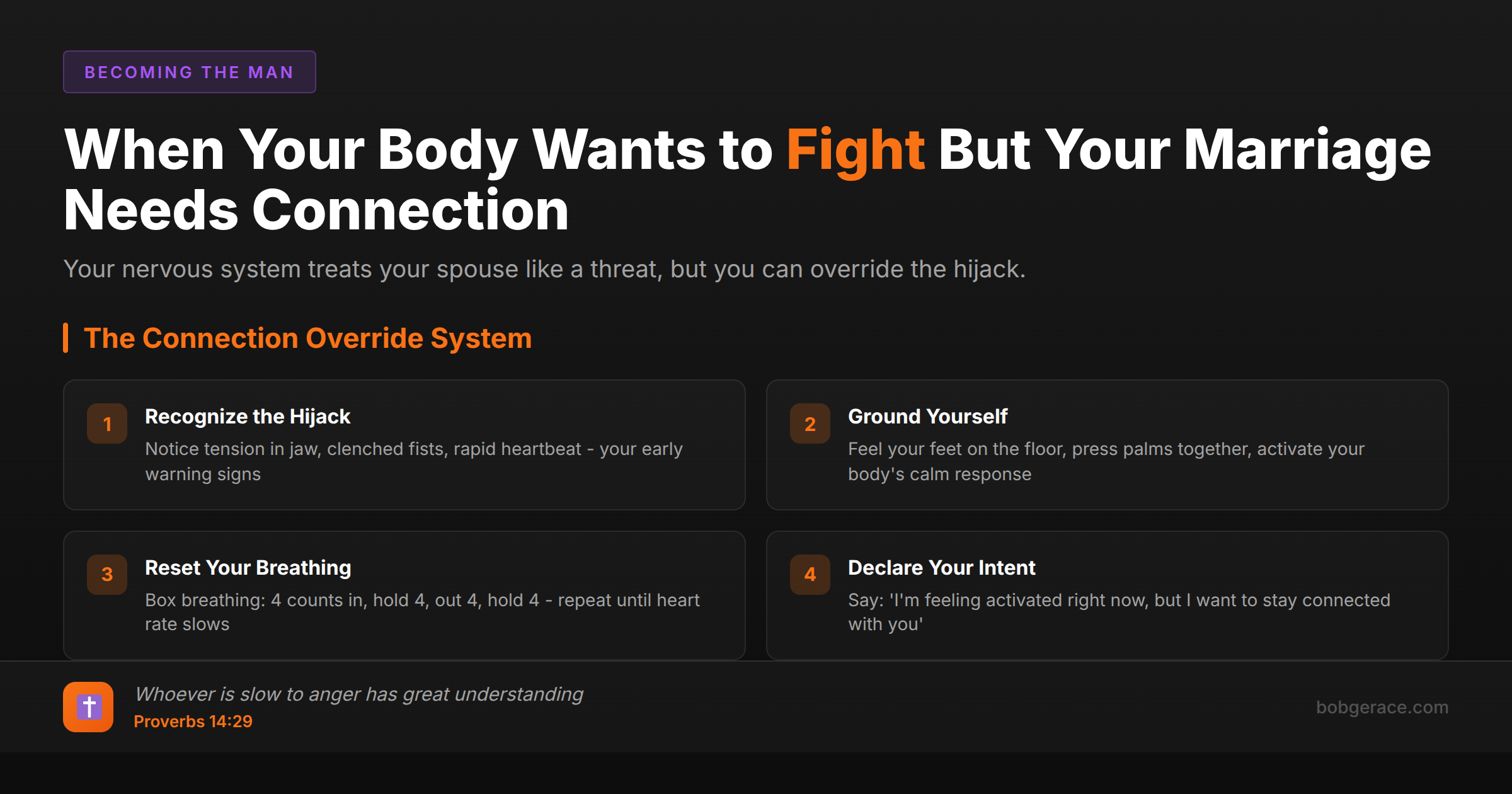
Your body's fight response is a survival mechanism that floods you with stress hormones, making connection feel impossible. The key is recognizing this physiological hijacking before it takes over completely. Start by focusing on your breathing - take slow, deep breaths to activate your parasympathetic nervous system. Ground yourself physically by feeling your feet on the floor or pressing your palms together. Remind yourself that your spouse isn't actually a threat, even though your nervous system is treating them like one. Use phrases like 'I'm feeling activated right now, but I want to stay connected with you.' This gives your prefrontal cortex time to come back online and override the primitive brain's impulses. The goal isn't to eliminate the physical response - it's to create enough space between the trigger and your reaction to choose connection over self-protection.
The Full Picture
When conflict hits your marriage, your body doesn't distinguish between a charging bear and a frustrated spouse. Your nervous system activates the same ancient survival programming that kept your ancestors alive, flooding your system with cortisol and adrenaline. Your heart rate spikes, muscles tense, and blood flow shifts away from the thinking parts of your brain to the reactive parts.
This isn't a character flaw - it's human design. But in marriage, this biological response becomes the enemy of intimacy. When your amygdala hijacks your system, you literally lose access to empathy, creativity, and rational thinking. You become a survival machine focused on one thing: eliminating the perceived threat.
The tragedy is that the person you're biologically programmed to fight is the one you most need to connect with. Your spouse becomes the enemy when they should be your teammate. You start defending, attacking, or shutting down - all of which destroy the very connection your marriage needs to thrive.
But here's what most couples don't realize: you have about 6-20 seconds between the trigger and full activation. In that window, you can intervene. You can acknowledge what's happening in your body without being controlled by it. You can choose connection over self-protection.
The goal isn't to become emotionless robots. Healthy marriages need passion and intensity. But when your nervous system is running the show, you're not having a conversation with your spouse - you're having a fight with your own past wounds, fears, and survival instincts projected onto the person you love most.
What's Really Happening
From a neuroscience perspective, what you're experiencing is limbic hijacking - your emotional brain overriding your rational brain. When your amygdala perceives threat, it sends signals that literally shut down the prefrontal cortex, the part responsible for emotional regulation, empathy, and complex thinking.
This process happens in milliseconds and triggers a cascade of physiological changes: increased heart rate, muscle tension, shallow breathing, and tunnel vision. Your nervous system is preparing for physical combat, not intimate conversation. The stress hormone cortisol impairs memory formation, which is why couples often remember the same fight completely differently.
Polyvagal theory helps us understand that we have multiple nervous system states. When triggered, you might move into sympathetic activation (fight/flight) or dorsal vagal shutdown (freeze/collapse). Neither state allows for genuine connection or collaborative problem-solving.
The good news is neuroplasticity - your brain's ability to form new patterns. Through consistent practice, you can literally rewire your nervous system's responses. Techniques like deep breathing activate the vagus nerve, shifting you from reactive to responsive states.
What's crucial to understand is that this isn't about willpower - it's about working with your biology rather than against it. Couples who learn to recognize and regulate their nervous system states together create what we call 'co-regulation' - the ability to help each other return to calm, connected states even in the midst of conflict.
What Scripture Says
Scripture doesn't ignore our human struggle with reactive emotions - it addresses it head-on. Proverbs 14:29 tells us, *'Whoever is slow to anger has great understanding, but he who has a hasty temper exalts folly.'* This isn't just moral instruction; it's practical wisdom about how our bodies and minds work together.
When Jesus said in Matthew 5:9, *'Blessed are the peacemakers, for they will be called children of God,'* He wasn't talking about avoiding conflict. He was calling us to be people who can stay present and loving even when everything in us wants to fight. Peacemaking requires the courage to override our self-protective instincts.
Ephesians 4:26-27 gives us crucial guidance: *'In your anger do not sin: Do not let the sun go down while you are still angry, and do not give the devil a foothold.'* Paul acknowledges that anger is natural - the question is what we do with it. When we let our fight response control us, we give destruction a foothold in our marriages.
The phrase 'be still and know that I am God' from Psalm 46:10 isn't just about quiet time - it's about learning to calm our activated nervous systems and remember God's presence even in conflict. James 1:19 instructs us to be *'quick to listen, slow to speak and slow to become angry'* - a perfect description of nervous system regulation.
1 Peter 3:7 calls husbands to live with their wives *'in an understanding way'* - which requires the emotional regulation to stay curious about your spouse rather than defensive about yourself. This level of understanding is impossible when your fight response is activated.
What To Do Right Now
-
1
Notice your early warning signs - tension in jaw, clenched fists, rapid heartbeat, shallow breathing, or the urge to interrupt. Create your personal 'activation inventory.'
-
2
Use the 5-4-3-2-1 grounding technique - Name 5 things you can see, 4 things you can touch, 3 things you can hear, 2 things you can smell, 1 thing you can taste.
-
3
Practice box breathing - Inhale for 4 counts, hold for 4, exhale for 4, hold for 4. Repeat until your heart rate slows and you feel your feet on the ground.
-
4
Create a connection phrase - 'I'm getting activated but I want to hear you' or 'My body wants to fight but my heart wants to connect with you.' Use it consistently.
-
5
Ask for a brief pause if needed - 'I need 2 minutes to get regulated so I can be present with you.' Always return to finish the conversation when calm.
-
6
Practice co-regulation - Place your hand on your spouse's chest or back, breathe together, make eye contact. Use your calm nervous system to help settle theirs.
Related Questions
Ready to Break the Reactive Cycle?
Learning to stay connected when your body wants to fight is a skill that transforms marriages. Get the support and tools you need to create lasting change.
Work With Me →