How long until new patterns become default?
6 min read
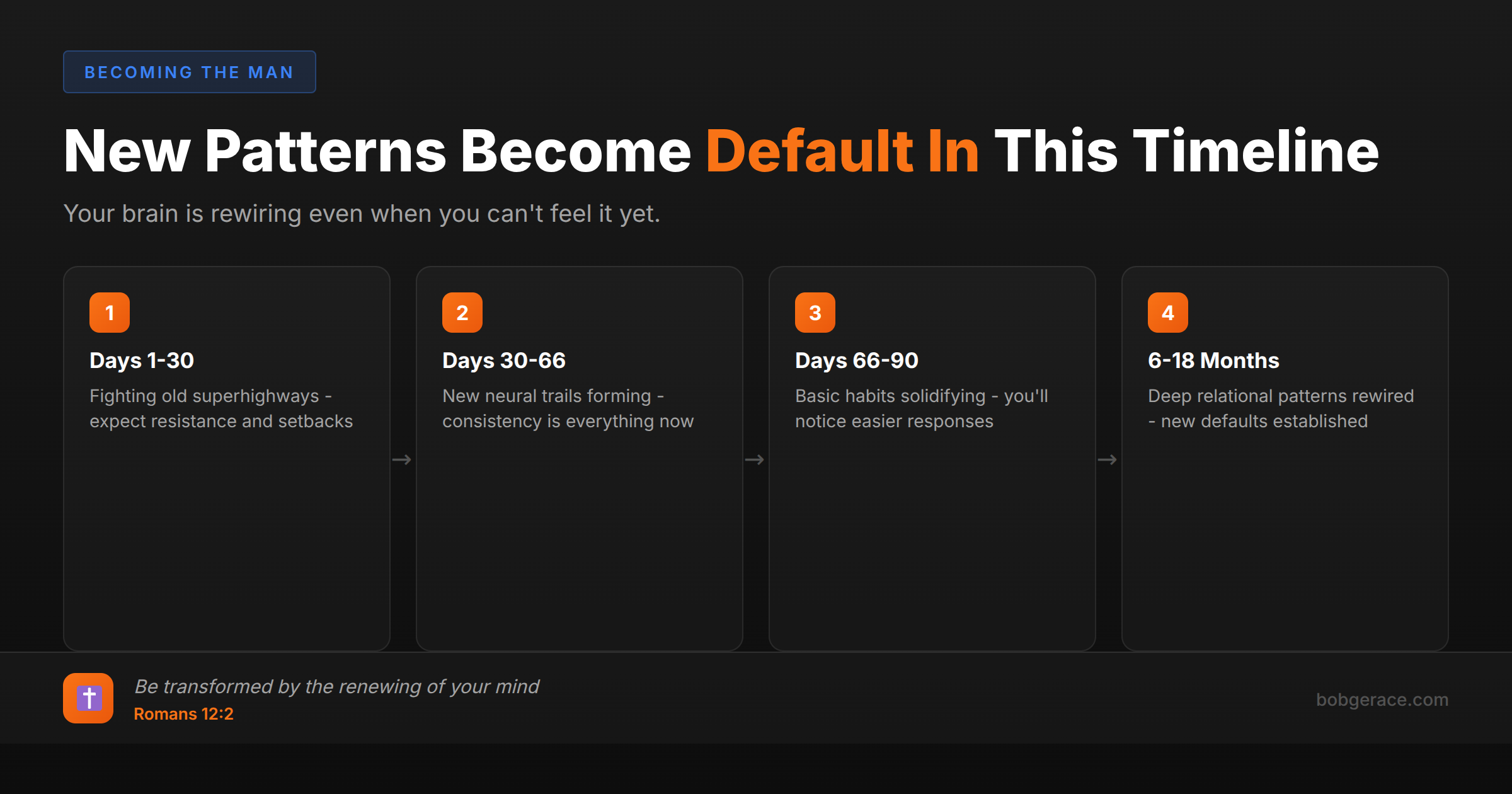
The timeline for new patterns to become default varies, but neuroscience shows us that basic habit formation takes 18-254 days, with an average of 66 days. However, deep relational patterns - especially those tied to emotional triggers and trauma responses - typically require 6-18 months of consistent practice to truly rewire. Here's the reality: your brain has been running the same relationship scripts for years, maybe decades. Those neural pathways are like superhighways in your mind. Creating new patterns is like carving fresh trails through dense forest. It takes time, repetition, and patience. But here's the encouraging part - every single time you choose the new response over the old one, you're literally rewiring your brain. The change is happening even when you can't feel it yet.
The Full Picture
Let me be straight with you - anyone promising quick fixes for deep relationship patterns is selling you something. The neuroscience is clear: real change takes time.
The 3 Phases of Pattern Change:
Phase 1: Conscious Effort (0-90 days) This is the hardest phase. Every new choice requires massive mental energy. You'll feel like you're swimming upstream. Your brain is literally fighting you because the old patterns feel "safer" even when they're destructive. Expect to fail frequently - that's normal, not evidence you can't change.
Phase 2: Building Momentum (3-9 months) The new responses start feeling more natural, but stress will still trigger old patterns. This is where most people quit because they think they're not making progress. Don't quit here. Your brain is actually rewiring faster than ever during this phase.
Phase 3: New Default (9-18 months) The new pattern becomes your go-to response, even under pressure. You'll still occasionally revert to old ways, but recovery is faster and the new pattern feels more "like you."
What affects your timeline: - Trauma history - deeper wounds take longer to heal - Consistency - daily practice accelerates change - Stress levels - high stress slows rewiring - Support system - isolation makes change harder - Self-compassion - shame actually slows neural change
The key insight: your brain changes every single day you practice, even when you can't feel it. Trust the process.
What's Really Happening
From a neuroscience perspective, we're dealing with something called neuroplasticity - your brain's ability to form new neural connections throughout life. When couples ask about timeline, I explain that we're essentially competing with years or decades of reinforced neural pathways.
The Neurochemical Reality: Your old patterns aren't just habits - they're neurochemical superhighways. Every time you've reacted with anger, withdrawal, or defensiveness, you've strengthened those neural networks. The myelin sheath around these pathways has thickened, making them faster and more automatic.
Creating new patterns requires consistent repetition to build competing neural networks. Research shows that it takes approximately 10,000 repetitions for a new neural pathway to become fully myelinated and automatic.
Why Stress Matters: Under stress, your brain defaults to the most established patterns - what we call "neural efficiency." This is why you can practice great communication for weeks, then blow up during one stressful conversation. Your stressed brain literally cannot access the newer, weaker neural pathways.
The Compound Effect: Here's what's encouraging - while it may take 6-18 months for complete rewiring, you'll see measurable improvements within 30-60 days. Each repetition of the new pattern strengthens that neural pathway while simultaneously weakening the old one through a process called "synaptic pruning."
The timeline isn't just about repetition - it's about creating new patterns under increasing levels of stress until they become truly automatic.
What Scripture Says
Scripture speaks directly to the process of transformation and renewal, giving us both realistic expectations and hope for change.
Romans 12:2 reminds us: *"Do not conform to the pattern of this world, but be transformed by the renewing of your mind."* The Greek word for "transformed" is *metamorphoo* - the same word used for a caterpillar becoming a butterfly. This isn't quick change; it's deep, structural transformation that takes time.
Philippians 1:6 provides hope for the journey: *"He who began a good work in you will carry it on to completion."* God isn't surprised by how long your transformation takes. He's committed to the process, not just the outcome.
2 Corinthians 3:18 reveals the gradual nature: *"We all, who with unveiled faces contemplate the Lord's glory, are being transformed into his image with ever-increasing glory."* Notice it says "ever-increasing" - transformation is progressive, not instant.
1 Corinthians 13:11 acknowledges the process of maturity: *"When I was a child, I talked like a child, I thought like a child, I reasoned like a child. When I became a man, I put the ways of childhood behind me."* Paul describes growth as a gradual putting off and putting on.
The biblical pattern is clear: transformation is God's work in us over time. We cooperate with His Spirit, but we don't control the timeline. Galatians 6:9 encourages us: *"Let us not become weary in doing good, for at the proper time we will reap a harvest if we do not give up."*
Ecclesiastes 3:1 reminds us that *"there is a time for everything"* - including the time needed for deep heart and mind renewal in your marriage.
What To Do Right Now
-
1
Track one specific pattern - Choose one destructive pattern and commit to 90 days of intentional practice replacing it
-
2
Create environmental cues - Set phone reminders, sticky notes, or visual triggers to prompt your new response
-
3
Practice during calm moments - Rehearse your new pattern when you're not triggered to strengthen the neural pathway
-
4
Expect and plan for setbacks - Write down your response plan for when you revert to old patterns (you will)
-
5
Celebrate small wins - Acknowledge every single time you choose the new pattern, even if it felt awkward
-
6
Get accountability - Share your specific pattern change with someone who can encourage the process and call out progress
Related Questions
- How long does it take to rewire the brain?
- What is 'neuroplasticity' and how do I leverage it?
- What is 'white-knuckling' vs. real transformation?
- Why do old patterns come back when I'm triggered?
- What conditions optimize neural rewiring?
- What role does repetition play?
- How long does recovery take?
- How long does real change actually take?
- What is the 'trust timeline' post-affair?
- What should I expect to see at 30/90/180 days?
Also find Bob on
Subscribe for weekly videos on Christian marriage.
Your Marriage Isn't a Textbook Case
Timelines are general. Your specific triggers, her specific wounds, the exact pattern you're stuck in — that's where a coach earns the money. Bob knows your story and calibrates to where you actually are.
Talk to Bob →