Should I get outside perspective?
6 min read
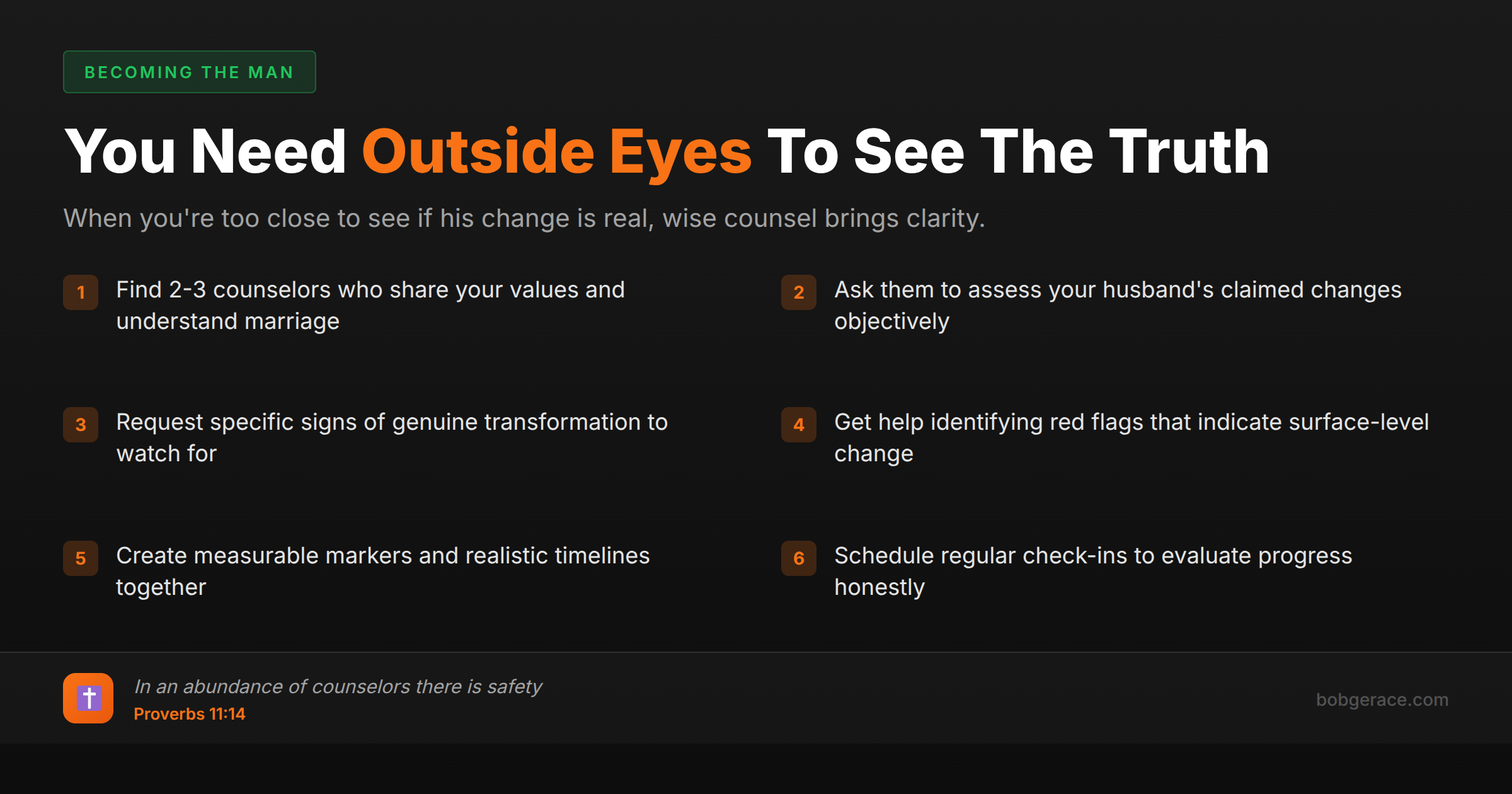
Yes, getting outside perspective is often crucial when assessing your husband's change. You're too close to the situation to see clearly, and your emotional investment can cloud your judgment. A trained counselor, wise mentor, or trusted friend can help you distinguish between genuine transformation and surface-level adjustments. However, choose your advisors carefully. Seek people who understand marriage dynamics, share your values, and can offer biblical wisdom rather than just emotional support. The right outside perspective provides objectivity, accountability, and guidance you simply cannot give yourself when you're in the middle of relationship turmoil.
The Full Picture
When you're living in the midst of marital crisis and hoping for change, your perspective becomes naturally distorted. You're simultaneously the victim, the observer, the hope-holder, and the judge. That's an impossible position that no human being can navigate with complete clarity.
You need outside eyes because:
- Emotional investment blinds you - You want to believe the change is real so desperately that you might miss red flags or accept minimal effort as major transformation - Trauma affects perception - If you've been hurt repeatedly, you might either minimize genuine progress or remain hyper-vigilant to threats that no longer exist - Manipulation is hard to spot from inside - Abusive or manipulative people are skilled at presenting change that looks real to their spouse while maintaining harmful patterns - Hope and fear create confusion - The cycle of hope and disappointment makes it nearly impossible to assess change objectively
The right outside perspective offers:
- Objective observation - They can see patterns you've become blind to - Professional expertise - Trained counselors understand the difference between genuine repentance and behavior modification - Accountability for both spouses - Good advisors hold everyone responsible for their part - Safety assessment - They can evaluate whether you're truly safe or just experiencing a calm period - Timeline perspective - They help you understand that real change takes time and has measurable markers
Don't let pride, embarrassment, or false independence keep you from seeking the wisdom you need. Your marriage is too important to navigate major change without qualified help.
What's Really Happening
From a clinical standpoint, the need for outside perspective during marital crisis isn't just helpful—it's essential for several psychological reasons. First, you're likely experiencing what we call 'cognitive bias,' where your emotional state and investment in the outcome affects your ability to process information objectively.
When assessing a spouse's change, you're dealing with 'confirmation bias'—unconsciously looking for evidence that supports what you hope is true while dismissing contradictory signals. This is compounded if you've experienced relational trauma, which can create hypervigilance (seeing threats everywhere) or learned helplessness (accepting minimal effort as sufficient).
Professional assessment provides what we call 'clinical objectivity'—the ability to measure change against established markers of genuine transformation rather than emotional wishful thinking. We look for consistency over time, internal motivation rather than external pressure, and behavioral change that extends beyond just the marriage relationship.
The most dangerous scenario is when someone experiencing abuse seeks perspective only from their abuser or people the abuser has influenced. This creates an 'echo chamber' that reinforces distorted thinking. Qualified outside perspective breaks this cycle and provides reality testing that's crucial for both safety and healing.
Remember: seeking help isn't a sign of weakness or failure. It's a sign of wisdom and strength, demonstrating your commitment to making decisions based on truth rather than just emotion.
What Scripture Says
Scripture consistently emphasizes the value and necessity of wise counsel, especially during difficult seasons of life. God designed us for community and accountability, not isolated decision-making.
"Where there is no guidance, a people falls, but in an abundance of counselors there is safety." (Proverbs 11:14) - This verse directly addresses your situation. God promises safety when we seek multiple sources of wise counsel rather than trying to figure things out alone.
"The way of a fool is right in his own eyes, but a wise man listens to advice." (Proverbs 12:15) - Pride tells us we should be able to handle everything ourselves, but wisdom recognizes our need for outside perspective, especially in emotionally charged situations.
"Without counsel plans fail, but with many advisers they succeed." (Proverbs 15:22) - Your marriage recovery plan needs the input of wise counselors to succeed. Going it alone significantly increases the risk of failure.
"Iron sharpens iron, and one man sharpens another." (Proverbs 27:17) - The sharpening process requires contact with something outside ourselves. Other people provide the 'iron' that sharpens our thinking and discernment.
"Let the wise hear and increase in learning, and the one who understands obtain guidance." (Proverbs 1:5) - Even wise people need ongoing guidance. Seeking counsel isn't admission of failure—it's the mark of wisdom.
"But when he, the Spirit of truth, comes, he will guide you into all the truth." (John 16:13) - God often provides His guidance through the wise counsel of mature believers who can speak truth in love.
God uses community, counselors, and mature believers as instruments of His wisdom and protection in your life.
What To Do Right Now
-
1
Identify 2-3 potential counselors or mentors who share your values and have experience with marital restoration
-
2
Schedule an initial consultation to explain your situation and get their assessment of your husband's claimed changes
-
3
Ask specific questions: 'What signs of genuine change should I look for?' and 'What red flags indicate surface-level change?'
-
4
Request help creating measurable markers and timelines for authentic transformation in your specific situation
-
5
Establish regular check-ins with your advisor to review progress and adjust expectations based on evidence
-
6
Give your counselor permission to challenge your perceptions and hold both you and your husband accountable
Related Questions
Need Help Assessing the Changes in Your Marriage?
Don't navigate this critical season alone. Get the objective perspective and biblical wisdom you need to make informed decisions about your marriage's future.
Get Guidance →