What does integrated masculine look like?
6 min read
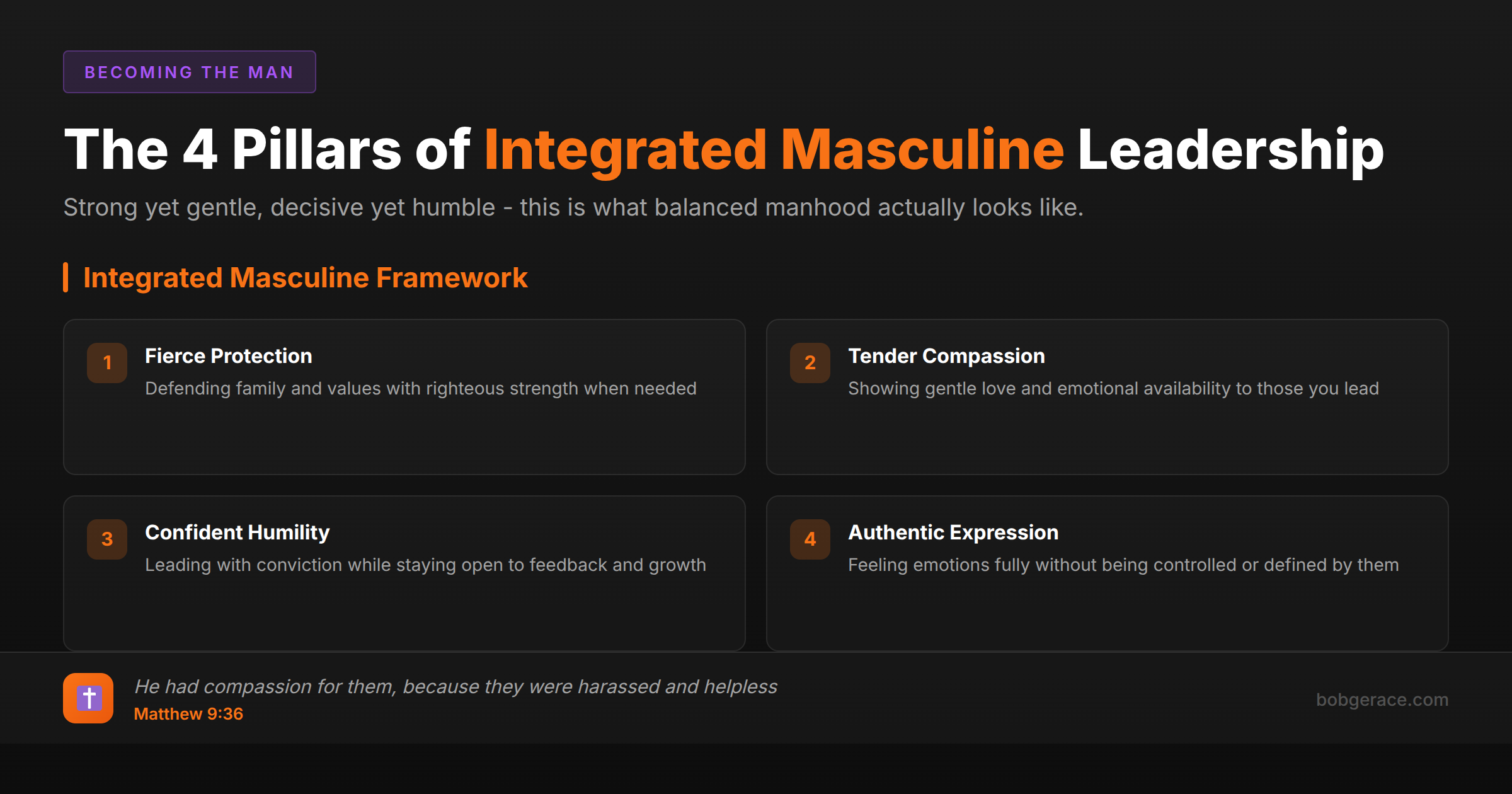
An integrated masculine man embodies the full spectrum of healthy masculine traits without extremes. He's strong yet gentle, decisive yet humble, protective yet nurturing. This isn't about becoming 'soft' or abandoning masculine strength - it's about wielding that strength with wisdom and emotional intelligence. Integrated masculinity means you can be fierce in defending your family while being tender with your children. You can lead with confidence while remaining open to feedback. You express emotions authentically without being controlled by them. You're comfortable with both your power and your vulnerability, understanding that true strength includes the courage to be genuine and connected.
The Full Picture
Integrated masculinity is masculinity made whole. It's what happens when a man stops fighting parts of himself and starts embracing the full range of healthy masculine expression.
Most men get stuck in one-dimensional masculinity - either the stoic, emotionally-distant provider or the overly accommodating 'nice guy.' Both are incomplete. Integrated masculinity brings together:
Strength AND Tenderness - You can be physically and emotionally strong while also being gentle and nurturing. These aren't opposites; they're complementary aspects of mature masculinity.
Leadership AND Humility - You lead your family and relationships with confidence while remaining teachable and open to growth. You don't need to dominate to lead effectively.
Emotional Intelligence AND Rationality - You feel your emotions fully without being controlled by them. You use both logic and intuition in decision-making.
Independence AND Connection - You're self-reliant and capable while also being deeply connected to others. You don't isolate to feel strong.
The integrated man has done his inner work. He's faced his wounds, acknowledged his shadows, and chosen growth over comfort. He's not perfect, but he's whole. He doesn't need external validation because he knows who he is.
This integration doesn't happen overnight. It's the result of intentional development, often involving therapy, mentorship, spiritual growth, and honest self-reflection. But the payoff is enormous - not just for you, but for everyone in your life.
What's Really Happening
From a psychological perspective, integrated masculinity represents the successful resolution of what we call 'masculine polarities' - the apparent contradictions that healthy men must learn to navigate.
Most men develop what I call 'defensive masculinity' in response to early wounds or societal pressures. They either become hyper-masculine (suppressing vulnerability) or under-masculine (avoiding healthy aggression and leadership). Both strategies are protective but ultimately limiting.
Integrated masculinity emerges when a man can hold paradox without anxiety. He can be both strong and soft, both leader and follower, both independent and interdependent. This requires what psychologists call 'emotional regulation' - the ability to experience the full range of emotions without being overwhelmed or reactive.
Neurologically, this integration involves better communication between the brain's emotional centers (limbic system) and executive function areas (prefrontal cortex). Men who've done this work show greater resilience, better relationship satisfaction, and improved overall mental health.
The key developmental milestone is moving from 'proving masculinity' to 'expressing masculinity.' When a man no longer needs to demonstrate his worth through performance or dominance, he's free to be authentically masculine in whatever way serves the moment. This is psychological maturity in action.
What Scripture Says
Scripture gives us the ultimate model of integrated masculinity in Jesus Christ. He embodied perfect strength and perfect love, never sacrificing one for the other.
Jesus showed fierce protection: *'And making a whip of cords, he drove them all out of the temple'* (John 2:15). He could be aggressive when righteousness demanded it.
Jesus showed tender compassion: *'But when he saw the crowds, he had compassion for them, because they were harassed and helpless, like sheep without a shepherd'* (Matthew 9:36). Strength served love, not ego.
Jesus demonstrated humble leadership: *'But whoever would be great among you must be your servant, and whoever would be first among you must be slave of all'* (Mark 10:43-44). True authority comes through service.
Jesus expressed emotions authentically: *'Jesus wept'* (John 11:35). The strongest man who ever lived wasn't afraid of his tears.
God calls men to this integrated approach: *'Finally, brothers, be strong in the Lord and in the strength of his might'* (Ephesians 6:10). Our strength comes from Him, not from our performance or image.
The integrated masculine man reflects God's character - both 'merciful and gracious, slow to anger, and abounding in steadfast love and faithfulness'* (Exodus 34:6) and the one who 'is a consuming fire'* (Hebrews 12:29). Love and strength united in perfect harmony.
What To Do Right Now
-
1
Identify your masculine extremes - where do you default to either over-masculinity or under-masculinity?
-
2
Practice emotional awareness daily - name and feel your emotions without immediately acting on them
-
3
Find a mentor or coach who models integrated masculinity and can challenge your growth
-
4
Start expressing both strength and tenderness in the same day - be firm with boundaries AND affectionate with family
-
5
Join a men's group focused on authentic growth, not just accountability or activities
-
6
Read books on mature masculinity and begin therapy if you have unhealed wounds affecting your development
Related Questions
- What is 'healthy masculinity'?
- What does mature masculine look like?
- What is 'boy psychology' vs. 'man psychology'?
- What are the archetypes of mature masculine (King, Warrior, Magician, Lover)?
- What is 'toxic masculinity' and what isn't?
- What is the path from boy to man?
- What does masculine leadership look like?
- How do I become emotionally intelligent?
- How do I be strong and gentle?
Also find Bob on
Subscribe for weekly videos on Christian marriage.
You Don't Have to Figure This Out Alone
Integrating these traits in your actual marriage—under pressure, with your wife's specific history—requires a coach who knows your story. Bob works with men one-on-one to calibrate strength and openness to where you actually are.
Talk to Bob →