What does surrendered prayer look like?
6 min read
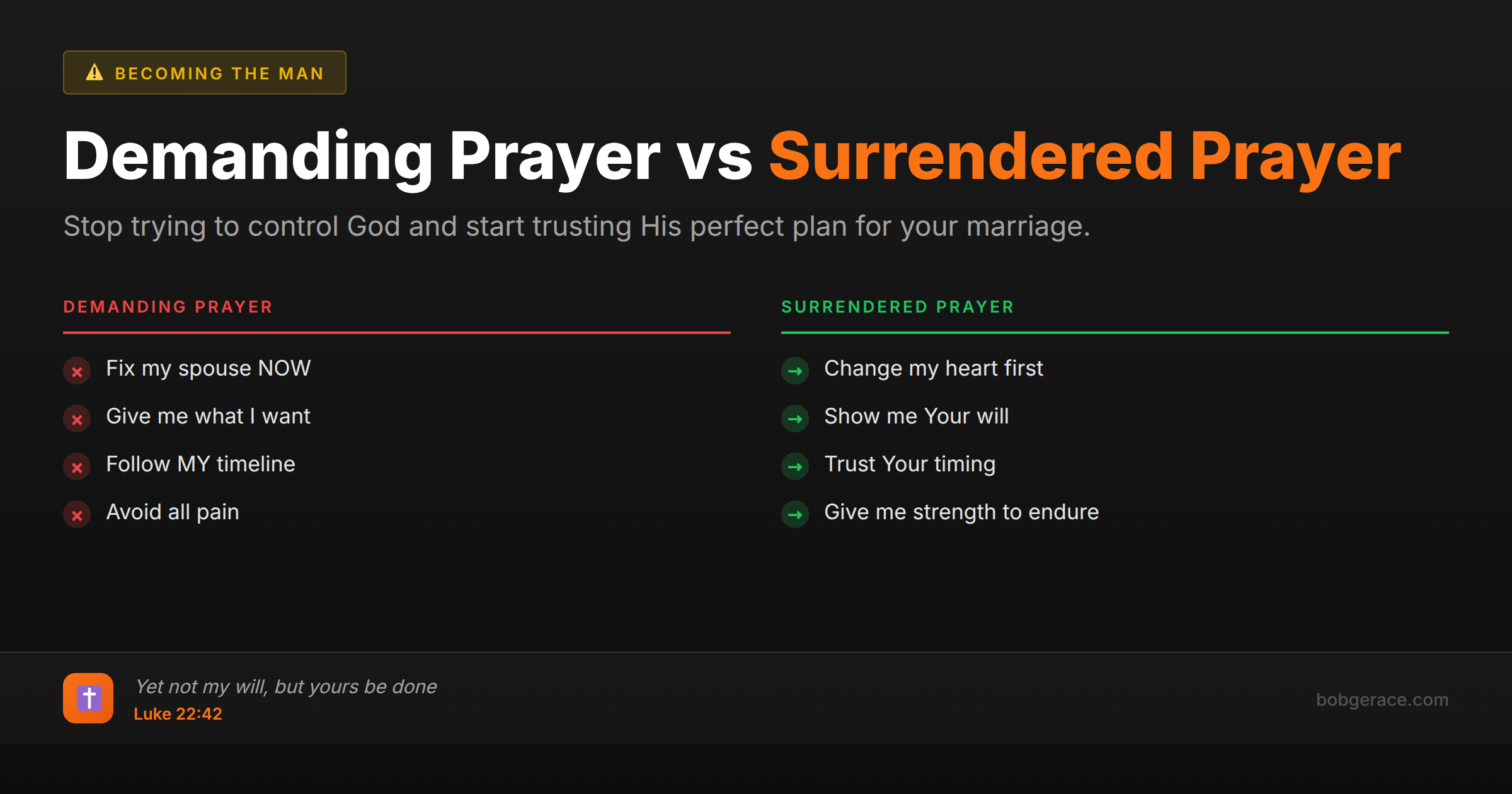
Surrendered prayer is releasing control of outcomes and trusting God completely with your marriage. It means praying with open hands instead of clenched fists, acknowledging that God's will and timing are perfect even when they don't match your expectations. This type of prayer shifts from demanding specific results to seeking God's heart and wisdom. Instead of telling God what to do, surrendered prayer asks for His perspective, strength to endure, and grace to love well regardless of circumstances. It's honest about pain and disappointment while maintaining faith that God is working for good.
The Full Picture
Surrendered prayer transforms how we approach God and our marriage challenges. Most of us start praying with a specific agenda - fix my spouse, change this situation, make the pain stop. That's natural, but it's not surrendered prayer.
True surrender means coming to God with empty hands. We acknowledge our limitations, confess our inability to control outcomes, and trust that His perspective is infinitely better than ours. This doesn't mean becoming passive or giving up - it means aligning our hearts with God's will instead of demanding He align with ours.
In marriage, surrendered prayer looks like praying for your spouse's good rather than just their change. It's asking God to work in your own heart first. It's releasing timelines and expectations while remaining faithful to love and serve. When your spouse hurts you, surrendered prayer processes that pain with God while choosing forgiveness and trust in His justice.
This type of prayer requires deep faith because it doesn't guarantee the outcomes we want. God may heal your marriage in ways you never expected, or He may use your difficult season to transform you both into people you never could have become otherwise. Surrendered prayer trusts that either outcome serves His good purposes.
The paradox is that releasing control often leads to breakthrough. When we stop trying to manipulate outcomes through prayer and instead seek intimacy with God, we position ourselves to receive His wisdom, strength, and peace that surpass understanding.
What's Really Happening
From a therapeutic perspective, surrendered prayer addresses one of the most destructive patterns in struggling marriages: the illusion of control. When couples are in crisis, they often become hypervigilant, trying to manage every interaction and outcome. This creates enormous anxiety and resentment.
Surrendered prayer interrupts this pattern by acknowledging what research consistently shows - we can only control our own choices and responses. When individuals release the burden of trying to control their spouse's behavior, thoughts, or timeline for change, they experience significant reduction in anxiety and depression.
Neurologically, surrendered prayer activates the parasympathetic nervous system, moving us from fight-or-flight into a state where actual healing and connection become possible. When we're constantly trying to control outcomes, our brains remain in threat-detection mode, making us reactive rather than responsive.
I've observed that couples who practice surrendered prayer develop what we call 'differentiation' - the ability to remain emotionally connected while maintaining individual identity and boundaries. They stop taking their spouse's struggles personally and can love without enabling or controlling.
This doesn't mean becoming a doormat. Healthy surrender includes setting appropriate boundaries and making wise decisions based on reality rather than wishful thinking. It's the difference between controlling and stewarding - we can't control outcomes, but we can faithfully steward our own hearts, words, and actions.
What Scripture Says
Jesus modeled surrendered prayer perfectly in Gethsemane: *"Father, if you are willing, take this cup from me; yet not my will, but yours be done"* (Luke 22:42). Even the Son of God expressed His desires honestly while submitting to the Father's plan.
The Lord's Prayer teaches us to prioritize God's will: *"Your kingdom come, your will be done, on earth as it is in heaven"* (Matthew 6:10). We pray for His purposes to be accomplished, not ours.
Romans 8:28 provides the foundation for surrendered prayer: *"And we know that in all things God works for the good of those who love him, who have been called according to his purpose."* This doesn't promise easy outcomes, but trustworthy purposes.
Paul demonstrated surrender in his own unanswered prayer: *"Three times I pleaded with the Lord to take it away from me. But he said to me, 'My grace is sufficient for you, for my power is made perfect in weakness'"* (2 Corinthians 12:8-9). Sometimes God's answer is grace to endure rather than circumstances to change.
Proverbs 16:9 reminds us of our proper role: *"In their hearts humans plan their course, but the Lord establishes their steps."* We can make plans and express desires, but ultimate outcomes belong to God.
First Peter 5:7 connects surrender with peace: *"Cast all your anxiety on him because he cares for you."* Surrendered prayer is an act of trust in God's character and love.
What To Do Right Now
-
1
Start your prayer time by acknowledging God's sovereignty and your limitations - literally say 'I don't know what's best, but You do'
-
2
Express your honest desires and concerns without demanding specific outcomes or timelines from God
-
3
Ask God to change your heart first before focusing on what needs to change in your spouse or situation
-
4
Practice praying for your spouse's relationship with God rather than just their behavior toward you
-
5
End each prayer session by verbally releasing control - 'Your will be done, not mine'
-
6
When anxiety about outcomes arises, return to prayer and re-surrender rather than trying to control or fix
Related Questions
- How do I pray when I'm angry at God?
- How do I pray without demanding outcomes?
- How do I pray for my wife when she's hurting me?
- How do I pray for my marriage when it seems hopeless?
- What does 'prayer of faith' mean for my situation?
- How do I surrender without giving up?
- Does God want me to stay in this marriage?
- How do I pray through this?
- How do I hear God when I'm in crisis?
Also find Bob on
Subscribe for weekly videos on Christian marriage.
Can't Surrender Alone
Releasing control of your marriage while it's still broken is brutal. A coach who knows your story can help you pray with open hands when every instinct says clench.
Talk to Bob →